This peculiar, locally made black-and-white feature by Jim Sikora premiered at the Chicago Underground Film Festival in 1996, and surprisingly this is its first extended booking in town, despite the fact that it’s enjoyed well-received runs in both New York and Los Angeles and played at European festivals. Apart from John Terendy’s effective cinematography, the film is notable for its impressive leads: Jeff Strong is creepily enigmatic as a misfit whose gratuitous phone prank, referred to in the title, leads to a murder and the subsequent incarceration of a young woman (a superbly composed Lara Phillips) who was the patient of his sister (Paula Killen) at a health clinic. The style is mainly classic low-rent noir, but Sikora adds a few interesting touches, such as Strong evaporating from certain shots rather than making conventional exits, a few striking freeze-frames toward the end, and some odd uses of music by the Denison-Kimball Trio. Joe Carducci collaborated with Sikora on the script; with David Yow and Richard Kern. 83 min. (JR) Read more
This essay film about contemporary Japan is the most visually pleasing work to date by writer Trinh T. Minh-ha, whose films often approach foreign cultures through a series of contrasting and layered perspectives. Trinh shot it herself in digital video, an exploration that may account for its distinct look, though her aphoristic narration fails to provide the degree of unity found in most of her films. (Its method recalls her 1991 documentary about China, Shoot for the Contents, more than her earlier African documentaries, Reassemblage and Naked SpacesLiving Is Round.) When she isn’t shooting landscapes from bullet trains and reflecting on what this mode of transport suggests about the country, a good deal of what she shows falls under the category of public spectacle. But like most of her work, this is provocative, intelligent, poetic, and certainly worth a look. 87 min. (JR) Read more
Iranian filmmaker Jafar Panahi (The White Balloon, The Mirror) takes a giant step forward with his third feature (2000), shifting his focus from little girls to grown women and presenting such a scorching look at what they put up with in their daily lives that it’s no surprise the film was banned in his native country. This masterpiece is radical in form as well: it begins one morning in a hospital and ends that evening in a jail cell, the camera revolving 360 degrees in each space, and its narrative passes from one character to the next as in Luis Bu Read more
Yvonne Rainer’s 1980 experimental feature links the experience of a woman undergoing psychoanalysis (played by film theorist Annette Michelson) with German political terrorism, forging an equation of personal and social oppression. This is one of Rainer’s densest and most ambitious films, though for political lucidity, I tend to prefer her features that come afterwardsuch as Privilege, made ten years later (see separate listing). 125 min. (JR) Read more
A gripping, stylish, unpredictable, and provocative thriller from Spain (1995) by Mariano Barroso. Javier Bardem stars as an ambitious petty criminal who insinuates himself into the theater world of Madrid by convincing a celebrated film director that he’s his illegitimate and long-abandoned son, meanwhile planning with his two roommates to rob him blind; with Frederico Lupi and Silvia Munt. 93 min. (JR) Read more
Winner of Cannes’ grand prix in 1991, Jacques Rivette’s absorbing if leering four-hour free adaptation of Balzac’s The Unknown Masterpiece concerns the work of a painter (Michel Piccoli) with his beautiful and mainly nude model (Emmanuelle Beart), plus the input and pressures of the painter’s wife and former model (Jane Birkin), the model’s boyfriend, and an art dealer who used to be involved with the painter’s wife. The complex forces that produce art are the film’s obsessive focus, and rarely has Rivette’s use of duration to look at process been so spellbinding; hardly a moment is wasted. Rivette’s superb sense of rhythm and mise en scene never falters, and the plot has plenty of twists. With exquisite cinematography by William Lubtchansky, beautiful location work in the south of France (mainly at an 18th-century chateau), and drawings and paintings executed by Bernard Dufour. The title translates roughly as the beautiful nutty woman; it’s also the title of the masterpiece the painter is bent on finishing. In French with subtitles. (JR) Read more
Though a caper comedy that runs for only 95 minutes is welcome, this movie manages to go from funny to formulaic in considerably less time than that. Martin Lawrence plays a professional Boston burglar, and Danny DeVito is the sleazy billionaire he burgles. When Lawrence is caught, DeVito takes his revenge by stealing a ring from Lawrence that his new girlfriend (Carmen Ejogo) gave him; the remainder of the movie is a protracted grudge match between the two, told with absolutely no sense of urgency. Screenwriter Matthew Chapman, adapting a Donald E. Westlake novel, does a pretty good job of stuffing comic grotesques into the crevices of the plot, but director Sam Weisman doesn’t handle them with much grace. With John Leguizamo, Glenne Headly, Nora Dunn, and William Fichtner. (JR) Read more
This is David Mamet’s own adaptation of his first play, an autobiographical and somewhat hokey account of the Summer He Became a Man, by working aboard a steel freighter on the Great Lakes while in graduate school. It’s also the first feature directed by one of Mamet’s best actors, Joe Mantegna, and the whole production can be described as a sort of family affair, with Mamet’s kid brother Tony playing the young hero and still another Mamet, Bob, in charge of the music. But the most striking thing here is a performance by Robert Forster, as one of the older men on the boat, that’s so terrific everything else in the picture pales beside it. (It’s a part one can imagine Mantegna playing, so maybe that’s why he’s so adept at directing Forster in it.) Otherwise, I’d call this fairly routine coming-of-age stuff, borderline juvenilia hampered by awkward flashbacks in black and white but enlivened from time to time by a good cast that includes Peter Falk, Charles Durning, an uncredited Andy Garcia (as the night cook whom the young hero replaces at the last moment), J.J. Johnston, Denis Leary, Jack Wallace, and George Wendt. 98 min. (JR) Read more
From the Chicago Reader (May 23, 2001). — J.R.
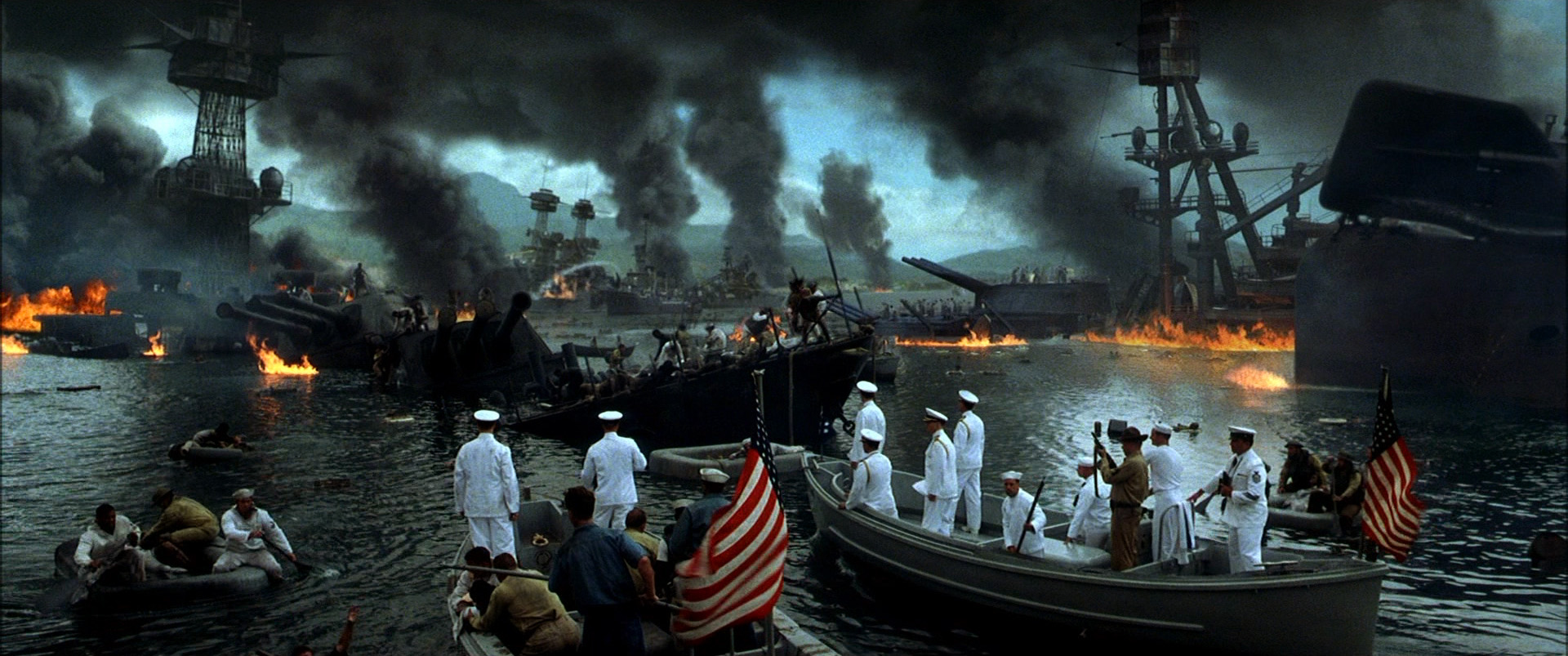
Three hours and three minutes of guff and goo about the nobility of killing and/or being killed for arbitrary reasons, whether you’re an American soldier or a Japanese. This is the Star Wars view of the U.S.’s entry into World War II (enemies are invisible and bloodless), which means that even though much of the story takes place in Hawaii, Hawaiians are deemed inconsequential, and the only ordinary Japanese we ever see apart from a few old soldiers are passing details in two shots: kids in the distance flying a kite and a couple of nice ladies in kimonos, both viewed before — not during or after — an air attack. If you decide to hit the concessions stand (where you’re bound to have lots of company), I’d suggest going out for popcorn during either the first hour or the third, because the second features some pretty good big-screen effects involving planes, ships, and explosions. (This is from the same team that brought you The Rock and Armageddon.) The lead characters are fairly interchangeable jocks and nurses — a bit like the characters in Starship Troopers but without the irony, aside from Jon Voight under tons of makeup striking presidential poses as FDR. Read more
It’s a pity that director Luis Mandoki occasionally tilts his camera to express a kind of overblown rhetoric, and that the movie misses golden opportunitiesthe traumatized hero once worked as a jazz trumpeterto work in the lovely Matt Dennis ballad it’s named after. But this touching love story essentially belongs to its stars, Jennifer Lopez as a Chicago cop and Jim Caviezel (The Thin Red Line) as the former trumpeter, and the rough spots are easy enough to get past while spending time with them. Lopez and Caviezel play armored characters who’ve essentially lost their families (in very different ways), and the sincerity of their performances overrides the intermittent implausibilities of Gerald Di Pego’s script. The backup castin particular Terrence Howard and Shirley Knightis equally fine; with Sonia Braga, Jeremy Sisto, and Victor Argo. 107 min. (JR) Read more
If you couldn’t care less about Vladimir Nabokov, whose early Russian novel this feature purports to be based on, and if you like John Turturro and Emily Watson regardless of whether you can identify the nationality of the characters they’re playing, then it’s theoretically possible that this tasteful Euro-pudding period love story (2001) about a dysfunctional chess master and a debutante might be for you. Or you might be bored anyway. This was directed by Marleen Gorris, who has recently been making inroads in the Merchant-Ivory literary adaptation business (as in Mrs. Dalloway), and written by Peter Berry; with Geraldine James, Stuart Wilson, and Christopher Thompson. PG-13, 108 min. (JR) Read more
There’s 53 more minutes than in the original Apocalypse Now, though the flaws are also magnified. Francis Ford Coppola’s guilty-liberal rethink of John Milius’s right-wing update and transplanting of Joseph Conrad’s Heart of Darkness to the war in Vietnam is above all an environmental experience, enhanced by what may still be Walter Murch’s best sound editing and Michael Herr’s best writing after Dispatches. Looking for a responsible or even coherent account of that war here would be barking up the wrong treeand the best way of glossing over this embarrassing lack would probably be to pretend, as many Western viewers do anyway, that this movie has no Vietnamese spectators. Like so many of our overseas escapades, this is really about American braggadocio and insanity in an exotic locale, spiced with a time-capsule sense of 60s counterculture, swell atmospheric expressionist effects, and many interesting performances (by Martin Sheen, Robert Duvall, a teenage Laurence Fishburne, Sam Bottoms, Frederic Forrest, Albert Hall, and Dennis Hopper; a bald Marlon Brando is mainly used as a parade float). 203 min. (JR) Read more
Terry Zwigoff (Crumb) brilliantly negotiates the shift to fiction filmmaking in a very personal adaptation of the Daniel Clowes comic book, which either captures with uncanny precision what it’s like to be a teenage girl in this country or fooled me utterly into thinking it does. Thora Birch (American Beauty) plays Enid, a comic book artist who plans to share an apartment with her best friend Rebecca (Scarlett Johansson) and befriends Seymour (Steve Buscemi), a lonely, much older collector of rare blues and jazz 78s, shortly after she almost graduates from high school. To get a diploma, she has to take an art course over the summer, and our glimpses of this add up to the funniest portrait of American art appreciation I’ve ever seen. Never predictable, this movie is often hilarious as well as touching, subtly adapting the mise en scene of Clowes’s original without being fancy or obtrusive about it. With Brad Renfro and Bob Balaban. 111 min. (JR) Read more
A pungent noir from 1948, with Robert Ryan as an aging boxer preparing to take a fall and noir axiom Audrey Totter as his girlfriend, who’s getting fed up with the grim life he leads. Screenwriter Art Cohn improbably adapted a book-length narrative poem by Joseph Moncure March (whose verse also inspired James Ivory’s 1974 feature The Wild Party), and Robert Wise directed during his best period, as an efficient studio craftsman. I probably wouldn’t tag this the greatest of all boxing pictures, but it’s certainly a contenderand I’d pick it in a flash over Raging Bull. 72 min. (JR) Read more
A very late silent picture, shot in 1935 and released the following year, V. Zhuravlev’s rarely screened Soviet SF feature about a flight to the moon is more accurate than Fritz Lang’s 1928 Woman in the Moon (in which one character runs around the lunar surface without a space helmet, carrying a dowser’s wand in search of gold). But its charm today lies mostly in its more archaic aspectsthe vaguely futurist cityscape at the beginning, the golly-gee boy inventor who joins the flight, the clunky handling of gravity (the loss of which enables the characters to leap about like grasshoppers). Neither film compares favorably to the English feature Things to Come (1936), but this remains an intriguing period piece. 60 min. (JR) Read more