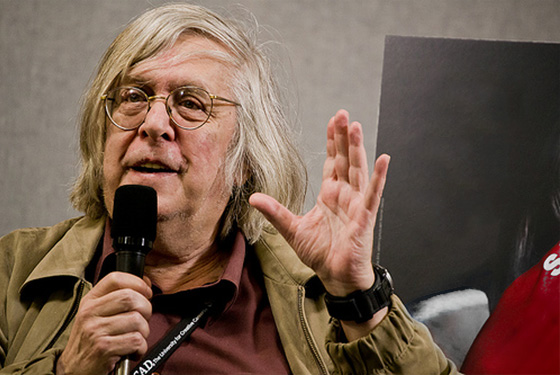
Kenneth Anger’s visionary magnum opus of the avant-garde, a work spanning 1947 almost to the present. Essential viewing. Approximately 150 minutes, at least at last count (the work is constantly being revised). (JR) Read more
Golub
Jerry Blumenthal and Gordon Quinn of Chicago’s Kartemquin Films focus for just under an hour on New York painter Leon Golub as he plans, executes, exhibits, and discusses one of his powerful canvases (1988). In the process Blumenthal and Quinn manage to make what is probably not only Kartemquin’s best film but also the best film account of the creation of a work of artan accomplishment that’s leagues ahead of such efforts as Clouzot’s The Mystery of Picasso and Paul Cox’s Vincent. Lucidly following the step-by-step process of Golub’s deliberations and creative work, the film also makes splendid use of TV news footage to pinpoint the social and political contexts of Golub’s artthe degree to which the violence and power relationships that he depicts with such clarity exist all around us. One of the inspirations of this highly concentrated and kinetic documentary was to eliminate the critical discourse of the art world entirely; what we get instead are the comments and reactions of ordinary spectators, many of which are penetrating and perceptive. Bristling with energy, movement, thought, and passion, and enhanced by an especially effective music score, this is essential viewing. 56 min. (JR) Read more
Farewell To The King
John Milius’s sincere but lachrymose adaptation of Pierre Schoendoerffer’s novel L’adieu au roi, set in Borneo during World War II, follows the adventures of one Sergeant Learoyd (Nick Nolte), a U.S. Army deserter and former communist who becomes king of the Dayaks, the headhunters of central Borneo, and his friendship with a British officer (Nigel Havers), who narrates the story and persuades the king to join forces with his troops against the Japanese. Like all of Milius’s best work, this is lush and romantic stuff, but the sentimentality about Learoyd’s freedom and nobility continually threatens to turn this Kipling-like tale into camp, and as in Milius’s infamous Red Dawn, grown men weep copiously throughout. For better and for worse, this is a 50s epic for ten-year-old boys, even down to the John Ford references (Learoyd teaches his tribesmen, whom he calls Comanches, how to sing The Rising of the Moon); the storytelling is clean, and even the watery flashback transitions reek of the writer-director’s movie boyhood. With Frank McRae, Gerry Lopez, Marilyn Tokuda, James Fox, and a cameo by John Bennett Perry as Douglas MacArthur (who also gets the hero-worship treatment). (JR) Read more
Exposed
James Toback’s third feature is marginally less silly and overblown than its two predecessors, Fingers and Love and Money, although Harvey Keitel as a Paris terrorist does manage to stretch this premise at times. Nastassia Kinski does remarkably well, however, with her American accent as a midwestern heroine who quits school, comes to New York, makes the big time as a fashion model, and then becomes involved with Rudolf Nureyev’s plot to kill Keitel. As usual with Toback, the proceedings are passionate, overripe, rhetorical, and undeniably kinetic. Whether or not you wind up hooting with disbelief largely depends on your capacities to share Toback’s macho conceits (1983). (JR)
Eat The Rich
This British satirical farcedirected by Peter Richardson, written by Richardson and Peter Richens, and starring members of the Comic Strip Troupeconcerns a group of social outcasts waging class war against the jet set. Produced by Michael White (The Rocky Horror Picture Show), the movie includes cameos by Koo Stark, Miranda Richardson, Robbie Coltrane, Bill Wyman, and Paul and Linda McCartney, as well as music by Motorhead. Much of the action centers on a fancy gourmet restaurant for the ultrarich (Excuse me, the baby panda, is it fried in honey?) that is eventually taken over by a team of revolutionary archers, including a disaffected black waiter. The campaign for prime minister by a home secretary called Nosh is another prominent narrative thread. While this film has its moments, it’s a sad commentary on the nature of late-80s political alienation that Richardson and company seem bent on ridiculing poor and rich alike without much of a coherent position of their own. The cannibalism metaphor that eventually becomes prominent seems to have been arrived at mechanically. (JR) Read more
Dirty Rotten Scoundrels
Steve Martin and Michael Caine star in a loose 1988 remake of the 1964 comedy Bedtime Story (which starred Marlon Brando and David Niven), about a couple of competing con men who prey on wealthy women. Set on the French Riviera, the movie has the kind of plot that cries out for the stylish treatment that a Billy Wilder could bring to it; without it, the various twists seem needlessly spun out and implausible, although Martin is allowed to show off his brand of very physical comedy to some advantage, and Miles Goodman contributes a pleasant score. Written by Dale Launer, Stanley Shapiro, and Paul Henning; directed by Frank Oz; with Barbara Harris (wasted as usual), Glenne Headly, and Anton Rogers. (JR) Read more
Broken Noses
Bruce Weber’s arty black-and-white documentary (1987) about Andy Minskera professional junior-lightweight boxer who runs a boxing camp for kids in Portland, Oregonaccompanied by the music of Chet Baker and Julie London, among others. Visually striking but otherwise not very absorbing, apart from its homoerotic interest, this conveys some of the modulated glamour of Weber’s Calvin Klein magazine ads. But its romantic vision finds a much better subject in Weber’s subsequent documentary about Chet Baker, Let’s Get Lost. (JR) Read more
Branded To Kill
Reputedly one of Seijun Suzuki’s finest works and unquestionably very stylish in its ‘Scope framings (Jim Jarmusch copied a few shots from it in his forthcoming Ghost Dog: The Way of the Samurai), this 1967 gangster film stars Jo Shishido as Hanada Goro, Tokyo’s number three killer, who carries out a series of gangland murders while his boss is seducing his wife. Then Goro flubs an assignment and finds himself marked for a rubout. The film’s cynicism and coldness led to Suzuki being fired from Nikkatsu studio, sparking a major controversy in the Japanese film world; it was a decade before Suzuki made another film. With Annu Mari and Mariko Ogawa. (JR) Read more
The Chocolate War
Best known for his work as an actor (he played the young Roy Scheider in All That Jazz and the lead in Home Movies), writer-director Keith Gordon makes his directorial debut in this odd, cold stylistic exercise set at a Catholic school and based on a novel of the same title by Robert Cormier. The plot involves the school’s drive to sell twice as many boxes of chocolates as it sold the previous year, and the intervention of a sadistic hazing club at the school known as the Vigils. Some reviewers have been bothered by the relative absence of characters’ backgrounds and motivations, but for Gordon’s arty purposes the stripped-down story and cast of characters are modeled to fit, and the insistent use of pop music on the sound track is equally effective. Thematically, the film recalls Calder Willingham’s End as a Man and the film version made of it (The Strange One, 1957); the presiding influence here seems to be Kubrick, and while the viewer may remain relatively uninvolved, the film’s address commands attention. With John Glover, Ilan Mitchell-Smith, Wally Ward, Doug Hutchinson, Jenny Wright, and Bud Cort, all of them quite serviceable. (Fine Arts) Read more
Peking Opera Blues
Set in Hong Kong in 1914, Tsui Hark’s highly energetic and quickly paced comedy-thriller pits three women of different classes–a housemaid, the daughter of a warlord, and the daughter of the owner of the Peking Opera–against a group of powerful warlords. The three actresses are reportedly Hong Kong’s three most popular; the lighting and the nonstop pacing smack of Spielberg–for better and for worse. (Film Center, Art Institute, Columbus Drive at Jackson, Saturday, January 21, 2:00 and 7:45, and Sunday, January 22, 6:00, 443-3737; also Univ. of Chicago, 1212 E. 59th St., Wednesday, January 25, 7:00, 702-8574) Read more
The January Man
The flair of screenwriter John Patrick Shanley (Moonstruck) for old-fashioned, Hollywood-style characters and dialogue is put to the test in this enjoyable, ludicrous Manhattan cop thriller about tracking down a serial murderer. The situations are consistently cliche-ridden and outlandish, but somehow the stylish writing keeps things spinning. Kevin Kline is the antiestablishment former detective who’s reinstated to solve the case; Harvey Keitel is his establishment brother; Susan Sarandon plays Keitel’s wife and Kline’s former lover; Rod Steiger is the mayor; Mary Elizabeth Mastrantonio is the mayor’s daughter; and Danny Aiello plays the police captain. Pat O’Connor’s direction doesn’t exactly minimize the cartoonish aspects of the plot and characters (Steiger, busting his gasket as usual, does a fair takeoff of Edward Koch), but keeps us amused as long as we don’t think too much about what were watching; Norman Jewison produced. (Burnham Plaza, Grove, Ridge, Water Tower, Woodfield, Deerbrook, Evanston, Evergreen, Hillside Square, Webster Place, Norridge) Read more
Something Wicked This Way Comes
After all the free advertising Ray Bradbury had given Walt Disney over the years, the Disney studio finally returned the compliment in 1983 by letting him write his own adaptation of his fantasy novel and giving his script a polished, respectful treatment, including tasteful direction by Jack Clayton. The plot concerns a mysterious carnival outside a small town in the early 1900s that grants the wishes of the town’s citizens, with dark consequences. With Jason Robards, Jonathan Pryce, Diane Ladd, James Stacy, Pam Grier, and Royal Dano. 94 min. (JR) Read more
Nanou
Imogen Stubbs plays a young English photographer vacationing on the continent who gets involved with a radical French activist (Jean-Philippe Ecoffey) in a small town in Lorraine. This first feature by Conny Templeman, produced by Simon Perry (Nineteen Eighty-Four), is an Anglo-French production, but for all practical purposes it is an English realist film with French dialogue and French and Swiss settings. It’s sensual and absorbing, although at times the ambiguities about the characters are a little more than the plot can withstand. Striking cameos are provided by Daniel Day-Lewis and Lou Castel, and the locations are used effectively. (JR) Read more
Husbands
Made soon after his first commercial success (Faces), this 1970 film is John Cassavetes’s most irritating, full of the male braggadocio and bluster that mar even some of his best work. But it’s impossible to dismiss or shake off entirely, and the performancesas is usually the case in his workare potent. Three middle-aged pals (Cassavetes, Ben Gazzara, Peter Falk) take off for Europe when their best friend dies; they gamble, booze, womanize, and generally try to have a good time, eventually slouching back home to their spouses and children. The sadness of suburbanites trying to liberate themselves, already the subject of Faces, is given some further inflections here. With Jenny Runacre, Jenny Lee Wright, and Noelle Kao. 131 min. (JR) Read more
We The Living
An unauthorized Italian adaptation of Ayn Rand’s first novel made in Italy in 1942 without Rand’s knowledge, suppressed by the Mussolini governmentwhich considered it antifascist in spite of its anti-Soviet materialand reedited by Rand herself before her death. Based on Rand’s youth in 1920s Russia, the plot concerns a melodramatic triangle made up of a counterrevolutionary engineering student (The Third Man’s Alida Valli), a dispossessed aristocrat she falls in love with (Rossano Brazzi), and a loyal party member (Fosco Giacchetti) who befriends and falls in love with her. Directed by Goffredi Alessandrini, this 170-minute film (it was originally about an hour longer) remains engrossing throughout. Roughly speaking, it registers as an Italian Gone With the Wind, with postrevolutionary Russia taking the place of the postbellum south. Highly atmospheric and romantic, and rich with well-defined secondary characters, it manages to combine Rand’s distinctive brand of hero worship and anticommunism with a great deal of narrative fluidity, effective schmaltz, and showmanship. (JR) Read more