Jerome Boivin’s 1988 French feature about a dog and its relationship to its owners, narrated in a human voice (Maxime Leroux), is a few cuts below Samuel Fuller’s White Dog, not to mention Robert Bresson’s still greater Au hasard Balthazar (about the life of a donkey), two films with a related tragic undertow. But it’s also infinitely superior to Look Who’s Talkinga more irreverent parallel that comes to mind before one gets used to the conceit of a nonverbal narrator. Used largely as a satirical ploy to comment on the human characters, Baxter is a bull terrier owned successively by a fussy old woman (Lise Delamare), a newlywed couple (Evelyn Didi and Jean Mercure), and finally a disturbed little boy (Francois Driancourt) who’s obsessed with Hitler. It’s entirely to the credit of Boivin and cowriter Jacques Audiardand presumably their source novel, Ken Greenhall’s Hell Houndthat the apparent anthropomorphism of the canine hero eventually proves to be both superficial and deceptive; the divergence between animals and humansspecifically between an amoral dog and a premoral boyproves to be much more important. An unusual film that’s likely to stick in your craw in unexpected ways. (JR) Read more
Barton Fink
Joel and Ethan Coen (Fargo) go to 1941 Hollywood in an oddball 1991 horror comedy about a blocked New York playwright (John Turturro) with a studio contract and the apparently normal insurance salesman (John Goodman) who lives next door. This creepy satire is full of laughs and flaky twists, but by the end you may still be scratching your head. As usual the Coen brothers brandish their adolescent smarminess and comic-book cynicismin this case trumpeting their apparent superiority to Clifford Odets (Turturro), William Faulkner (John Mahoney), and Jewish studio heads (Michael Lerner) while showing a middling ability to ape the moods and stylistic mannerisms of Roman Polanski, Stanley Kubrick, and David Lynch. Very competently mounted and acted (there are also juicy parts for Judy Davis, Tony Shalhoub, and Jon Polito), this is basically a midnight-movie gross-out in Sunday-afternoon art-house clothing. R, 117 min. (JR) Read more
Song of the Exile
From the Chicago Reader (August 1, 1991). — J.R.
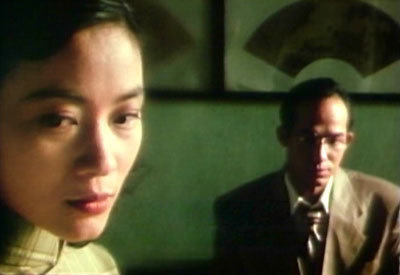
A lovely autobiographical feature by Boat People‘s Ann Hui, set in 1973. A young Chinese woman (Maggie Cheung) studying in London is summoned back to Hong Kong to attend her younger sister’s wedding, and finds herself in frequent conflict with her Japanese mother (Chang Shwu-Fen) until she accompanies her mother on her first trip back to Japan since being married. In Japan the daughter experiences much of the same cultural estrangement her mother went through when she came to China, and gradually the bond between mother and daughter becomes closer. Much of this is an interesting lesson for Westerners about some of the vast differences between Chinese and Japanese life. (A major problem for the daughter is the language barrier, and on a few occasions she can get by only in English.) Hui’s sensitive handling of her actors and her keen feeling for family dynamics never falter (1990).(JR) (Film Center, Art Institute, Columbus Drive at Jackson, Saturday, August 24, 4:00, and Monday, August 26, 6:00 and 8:00, 443-3737) Read more
Life Stinks
A primitive filmmaker who can usually be counted on for moments of genius, Mel Brooks runs true to form in a comedy about a greedy billionaire (played by Brooks) who bets another tycoon that he can spend a month with the Los Angeles homeless without any of his usual resources and survive. The movie takes a while to hit its stride, and its conclusion is fairly slapdash, but somewhere in between are some of the funniest bits of low slapstick Brooks has ever come up with, and an overall uncloying sweetness helps to save much of the rest. Coscripted by Rudy De Luca, Steve Haberman, and Ron Clark; with Lesley Ann Warren (in an unconventional turn as a bag lady), Jeffrey Tambor, Stuart Pankin, Howard Morris, and De Luca, who’s especially funny. (Esquire, Old Orchard, Pipers Alley, Norridge, Ford City, Harlem-Cermak, Lincoln Village) Read more
Open Doors
Festooned with European prizes and an Academy Award nomination, this solid, well-acted humanist period drama–adapted by director Gianni Amelio and Vincenzo Cerami from a novel by Leonardo Sciascia–makes its points quietly but firmly. In Palermo, Sicily, in 1937, an accountant (Ennio Fantastichini) for the Fascist Confederation of Professionals and Artists, who was recently fired for embezzlement, cold-bloodedly murders his former boss, the accountant who replaced him, and his wife (after raping her). He makes no effort to resist arrest or defend himself and expects to be executed by a firing squad. But one of the judges (Gian Maria Volonte), a pensive widower opposed to the death penalty, insists on drawing out the trial and finding a way to save the killer, despite the opposition of the chief magistrate and all the other judges but one, a farmer (Renato Carpentieri). There are few fireworks in this courtroom drama, but the film acquires a genuine sense of mass and moral weight as it develops (1990). (Music Box, Friday through Thursday, July 19 through 25) Read more
Daughters Of The Dust
Julie Dash’s first feature (1991), set in the islands along the south Atlantic coast of the U.S. sometime around 1900. A group of black women, carrying on ancient African traditions and beliefs as part of an extended family preparing to migrate north, confront the issue of what to bring with them and what to leave behind. Lyrically distended in its folkloric meditations, with striking use of slow and slurred motion in certain interludes, this doesn’t make much use of drama or narrative, and the musical score and performances occasionally seem at war with the period ambience. But the resources of the beautiful locations are exploited to the utmost, and Dash can be credited with an original, daring, and sincere conception. With Cora Lee Day, Alva Rogers, Adisa Anderson, Kaycee Moore, and Barbara-O. 114 min. (JR) Read more
Sunset
Apart from James Garner, who always seems to shine more in writer-director Blake Edwards’s contraptions than anywhere else, everyone from Bruce Willis, Mariel Hemingway, and Malcolm McDowell (with an indeterminate accent) to Kathleen Quinlan, Jennifer Edwards, and Joe Dallesandro seems to be at sea in this curious movie set in Hollywood in the late 20s. Garner plays Wyatt Earp, hired as a technical adviser on a film in which Tom Mix (Willis) stars; the two of them get involved in uncovering the murderer of a prostitute in a tale that is not quite a comedy, or a murder mystery, or a crime thriller, or an expose of Hollywood slime, but manages to make half-hearted stabs in all these directions. Period flavor and authenticity seem almost nonexistent, and whatever Edwards had in mind, he appears to have kept it mainly to himself; Rod Amateau wrote the original story, so maybe he knows. (JR) Read more
Strangers In Good Company
Canadian director Cynthia Scott’s 1990 first feature about the adventures and interactions that ensue when seven elderly women find themselves stranded in the Quebec countryside after their bus breaks down. Largely improvised by the nonprofessional cast, this is mainly quirky and good-natured fun with occasional cute interludes. (JR) Read more
Straight Time
Despite some signs of muddle and uncertainty (Ulu Grosbard replaced Dustin Hoffman as director during the shooting), this is a surprisingly strong picture about a convict (Hoffman) on parole in LA learning what the supposedly normal world is all about. Based on Edward Bunker’s novel No Beast So Fierce and adapted by several hands, this gains one’s respect largely through its secondary castTheresa Russell, Gary Busey, Harry Dean Stanton, M. Emmet Walsh, and Rita Taggartalthough Hoffman has his moments as well (1978). (JR) Read more
The Seventh Sign
Tiresome mumbo jumbo about the apocalypse brought on by biblical signs, reversible only if the heroine (Demi Moore), a pregnant woman, gives up her life for her baby. The real blasphemy of this plodding horror tale is that, no matter how flat-footed the script (W.W. Wichet and George Kaplan) and direction (Carl Schultz) are, they make God out to be an auteur who could take lessons from, say, Edward D. Wood Jr. Do yourself a favor and avoid this one like the plague. With Michael Biehn, Peter Friedman, and Jurgen Prochnow. (JR) Read more
V.i. Warshawski
A strictly standard-issue private-eye caper based on Sara Paretsky’s V.I. Warshawski novels set in Chicago; the plot (script by Edward Taylor, David Aaron Cohen, and Nick Thiel) is simplified Raymond Chandler by way of simplified Ross Macdonald, complete with so-so imitations of some of the former’s wisecracks salted with a feminist twist. The whole thing benefits from spunky Kathleen Turner as the lead and suffers from patchy direction by Revenge of the Nerds’s Jeff Kanew; Jay O. Sanders (as the heroine’s sometime boyfriend), Charles Durning (as a police lieutenant ally), and Angela Goethals (as a 13-year-old Warshawski winds up representing and protecting) manage pretty well under the circumstances, especially considering Randy Edelman’s awful music. (JR) Read more
Tabu
The last film of F.W. Murnau (1931, 82 min.), probably the greatest of all silent directors (he didn’t live long enough to make sound films, dying in an auto accident only a few days after work on the synchronized musical score for this masterpiece was completed). Filmed entirely in the South Seas in 1929 with a nonprofessional cast and gorgeous cinematography by Floyd Crosby, this began as a collaboration with documentarist Robert Flaherty, who still shares credit for the story, though clearly the German romanticism of Murnau predominates, above all in the heroic poses of the islanders and the fateful diagonals in the compositions. The simple plot is an erotic love story involving a young woman who becomes sexually taboo when she is selected by an elder to replace a sacred maiden who has just died; an additional theme is the corrupting power of civilization. The exquisite tragic endingconceived musically and rhythmically as a gradually decelerating diminuendois one of the pinnacles of silent cinema. 82 min. (JR) Read more
Rikyu
A feature by Hiroshi Teshigahara (Woman in the Dunes) about the relationship between the famous 16th-century tea master Sen-no Rikyu (Rentaro Mikuni) and an ambitious warlord named Hideyoshi Toyotomi (Tsutomu Yamazaki). Adapted by the director with painter-novelist Genpei Akasegawa from the novel of the same title by Yaeki Nogami, this lavish period drama is said to raise questions about contemporary Japanese values, though the parallels were less than obvious to me. Despite the beautiful colors, it comes across as a rather static period drama, almost at times a kind of Japanese counterpart to Masterpiece Theatre. It is Teshigahara’s first feature in 17 years, and the fact that he’s mainly been involved with flower arrangement in the interim may help account for the tendency to be decorative; occasional odd and striking camera angles, while effective in themselves, often seem indulged in for their own sake rather than dramatically motivated (1990). (JR) Read more
Regarding Henry
After being shot in a holdup, a heartless but successful New York lawyer (Harrison Ford) loses his memory of everything, including his wife (Annette Bening) and daughter (Mikki Allen), in an upscale weepie directed by Mike Nichols from an original script by Jeffrey Abrams. Nichols is so astute at directing the actors (who also include Bill Nunn, Donald Moffat, and Nancy Marchand) that it’s relatively easy to overlook the yuppie complacency, shameless devices (starting with an adorable puppy), and product plugs (especially Ritz crackers) that undermine the seriousness of the whole project. The existential drama of the hero rediscovering and redefining his identity is couched in the form of a fairy tale upholstered by glossy Vanity Fair ads, making this movie a genuine contradiction in terms in classic Hollywood style. Whether you’re won over or simply appalled is purely a matter of temperament (1991). (JR) Read more
Poison
This 1991 avant-garde shocker by Todd Haynes (Far From Heaven) freely cuts between three supposedly separate stories, each in a different style and set in a different period: a 40s tale of homoerotic passion in a prison that’s loosely derived from Jean Genet, a black-and-white 50s SF-horror melodrama about a leprous sex criminal, and an 80s TV expos Read more