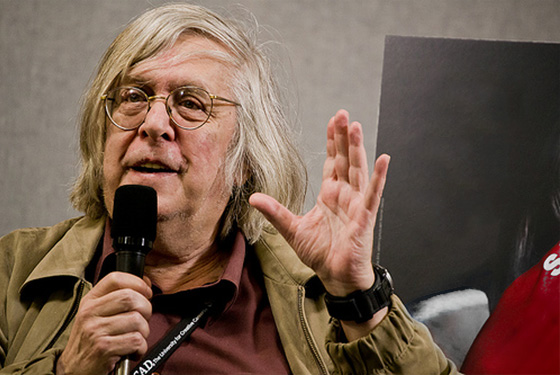
This feature-length 1996 video documentary by Houshang Golmakani about the eclectic and prolific Iranian filmmaker has the worst English subtitles of any Iranian film I’ve seen (which is saying a lot), and the editing is needlessly fussy and fancy. But it has a lot of interesting things to say about Makhmalbaf, with loads of material about his early life and career, many clips, archival material, and interviews, including a brief dialogue with filmmaker Werner Herzog. Anyone who wants to understand Makhmalbaf’s work better shouldn’t pass up this film, though it arguably goes beyond acceptable bounds when it includes footage of him grieving at his wife’s funeral. (JR) Read more
Ice
One of American independent Robert Kramer’s strongest underground features (1969), arguably his best, made in and around New York before he resettled in Paris. This potent and grim SF thriller about urban guerrillas of the radical left, shot in the manner of a rough documentary in black and white, has an epic sweep to it. (Like many politically informed art movies of the period, starting with Alphaville and including even THX 1138, it was set in the future mainly as a ruse for critiquing the present.) Now as then, the power of this creepy movie rests largely in its dead-on critique of the paranoia and internecine battles that characterized revolutionary politics during the 60s; the mood is terrorized and often brutal, but the behavioral observations and some of the tenderness periodically call to mind early Cassavetes. A searing, unnerving history lesson, it’s an American counterpart to some of Jacques Rivette’s conspiracy pictures, a desperate message found in a bottle. 130 min. (JR) Read more
Maniac
A 1980 New York slasher thriller that, according to the Psychotronic Encyclopedia, managed to offend even many gore fans. Leonard Maltin’s Movie & Video Guide finds it claustrophobic, sickening. William Lustig directed a story written by executive producer Joe Spinell, who also plays the title role. Not to be confused with features of the same title by Dwain Esper (1934), Michael Carreras (1962), and Richard Compton (1978). Read more
Troublesome Creek: A Midwestern
A touching 1996 documentary by a wife-and-husband team, Jeanne Jordan and Steven Ascher, about Jordan’s parents’ farm in Iowa, first plowed by her great-grandparents over a century ago and lost to a bank in the 1990s. The filmmakers discuss the family’s struggle in relation to the various westerns they watch on TV (hence the subtitle), but they cover life in rural America from many different angles. (JR) Read more
Umm Kulthum, A Voice Like Egypt
A fascinating and intelligent feature-length documentary (1996) by Michal Goldman about the late Egyptian singer, the best-selling female vocalist in the Arab world. Goldman uses many archival clips of her performances (including some from Egyptian films) and interviews with several Egyptians; the narrator is Omar Sharif. Like many such informative works, it leaves one wanting to know more. Recommended. 67 min. (JR) Read more
Hide And Seek
Su Friedrich’s 64-minute black-and-white 1996 narrative about lesbian adolescence in the 60s makes impressive use of found footage from that period; the match between this material and the film’s fiction is often uncanny, assisted by wonderful performances from Chels Holland, Ariel Mara, and Alicia Manta, among others. Friedrich scripted with Cathy Nan Quinlan. (JR) Read more
Murder And Murder
Gutsy experimental filmmaker Yvonne Rainer tackles two personal issues at oncehaving a lesbian relationship for the first time in middle age and developing breast cancerin one of her most direct and accessible semiautobiographical narratives. This 1996 film has a rich sense of social history, and the wisecracking irreverence of Rainer’s earlier work (e.g., Film About a Woman Who . . . , Privilege) is back in force, though for once the humor seems homey, even homespun, and not merely angry. With Joanna Merlin and Kathleen Chalfont; Rainer also turns up periodically in a tuxedo. (JR) Read more
Suburbia
Richard Linklater, adhering to the 24-hour frame of his first three features (Slacker, Dazed and Confused, Before Sunrise), directs a fine 1996 adaptation of Eric Bogosian’s tragicomic play about the frustrated lives of several 20-year-old suburbanites. They spend their time mainly in parking lots and are pushed to a crisis point when an old friend who’s made it big as a rock star (Jayce Bartok) stops by for a visitmaterial that’s conventional to the point of being generic, even in its surprises, and that remains obstinately stage bound. Nevertheless, the cast of mainly unknowns is so good, and Linklater is so adept at playing them off one another, that the two-hour running time never seems overextended. With Giovanni Ribisi (especially impressive), Steve Zahn (That Thing You Do!), Amie Carey, Nicky Katt, Ajay Naidu, Samia Shoaib, and the ubiquitous Parker Posey. (JR) Read more
Films By Frederick Marx
Films by one of the directors of Hoop Dreams, an Illinois-based film and video maker whose experimental and political interests sometimes inform each other. House of Un-American Activities (1983) is a documentary that mixes personal and public history as it describes the 1956 persecution of Marx’s fathera Jewish refugee from Germany who joined the Communist Party in 1945. Dreams From China was shot while Marx was working as an English teacher in China between 1983 and 1985; the portrait of China it presents is highly personal, full of fascinating details, and, given Marx’s leftist background, unfashionably negative. Also showing are Higher Goals, an offshoot of Hoop Dreams, about a children’s program; Jail Vision, an excerpt from a play written and acted by Cook County Jail inmates; and excerpts from works in progress. (JR) Marx will attend the screening. Read more
The Garden
A 1995 Slovak feature, directed and cowritten by Martin Sulik, about a 30-year-old schoolteacher beset by problems who gradually becomes enlightened by the experience of spending time in his late grandfather’s overgrown garden. If memory servesI saw this a couple of years ago and retain only a few imagesthis is an intriguing and poetic piece of magical realism. It was nomiated for an Oscar. (JR) Read more
Queen Of Outer Space
Believe it or not, Ben Hecht wrote the original script for this deliberate hoot of 1958, and Charles Beaumont gave it a polish. Producer Walter Wanger turned the project over to director Edward Bernds, a Bowery Boys and Blondie specialist; Laurie Mitchell was cast in the lead, and Zsa Zsa Gabor and several others filled out the cast, which largely consists of Venusian amazons in miniskirts, along with Eric Fleming and Paul Birch. (JR) Read more
The Picture of Dorian Gray
The underrated Albert Lewin (Pandora and the Flying Dutchman, The Moon and Sixpence), a sort of Val Lewton who had the run of the MGM back lot, adapted Oscar Wilde’s novel and directed his own script in a skillfully somber and haunting version of the metaphysical fable about a man whose painting ages and records his moral corruption while he retains his youthful appearance. With Hurd Hatfield memorably playing the title part, the 1945 film also includes juicy performances by George Sanders, Angela Lansbury, and Donna Reed. Deeper and creepier (that is to say, better) than anything turned out by Merchant-Ivory, this is both very Hollywood and very serious in a manner calculated to confound the “Hey, it’s only a movie!” crowd. This screening of a 35-millimeter print is tied to the Art Institute’s retrospective of painter Ivan Albright–who executed the extraordinary portrait of Dorian Gray’s rotting corruption, which appears in the black-and-white film as one of its only color shots (hey, it’s only a painting!)–and will be graced by a personal appearance by Hatfield, who’ll discuss both the movie and painting, and hopefully the novel as well. Film Center, Art Institute, Columbus Drive at Jackson, Saturday, March 1, 8:00, 312-443-3737. Read more
Absolute Power
Clint Eastwood as producer-director-star strikes out in a rather slack thriller that oddly recalls a couple of Hitchcock’s lesser movies, To Catch a Thief and Topaz. This combines the mythological jewel thief of the former and the disgust for political hypocrisy of the latter, but with none of Hitchcock’s humor or stylistic flourishes. The William Goldman scripta piece of cheese without much flavoradapts a novel by David Baldacci, and part of the problem appears to be that the story calls for someone like Cary Grant. A debonair burglar inadvertently spies the U.S. president (Gene Hackman) having sadistic sexual foreplay with the young wife of his political mentor, which leads to her getting killed. Something’s already awry in this would-be set piece, which has too many reaction shots of Eastwood, and things get worse when Eastwood as director has to plow through the laborious consequences. Generally resourceful in such matters, though always at the mercy of the scripts he selects, Eastwood has to contend here with unpleasant and uninteresting characters that even Hackman, Scott Glenn, Judy Davis, and E.G. Marshall can’t bring to life, and the halfway likable putative romantic leads, Ed Harris (detective) and Laura Linney (the burglar’s daughter), have to take a backseat to the machinations of the others. Read more
The Passion of Joan of Arc
Though I haven’t heard Richard Einhorn’s new oratorio Voices of Light — which was a brisk seller on Billboard‘s classical charts early last year, written to accompany Carl Dreyer’s last silent film — I have seen the original version of Dreyer’s masterpiece, rediscovered in a Norwegian mental asylum during the 80s after having been lost for half a century. (The other prints were lost in a warehouse fire, and the two circulating versions since then have both consisted of outtakes.) Considering that this film’s beautiful original score resembled an oratorio at certain moments, I suspect that this rare opportunity to see the greatest of all Joan of Arc films in optimum conditions shouldn’t be passed up. (Anonymous 4 performs Joan’s voice in both alto and soprano, and Lucinda Carver conducts the Los Angeles Mozart Orchestra and the Zephyr Chorus.) Joan is played by Comedie-Francaise member Renee Falconetti, and though hers is one of the key performances in the history of movies, she never made another film. (Antonin Artaud also appears in a memorable cameo.) Dreyer’s radical approach to constructing space and the slow intensity of his mobile style make this a difficult film in the sense that, like all the greatest films, it reinvents the world from the ground up; it’s also painful in a way that all of Dreyer’s tragedies are. Read more
Metro
Apart from a few wisecracks Eddie Murphy plays it straight, as a hostage negotiator working for the San Francisco police force in a loud and often stupid action thriller in which director Thomas Carter (Swing Kids) has every screaming psycho killer and every hysterical hostage behaving identically. Lots of car crashes, one superb explosion, and the fleeting charms of Carmen Ejogo (Absolute Beginners) hardly compensate for the overall unpleasantness, in which sadism is taken for granted and no character is allowed to develop. The idiotic script is by Randy Feldman. Michael Rapaport plays Murphy’s partner; the most prominent leering villainwho actually chains the heroine to a buzz saw in the final showdownis Michael Wincott. (JR) Read more