Review of Peter Biskind’s SEEING IS BELIEVING
From the Autumn 1984 Film Quarterly. I reviewed this book at Biskind’s request, and my position was hampered by the fact that he was the main editor of American Film at the time, where his commissions were essential to my livelihood. Our relationship became even more strained after I was all set to review the book and he then informed me that he wished I weren’t reviewing it. — J.R.
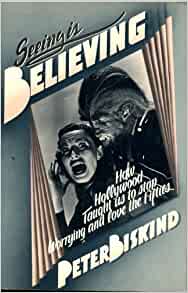
SEEING IS BELIEVING: How Hollywood Taught Us to Stop Worrying and Love the Fifties By Peter Biskind. New York: Pantheon Books, 1983. $22.95 cloth, $10.95 paper.
The first thing to be said about Peter Biskind’s ambitious and long-awaited study of ideology in Hollywood movies of the fifties is that it can’t be dipped into at random with out a considerable amount of confusion setting in. Without the benefit of Biskind’s careful construction and preparation, the unwary reader who plunges in midstream is bound to be bewildered or dismayed by many of the political labels, whereby Thieves Highway, for instance, is designated as a “right-wing film,” or High Noon and The Blob as “radical films.” Even in the Introduction, which tends to be more cautious than the rest of the book, several eyebrows are likely to be raised by the following sentence: “The films of Robert Aldrich can usually be counted on to be somewhere on the left, just as the films of Elia Kazan are frequently in the middle, while those of John Ford are to the right of his and those of Alfred Hitchcock are to the right of his. Read more