From Monthly Film Bulletin, September 1975, Vol. 42, No. 500.
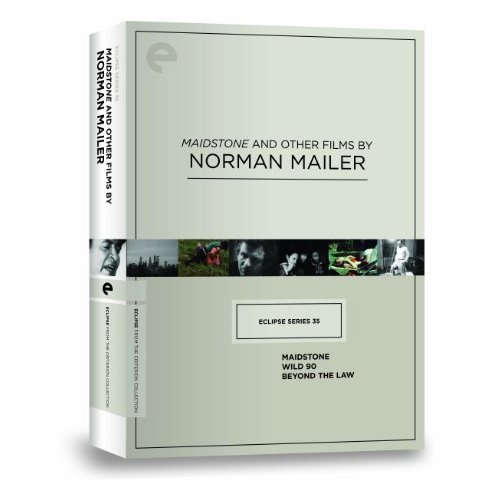
It’s good to see Norman Mailer’s first three features just out in a two-disc DVD set from Eclipse (it would be great if Criterion could eventually do the same for Susan Sontag’s three fiction features), even though I regret that my two favorite Mailer films — his untitled, ten-minute experimental short from 1947 (recently discovered by archivist Michael Chaiken, who wrote the excellent and provocative notes for the Eclipse set, and which I saw last July at Il Cinema Ritrovato) and Tough Guys Don’t Dance (1987) — aren’t included. (Admittedly, I haven’t yet seen all of Maidstone, which Chaiken makes the most claims for, so these rankings on my part are still subject to revision.)…In his Eclipse notes, Chaiken describes Will the Real Norman Mailer Please Stand Up? [sic] as “a filmed counterpart to The Armies of the Night“, which parallels my own observation here. Read more
Truman Burbank (Jim Carrey) thinks he lives in a model island community, but then he discovers that his entire life has been televised without interruption as The Truman Show; his family and friends, along with everyone else in town, are actors and extras, and the island itself is a TV studio. Half-clever and half-dumb, though always interesting and provocative, this 1998 fantasy was written with some wit by Andrew Niccol and directed with some style by Peter Weir. It makes better sense as allegory than as SF premise, expecting you to accept that the viewing public consists of jerks (except for you and me and other media-savvy types) and that the Truman Show creator (Ed Harris, radiating holiness) who services the jerks is a godlike genius. In short, this pretends to be daring while parroting what much of the TV industry already thinks about itself and its audience. But it’s still pretty much fun to watch. With Laura Linney, Noah Emmerich, Natascha McElhone, and Holland Taylor. 103 min. (JR) Read more
At first I was put off by the hagiographic and metaphoric aspects of this 2002 Canadian documentary about communications essayist Marshall McLuhan (1911-’80); director Kevin McMahon and screenwriter David Sobelman seem to regard their subject as Moses, Hegel, and Northrop Frye rolled into one. But I was won over by the film’s mimetic process, as McLuhan’s endlessly suggestive (if sometimes fruitless) probes are matched by fragmented voices intoning all the praise and criticism that have circled his work (among the commentators are Gerald O’Grady, Lewis Lapham, Neil Postman, Laurie Anderson, and McLuhan’s son Eric). Ultimately this adds up to a comprehensive and highly ambitious study of McLuhan’s life, thought, and influence. 94 min. (JR) Read more
Hunter S. Thompson’s 1971 account of taking drugs and behaving like an asshole in Las Vegas yields a singularly unpleasant 1998 feature from writer-director Terry Gilliam, though one with a lot of creativity and a scuzzy integrity of its own. There’s a good grasp of period, an impressive impersonation of the author-hero by an almost unrecognizable Johnny Depp, and a determination to honor the original in all its gross-out particulars. I assume that part of the idea here was to play in the ambiguous zones where Las Vegas tackiness, LSD hallucinations, Gilliam beasties, and lots of vomit become difficult to separate. It’s certainly distinctive, looking at times like Richard Lester put through a postmodernist blender, and Gilliam, an American expatriate since the 60s, skewers his native country with guts and zeal. 119 min. (JR) Read more
Art 1998 Chicago presents continuous showings of films that debuted at the Documenta X festival in Kassel, Germany, last summer. The Final Insult is Charles Burnett’s first foray into digital video, released in 1997 and running 55 minutes. It’s a fictional story about a homeless middle-aged man (Ayuko Babu of When It Rains) interspersed with a lot of documentary footage about the homeless, including several interviews. Both blocks of material have their own strength and validity, but they seldom mesh comfortably, and their juxtaposition tends to distract one from the subject at hand. Mother and Son (1997) is by the Russian filmmaker Alexander Sokurov. Apart from the eye-filling black-and-white video Oriental Elegy Sokurov’s painterly, visionary side has seldom been more evident than in this gorgeous contemplation of a son caring for his dying mother. The story is minimal, but the color images are so breathtaking that there’s never a lax moment; even when the already slow action is reduced to a virtual standstill, Sokurov’s intensity insures that something is always happening, both on the screen and inside us. (This is only 73 minutes long, but if you’re hungry for plot, it will seem like an eternity.) In his taste and his patience, Sokurov may be our only truly 19th-century avant-gardist—which means in effect that his works are timeless. Read more