Written for the catalogue of Il Cinema Ritrovato in Bologna (June-July 2017). — J.R.
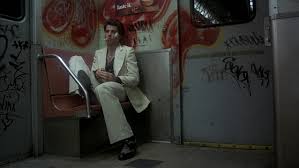
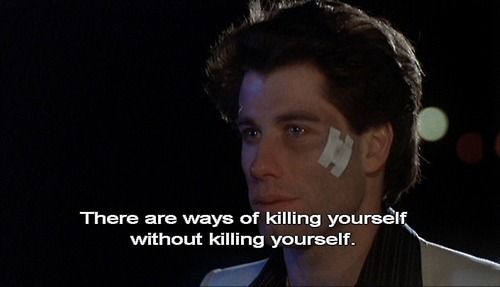
Dave Kehr has aptly described it as a “1977 update of Rebel Without a Cause” and a “small, solid film, made with craft if not resonance”. But it’s also a dance musical and the hit that catapulted John Travolta to stardom after a brief career in theater and on television (notably on Welcome Back, Kotter).
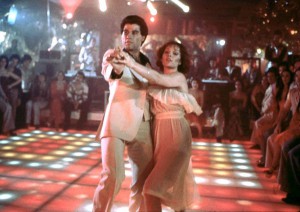
There’s a manic-depressive side to most musicals—a tendency to navigate mood swings from depression to exhilaration and back again–that’s observable in everything from Swing Time to The Band Wagon to La La Land. Saturday Night Fever takes that pattern to an unusual extreme in the way it oscillates between a view of Brooklyn’s Bay Ridge neighborhood as a version of hell on earth whose residents devote all their waking hours to humiliating one another and the heavenly, utopian lift and glory of dancing at one of its discotheques called 2001 Odyssey. Most people who fondly remember this movie are likely to focus on the latter and think less about the former, but it’s the relation between these two registers that gives the movie its energy.
The screenplay by Norman Wexler (Joe, Serpico, Mandingo) is derived from an article in New York magazine (“Tribal Rites of the New Saturday Night”) whose author, British rock critic Nik Cohn, admitted two decades later was more invented than observed. Read more
From Cinema Scope No. 50, Winter 2012, as part of a feature, “50 Best Filmmakers Under 50”. — J.R.
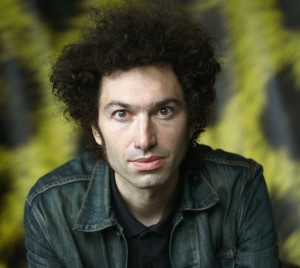
Many reviewers of Azazel Jacobs’ four features understandably place them in a direct lineage from his father Ken’s work. Both filmmakers are clearly preoccupied with interactions and crossovers between fiction and nonfiction — although the same could be said of everyone from Lumière, Méliès, and Porter to Costa, Hou, and Kiarostami. And both are remarkable directors of actors/performers, even though, in the case of Ken, projectors and found footage have performative roles along with people. The dialectics forged by opposite coasts and mindsets — corporate Hollywood vs. flaky New York Underground, claustrophobic obsession/fixation versus airy and uncontrollable street theatre — are equally constant.
Most reviewers are quick to point out that Azazel is more committed to narrative than his father. It’s easy to see what they mean, but some of their assumptions are worth questioning. If part of what we mean by “narrative” is plot and incident, there may be more of both contained in the intertitles of Ken’s The Whirled (1956-63) than there is in the main action of Azazel’s second feature The GoodTimes Kid (2005). If part of what we mean is “character,” then the work of both filmmakers is overflowing with it, from Jack Smith’s manic cavorting in many of Ken’s films to Diaz’s exhilarating dance in The GoodTimes Kid, not to mention John C. Read more