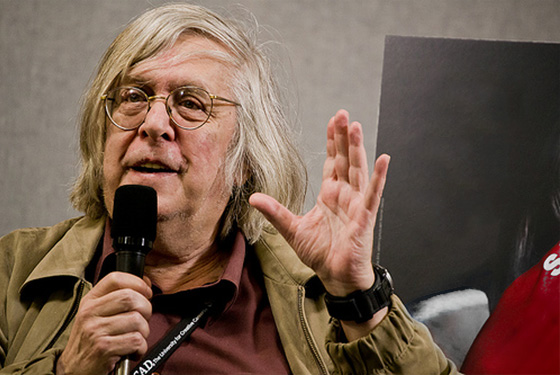
This appeared originally in the May-June 1990 issue of Tikkun, and was reprinted in my first collection, Placing Movies: The Practice of Film Criticism, five years later. — J.R.
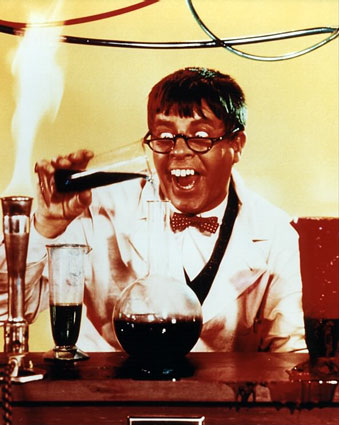
“Why are the French so crazy about Jerry Lewis?” is a recurring question posed by film buffs in the United States, but, sad to say, it is almost invariably asked rhetorically. When Dick Cavett tried it out several years ago on Jean-Luc Godard, one of Lewis’s biggest defenders, it quickly became apparent that Cavett had no interest in hearing an answer, and he immediately changed the subject as soon as Godard began to provide one. Nevertheless it’s a question worth posing seriously, along with a few related ones — even at the risk of courting disbelief and giving offense.

Why are American intellectuals so contemptuous of Jerry Lewis and so crazy about Woody Allen? Apart from such obvious differences as the fact that Allen cites Kierkegaard and Lewis doesn’t, what is it that gives Allen such an exalted cultural status in this country, and Lewis virtually no cultural status at all? (Charlie Chaplin cited Schopenhauer in MONSIEUR VERDOUX, but surely that isn’t the reason why we continue to honor him.) Read more
I’ve spent most of my life in search of communities
I can join without compunction—decidedly not
the small town in Alabama where I grew up, and at
most only two of the schools I chose to attend as a
student: Highlander Folk School in Tennessee
(summer 1961), cradle of the civil rights movement in the U.S., and Bard College in New York (1962-66), where my professional and vocational involvements in film and literature took shape. But the only such
community that I was invited to join, as a teacher, was film.factory in Sarajevo (over four two-week periods, 2013-2015), and this was entirely due to Béla Tarr (1955-2026), a Hungarian filmmaker I discovered in Chicago via Almanac of Fall (1984) and Damnation (1988) in 1990, who became a friend around the time of the international premiere of Sátántangó (1994). I had been on the New York Film Festival’s selection
committee that had chosen the film, had arranged for its showing at the Chicago International Film Festival
as a “critic’s choice” of mine, and had found its first
American distributor. (I copied my own video of the
film and sent this copy to my friend Rob Tregenza, a
remarkable filmmaker and cinematographer who ran
Cinema Parallel—a small company that distributed films by Godard and Haneke, among others—correctly guessing that he would want to distribute Sátántangó.) Read more
Here is another one of my Paris Journals for Film Comment — the first one, I believe, after the magazine shifted from being a quarterly to a bimonthly publication. Once again, I think part of the reason for reproducing this now is its value as a period piece.
2019: A fascinating footnote about Solntseva: at a film festival in Spain a few years ago, Sergei Loznitsa told me that thanks to an opening of some of the KGB’s old files for public scrutiny, it was revealed that she had been a longtime member. Most of us know far too little about the Russian and Soviet past to begin to understand the reasons for this, but it seems possible that Solntseva may have actually joined the KGB in order to help protect her Ukrainian husband, who was reportedly under Soviet surveillance for most of his life. It does help to explain, in any case, how, after Dovzhenko failed to get so many of his own personal projects like Desna produced, Solntseva was able to direct three of them with lavish budgets and immense technical resources after his death.
For a link to The Enchanted Desna with English subtitles,
go to YouTube.
Read more