When This is Orson Welles, which I edited, was originally published in 1992, the section of the book which elicited the most comments was the 131-page summery of Welles’ career, an attempt at an exhaustive account that I had taken over and expanded from Welles and Peter Bogdanovich’s original manuscript. People were awed by the size of this section, but ever since the book’s publication, I’ve been periodically reminded of how incomplete it actually was and is.
My latest reminder was coming across Welles’ 19-minute radio adaptation/performance of Alexander Pushkin’s “The Queen of Spades,” introduced by Laurence Olivier and available for free at
https://www.audible.com/pd/The-Queen-of-Spades-Audiobook/B011J042XK?ref=a_library_t_c5_libItem_&pf_rd_p=80765e81-b10a-4f33-b1d3-ffb87793d047&pf_rd_r=87W16ZWVNQ3BJXCWR4TH
I have no idea when this was recorded or broadcast, but Audible has posted it alongside other audio adaptations of other Russian literary works performed by Olivier, Michael Redgrave, Trevor Howard, and an apparently unidentified actress in the same series, which aren’t free. [4/25/2022]
Read more
From the Chicago Reader (June 1, 1990). — J.R.

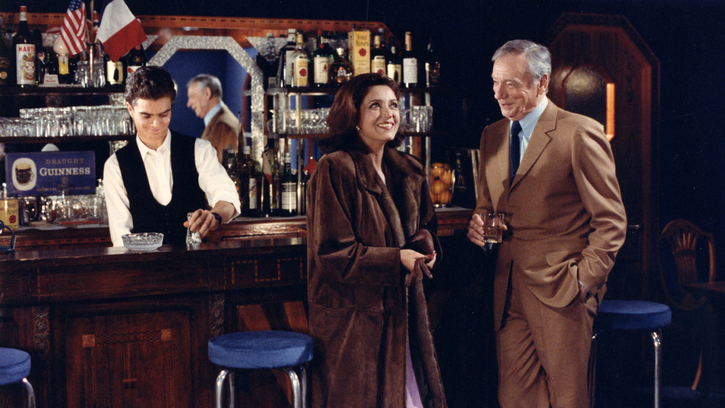
For viewers like me who harbor passionately fond memories of Jacques Demy’s 1967 tribute to the American musical, The Young Girls of Rochefort, Demy’s 1988 musical (his last film) is clearly worth seeing, even if the recommendation has to come with reservations. While Michel Legrand’s score for The Young Girls of Rochefort is one of the greatest for any musical, his comparably jazzy and airy work for the this one is only a pale reflection of his best. Similarly, the references to touchstones such as Silk Stockings, Singin’ in the Rain, and The Band Wagon are all too fleeting, in striking contrast to the full-scale tributes in the earlier film to West Side Story, An American in Paris, and Gentlemen Prefer Blondes. The difference between the two is partly a matter of scale and budget, and partly that the more recent film centers on Yves Montand, an eminence grise who looks more and more like Milton Berle. Playing himself, Montand arrives in Marseilles to launch an autobiographical musical revue that he plans to take on a world tour. He spends his spare time looking for an old lover, a onetime prostitute now a baroness (Francoise Fabian), whose husband is in jail for theft and whose 22-year-old daughter (Mathilda May), who knows nothing of her mother’s past, has a burning desire to make it in show biz. Read more