Posted by New Lines (https://newlinesmag.com/) with a different title on June 28, 2023:
It is a pity and a paradox that Jafar Panahi — Iran’s most important living filmmaker, in my judgment (at least among those I’m familiar with) — seems to be valued in the West more for his persecution than for his filmmaking. His first feature, “The White Balloon” (1995), became the first Iranian film ever to win a major award at the Cannes Film Festival (the Camera d’Or), and his four subsequent features — “The Mirror” (1997), “The Circle” (2000), “Crimson Gold” (2003) and “Offside” (2006) — all won awards at major festivals. But it wasn’t until Panahi was arrested in 2010, sentenced to six years in prison and banned from all filmmaking activities for the next 20 years that he was noticed in the mainstream press in the West. (He was charged with “propaganda against the system” for attending the funeral of a student killed during the 2009 Green Movement protests and for attempting to make a film sympathetic to that rebellion.)
Since then, Panahi has miraculously managed to make five more features in defiance of the ban, appearing as himself in each of them. Severely limited in terms of their resources and shooting conditions, the films have nonetheless garnered more attention than the five features made between 1995 and 2006, prior to his arrest. Read more
An obituary, written in February 2006 for Sight and Sound. — J.R.
Film history has always been at the mercy of technology and markets, yielding the brutal shifts from silent to sound pictures and from black and white to colour, as well as the reconfigurations of films on television. More recently, digital video and the Internet have ushered in a confusing transitional period that we’re still in the middle of, recasting our canons of films and film critics alike according to what’s available.
Improbably, most of Carl Dreyer’s major films —- which until recently were almost impossible to see anywhere in decent prints —- are now available in pristine form to anyone on the planet with a multiregional DVD player. Yet those of James Whale that don’t qualify as horror, including such 30s masterpieces as Remember Last Night?, Show Boat, and The Great Garrick, remain firmly out of reach. And the warm, mischievous, shy yet gruff, and dedicated critic who introduced me to all this and much else — Tom Milne, who died in Aberdeen last December — is barely known today because little of his prose has made it onto the Internet.
For those with backlogs of Monthly Film Bulletin and Sight and Sound from the 60s through the 80s, it’s hard to think of other London-based film writers during that stretch who wrote more cogently and passionately about film. Read more
The World (Jia Zhang-ke) Not on the Lips (Alain Resnais) A History of Violence (David Cronenberg) Ten Skies (James Benning) Tropical Malady (Apichatpong Weerasethakul) Howl’s Moving Castle (Hayao Miyazaki) & Charlie and the Chocolate Factory (Tim Burton) Yes (Sally Potter) & Capote (Bennett Miller) Michelangelo Eye to Eye (Michelangelo Antonioni) & Saraband (Ingmar Bergman) Broken Flowers (Jim Jarmusch) & Me and You and Everyone We Know (Miranda July) The Girl from Monday (Hal Hartley) & 2046 (Wong Kar-wai)
Chicago Reader, 2006:
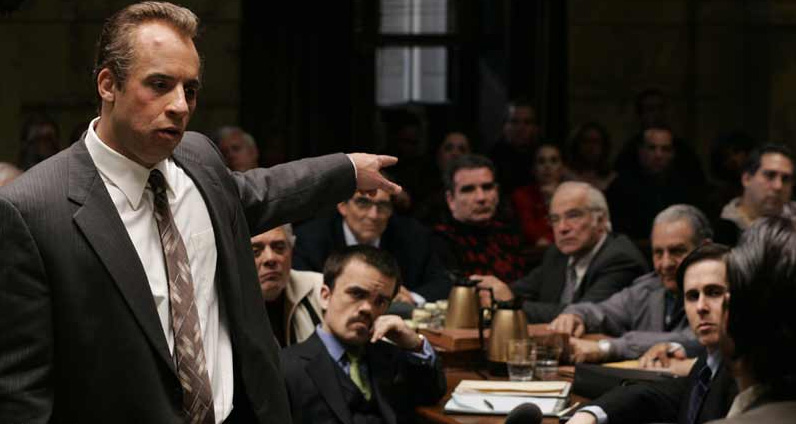
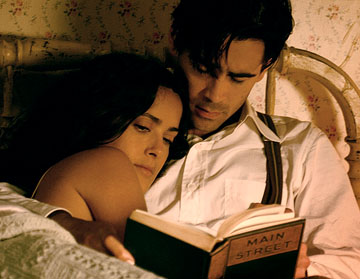
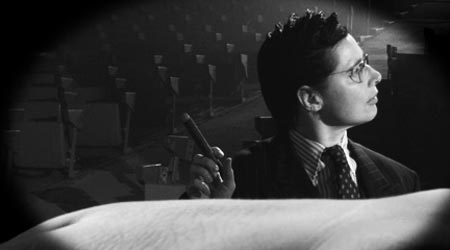
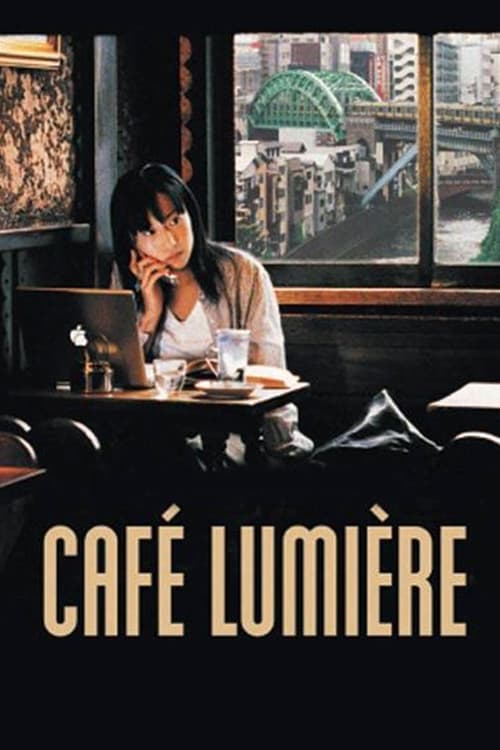
Cafe Lumiere (Hou Hsiao-hsien) & Three Times (Hou Hsiao-hsien) Army of Shadows (1969, Jean-Pierre Melville) & Statues Also Die (1953, Resnais/Marker/Cloquet) The War Tapes (Deborah Scranton) & Iraq in Fragments (James Longley) Cuadecuc-Vampir (1970, Pere Portabelle) & Warsaw Bridge (1990, Portabella) Find Me Guilty (Sidney Lumet) & Half Nelson (Ryan Fleck) Citadel (Atom Egoyan) & The Power of Nightmares (Adam Curtis) The Three Burials of Melquiades Estrada (Tommy Lee Jones) & The Illusionist (Neil Burger) Ask the Dust (Robert Towne) & Hollywoodland (Allen Coulter) Moments Choisis des Histoire(s) du Cinéma (Godard) & My Dad Is 100 Years Old (Maddin) Fast Food Nation (Richard Linklater) & Bobby (Emilio Estevez)
DVD Beaver, 2006:
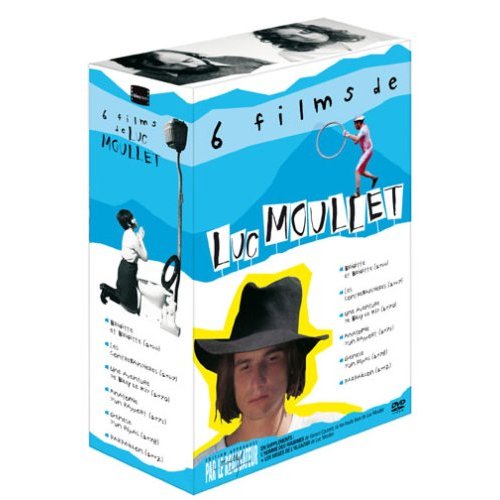
1. 6 Films de Luc Moullet (Luc Moullet, 2006), Blaq Out; multizone NTSC
2. Read more
Here’s my promised list: 25 films in 20 entries, allowing for five ties. I’ve made it somewhat different from my Village Voice ballot and my forthcoming Chicago Reader list by changing some of the ground rules: The only criterion for inclusion is a public screening somewhere in the United States, and the order is strictly alphabetical rather than hierarchical. I’ve appended comments to each entry, including some remarks about performances (good idea, Tony) and some responses to other comments. Tony’s point that more films are becoming easier to see, at least on DVD, is well taken; this means that most (if not all) of my choices will be obtainable that way in the coming year, if they aren’t already.
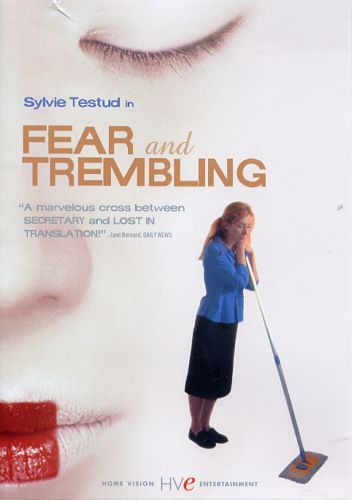
Café Lumière and Fear and Trembling. Two first-rate alternatives to the dubious Lost in Translation, both showing how one can view Japan from a foreign viewpoint with some nuance and a bit more sensitivity than simple class blindness. Politesse isn’t the issue. Though I’ve yet to find a Japanese person who can bear Sofia Coppola’s film, I don’t know if Alain Corneau’s even more unflattering Stupeur et tremblement — about the suffering of a Belgian woman (Sylvie Testud) working for a corporation in Tokyo and trying to conform to the local protocol — has even shown in Japan. Read more
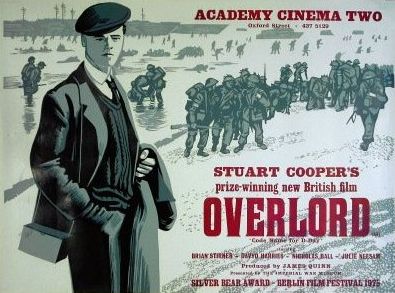
Criterion has just released Overlord on Blue-Ray. Here are my two separate reviews of the film, written over three decades apart — for Monthly Film Bulletin, September 1975, Vol. 42, No. 500, and for the Chicago Reader,June 2, 2006. — J.R.
Overlord
Great Britain. 1975
Director: Stuart Cooper
Cert–A. dist-EMI. p.c–Joswend. p–James Quinn. p. manager—
Michael Guest. sc–Stuart Cooper, Christopher Hudson. ph–John
In order to write briefly about five films that I first saw in 2006 that are especially important to me, I have to violate a taboo against acknowledging works that aren’t (yet) readily available. More specifically, the first two on my list haven’t yet been seen very widely outside of film festivals and/or the countries where they were made, while the last two, even more rarefied, have only been shown under special circumstances, in both cases because their filmmakers are under no commercial pressures to release them and would like to oversee and monitor their exhibition. Although I’m aware that this may irritate some readers, I’d rather address them like adults than succumb to the infantile consumerist model of instant gratification, according to which works should be known about only when they can be immediately accessed. After all, some pleasures are worth waiting for.
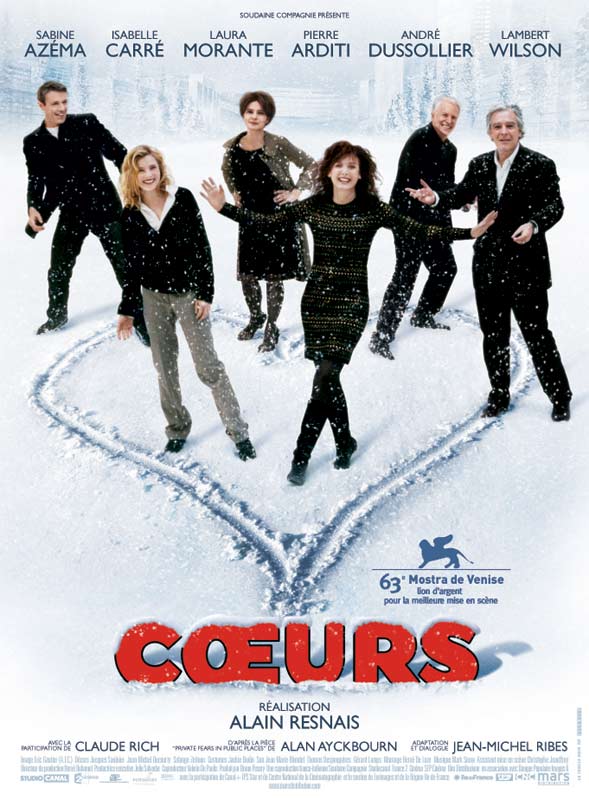
Coeurs
Alain Resnais’ dark, exquisite, and highly personal adaptation of Alan Ayckbourn’s Private Fears of Public Places, which I saw at film festivals in Venice and Toronto, is eloquent testimony both to how distilled his art has become at age 84 and how readily Ayckbourn’s examples of English repression can be converted into French equivalents. Read more
One of the most cherished fantasies in the world of movies is that around this time every year we critics are all dying to think about the best films of the past 12 months — as if listmaking represented some particular populist need for consensus rather than the industry’s desire to resell goods that have already been sold to us again and again (or, in this neck of the woods, to presell goods that haven’t arrived yet).
I’ll admit that one list engenders another, and that once the game starts in earnest, every critic wants to be part of the discussion. But consider some of the drawbacks:
(1) Piles of movies getting released at the end of this year in such a manner that critics (and some audience members) don’t even have time to take them in, much less think about them. (Maybe that’s exactly what the studios want–snap judgment is another practice that serves the industry more than the audience.)
(2) Contortions by critics outside New York and Los Angeles who don’t want to come across as rubes and so vote for movies that most of their readers can’t see yet.
After recently having caught up with Alain Resnais’ magisterial Vous n’avez encore rien vu, I belatedly discovered from diverse sources on the Internet that “Axel Reval,” the credited cowriter on both this film and Les herbes folles, is in fact a Resnais pseudonym, making it a typically sly acknowledgment of the personal nature of his filmmaking, which has been an essential part of his work since the 1950s. Remember the glimpse of the Mandrake the Magician comic strip found in the Bibliothèque Nationale in Toute la mémoire du monde? One could even argue that the fact that personal moments of this kind tend to be veiled or masked in Resnais only makes them more intense, as they sometimes are in the films of Sternberg. (Claude Ollier’s alternate title for The Saga of Anatahan: My Heart Laid Bare.)
Indeed, it might make an interesting exercise to run through Resnais’ oeuvre picking out such intense but half-hidden and fleeting details spelling out his personal investments in the films. Read more
With Sabine Azema, Isabelle Nanty, Audrey Tautou, Pierre Arditi, Jalil Lespert, Daniel Prevost, Lambert Wilson, and Darry Cowl
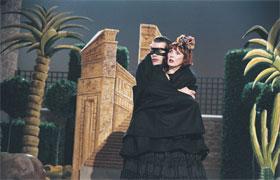
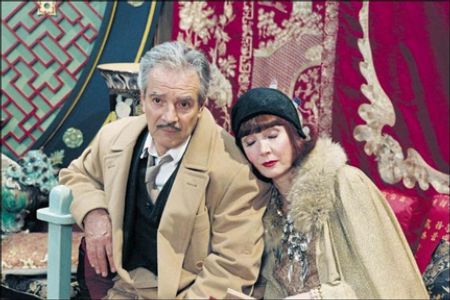
Alain Resnais’ latest feature, Not on the Lips (2003), apparently won’t be shown in commercial theaters in this country. I can’t think of another French movie that’s given me as much pleasure in years—it’s his best since Melo (1986) and surely his most accessible to American audiences. It is showing twice this week in the Gene Siskel Film Center’s European Union festival, and its U.S. distributor, Wellspring, will bring it out on DVD on March 22. DVDs are now more profitable than ticket sales, so I suppose it’s understandable that Wellspring doesn’t want to spend a fortune on a theatrical release. But this movie’s gorgeous visuals are still best seen first on a big screen.
In any case, this delightfully eccentric film of a 1925 French operetta, with its English subtitles laid out in rhyming couplets, can be enjoyed in any format. It has a harmonically rich score, which Resnais calls “brisk and hilariously jubilant,” and it’s brilliantly orchestrated by Bruno Fontaine, featuring counterpoint by Maurice Yvain that’s as lively as the wordplay in Andre Barde’s lyrics. Read more
The most gratifying aspect of Peggy Noonan’s eloquent article last Friday in the Wall Street Journal isn’t merely the belated sign that sane and grown-up conservative thought is finally being heard on the subject of the Middle East, in contrast to the obtuse bellicosity and stupid posturing of John McCain and others. Even more, it’s a sign that some Americans are finally beginning to learn something from American mistakes — above all, from the peculiar conviction that American self-aborption is the only thing urgently needed in the world outside the U.S., and that any sign of tact, calm, and/or reticence automatically translates into weakness. (I hasten to add that Noonan’s voice hasn’t been the only sensible one recently coming from the right; I’m emphasizing it only because it seems the loudest and clearest of these voices.)
I would love to see this dawning wisdom take one crucial further step — the recognition that the terrorist attacks of September 11, 2001 weren’t simply, exclusively, and unproblematically “attacks on America”, whatever that means. They were attacks on people, many of whom weren’t American. Assuming otherwise, as so many chest-beaters did and still do, means playing into the hands of the fanatics who committed these murders and perversely honoring their supposed wisdom and one-dimensional view of the world for the sake of throwing out every other possible reading of what happened. Read more