From the Chicago Reader (November 1, 1996). — J.R.
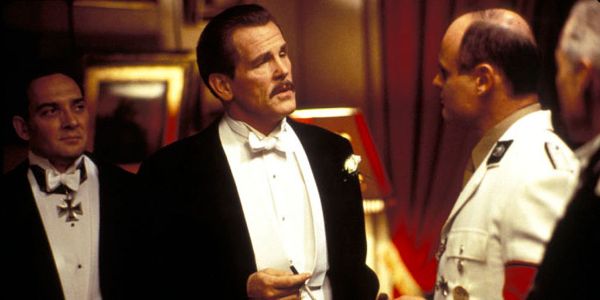
An honorable failure, this intelligent adaptation of one of Kurt Vonnegut’s best early novels falters in part because it rejects Vonnegut’s narrative structure of alternating several time frames for more chronological flashbacks. This plays havoc at times with the book’s delicate ordering of facts about Howard W. Campbell Jr. (Nick Nolte) — a successful German-American playwright living in Germany who decides during the rise of Nazism to work as an American spy, knowing that for security reasons his masquerade as a Nazi can never be revealed. The invaluable moral of the novel, placed in the first paragraph of the introduction, is We are what we pretend to be, so we must be careful about what we pretend to be. By placing it less prominently in the narration, director Keith Gordon and adapter Robert B. Weide grant it a lesser function, so that the powerful literary irony established in the film’s first half — all the more valuable in the context of Schindler’s Listand its suggestion that there were good ways of being a Nazi — is eventually dissipated, and the improbabilities of the original become much more vexing without the author’s exquisite expositional strategies.Read more
From Film Comment (January-February 1975). (January 23, 2012 update: Thanks, once again, to the ever-vigilant Ehsan Khoshbakht for spotting a few typos here and thus enabling me to correct them.)– J.R.
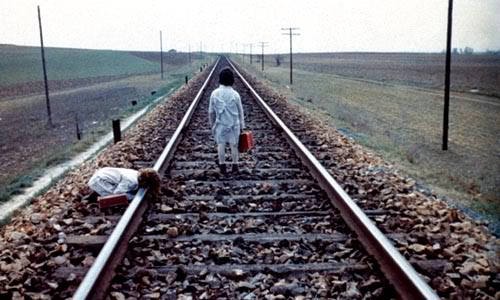
October 8: Victor Erice’s EL ESPIRITU DE LA COLMENA (THE SPIRIT OF THE BEEHIVE). I’ve been trying all weekend to come up with an adequate description of this lovely Spanish film, but I can’t get anywhere. A colleague recently spoke of the film as “beguiling,” which seems like an honest start. Two remarkably expressive little girls, Ana Torrent and Isabel Telleria, see James Whale’s FRANKENSTEIN at a traveling film show that stops in their village in Castille. Afterwards, Isabel explains to her sister that the monster is still alive — and indeed, he makes a brief appearance in the final reel. The girls’ father is a bee-keeper who broods over Maeterlinck, while the mother writes unexplained letters to someone in France. Isabel plays dead for a bit, and Ana believes her. Ana befriends a fugitive soldier who is eventually killed.
I don’t know what sense to make of either the plot or Erice’s beautiful honey-tone colors and honeycomb compositions, but I find the film haunting and rather spellbinding in a muted way, and emotionally it all seems to add up to something. Read more