Un soir, un train: Nightmare of a Divided Self and Nation
Commissioned by the Belgian web site Cinetek and posted in December 2022.
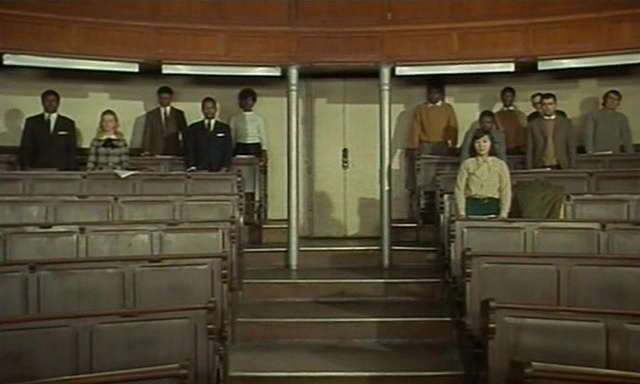
Displacement in relation to language stands at the center of André Delvaux’s troubling and troubled Un soir, un train (1968) — so precisely and so relentlessly that even the disquiet created by the collision of disparate nouns in the poetic title (a time and a place/ thing/vehicle, improbably yoked together like a chance meeting between a sewing machine and an umbrella on a dissecting table) arguably becomes lost or at least diluted in its English translation. One Night… A Train, by contrast, feels like the opening phrase in a familiar-sounding narrative, a prosaic flow of words that accounts for the three- period ellipsis, continuance replacing collision. And somewhere in between this collision and this continuance is the sort of stasis or uncertainty of both time and place evoked by the Flemish title of the Johan Daisne novella that the film is loosely based on, De trein der traagheid, which my Google translation engine, recognizing it as Dutch, translates as “The Train of Indolence”.

In the film, a conflict is being played out between Mathias (Yves Montand), a Flemish linguist and literature professor, and a theatrical stage designer named Anne (Anouk Aimée) who left France to live with him in Belgium and feels both excluded and scorned by the Flemish members of Mathias’ circle. Read more