From The Soho News (September 15, 1981). -– J.R.
Made in USA
By Jean-Luc Godard
Thalia, September 11 and 12
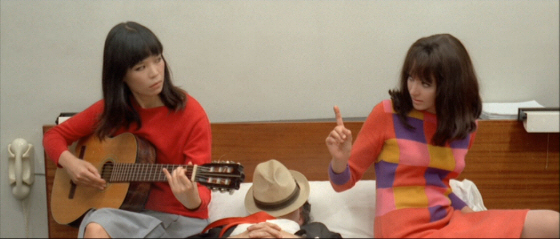
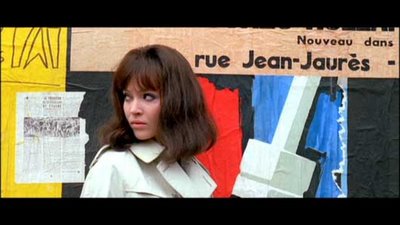
WHAT could be more timely than a Godard movie that repeatedly returns to the slogan, “The Left, Year Zero”? In point of fact, the beautiful, goofy, and explosive Made in USA was made in France in 1966. But for dispirited moviegoers, having to choose between Blow Out and Prince of the City (or the bossy rival senior critics pushing them) is like having to choose between the United States and the Soviet Union during the 50s (with bland Eisenhower and jocular Khrushchev at the respective helms). All things considered, Made in USA may well be the funniest and punchiest “new” movie around.
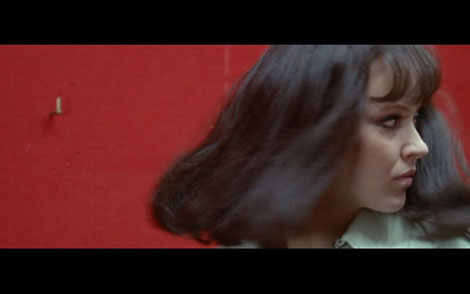
It’s the last feature that Godard ever shot with Anna Karina, who was never lovelier and never more made-up to seem at once Japanese and doll-like — in dazzling color and Scope. (Most of the close-ups of her in the movie are the kind of bold compositions you could hang on your wall.) In her off-screen film noir narration, she more or less accurately describes the formal and moral profile of the movie she’s in as ”a film by Walt Disney, but played by Humphrey Bogart — therefore a political film. Read more
From Written By 3, no. 11, November 1998. — J.R.
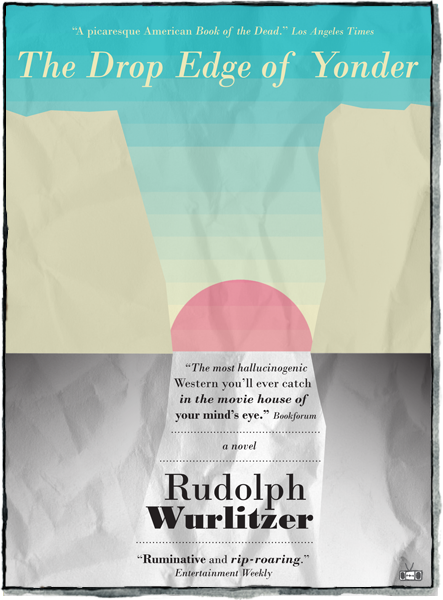
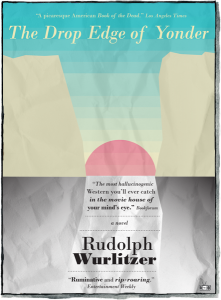
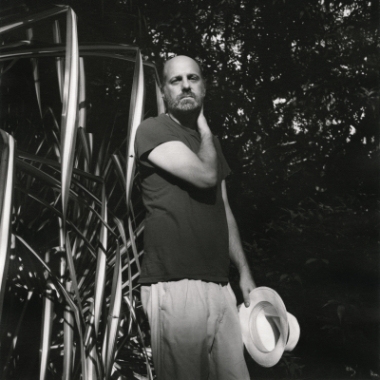
Let me start this off with an update: a plug for Wurlitzer’s most recent novel, a sort of Buddhist Western that grew out of an unrealized script, and a truly haunting page-turner. — J.R.
“What’s your name?” she asked.
“I don’t know,” I said. “I mean, I don’t know how to answer that.”
I was suddenly afraid of losing the anonymity that existed between us, as if once we knew our names the erotic focus we were falling into would dissolve. I curled my lower lip.
“We’re overloaded as it is.”
“Yeah, you’re right,” she said.
— Rudolph Wurlitzer, Quake (1972)
SQUIER We must move southward. Only by expanding can we hope to avoid a civil war and save those in
situtions we hold most precious.
DR. JONES I assume you are including slavery?
SQUIER I certainly am. We must not be sentimental if we wish to preserve that which is most precious to
us. The camera cuts to Ellen, enraged by the conversation. As her eyes dart around the room, she and Walker begin to move their hands in sign language. We see for the first time that Ellen is deaf. Read more
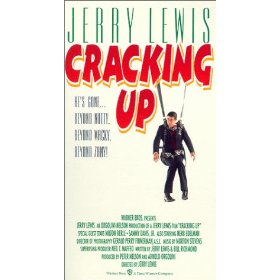
If you’re in Los Angeles in June (I won’t be), you might want to check out The Cinefamily‘s Jerry Lewis retrospective (page down), playing on Saturdays. This culminates in his last feature to date, Cracking Up (the poster for its European version is seen below).
I’m cited in the ad for the latter film in the following way: “In some ways it comes off as so formally brazen that the end result of this Airplane!-style gag-fest was avant-garde enough to appeal to academically inclined critics and Lewis lovers — Jonathan Rosenbaum, for example, sandwiched Cracking Up between Bresson’s L’Argent and Kiarostami’s Fellow Citizen on his list of best films of 1983 (the only English-language pick on the list).” I’m not sure what makes me “academically inclined,” but for the record, the (alphabetical) list of my favorite films of 1983 [in Essential Cinema] also includes, immediately below Fellow Citizen, Potter’s The Gold Diggers, Wenders’ Hammett, Dante’s It’s a Good Life [from Twilight Zone: The Movie], Scorsese’s The King of Comedy, Burnett’s My Brother’s Wedding, and, a bit further down the list, Wenders’ The State of Things, Brownlow and Gill’s The Unknown Chaplin, and Cronenberg’s Videodrome — all of them “English-language picks”. Read more
From the Chicago Reader (December 2, 2005). Also reprinted in my collection Goodbye Cinema, Hello Cinephilia. — J.R.

This weekend the Gene Siskel Film Center launches “Merry Marilyn!,” a Marilyn Monroe retrospective, starting with two pivotal Howard Hawks features, Monkey Business (1952) and Gentlemen Prefer Blondes (1953). The series will include most of her major films at Fox as well as Some Like It Hot (1959) and The Misfits (1960).
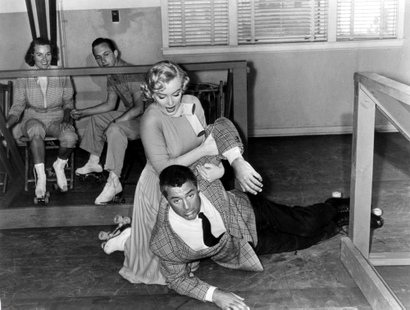
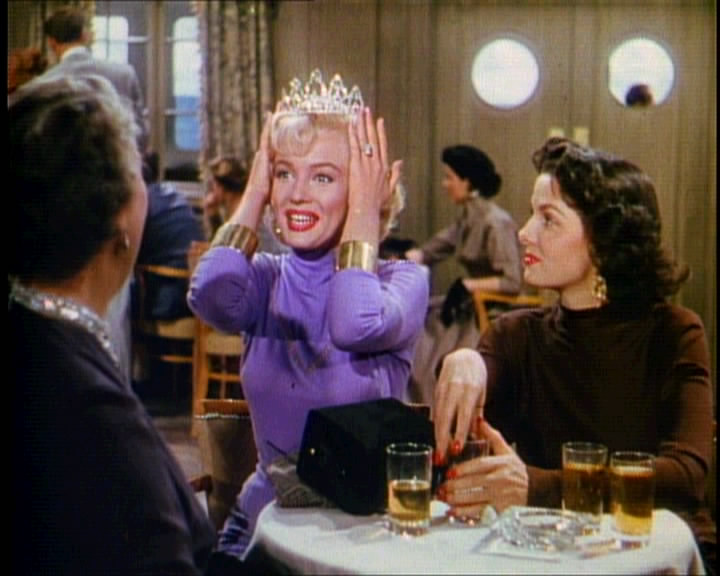
By coincidence Playboy this month is publishing a package of stories about her final days and death. The magazine is reviving the popular conspiracy theory that Monroe’s reported suicide in August 1962 was murder, the consequence of her secret affairs with John and Bobby Kennedy. If, like me, you’re less interested in how she died than in how she lived, the most interesting part of this package is an inexact transcript of the freewheeling confessional tape recordings she made for her psychiatrist, Ralph Greenson, a few weeks before her death. Greenson had asked her to free-associate during their sessions, but she found that difficult. Then she discovered that she lost her inhibitions when she was by herself speaking into a recorder. Shortly after her autopsy Greenson played these tapes—once, in his office—for Los Angeles County deputy district attorney John Miner, who like him was skeptical that Monroe had been of a mind to kill herself. Read more
This appeared in the November 6, 1998 issue of the Chicago Reader. Reseeing Pleasantville on DVD, I continued to find its diverse perceptions and confusions equally fascinating. On his audio commentary, producer-director-writer Gary Ross alludes to his childhood as the son of an activist screenwriter who was blacklisted, and part of what’s so intriguing about the film is the way its own theme of innocence crossed with sophistication is matched at times by its own multiple forms of ideological doublethink. Ross’s ongoing and seemingly untroubled assumption, for instance, that black and white film is innately artificial and stylized whereas color film is innately “realistic” makes me wonder how he can perceive MGM Technicolor of the 50s as being closer to reality (and thus presumably further away from fantasy) than all the black and white cinematography from the same period — or whether, for that matter, he can even distinguish sufficiently between the alleged “realism” of the contemporary color sections of this film and the subsequent expressionism of the hallucinogenic colors impinging on a 50s sitcom’s black and white to confidently declare that both of these kinds of color are automatically and unproblematically superior to black and white in representing reality accurately. Read more
The following, which I wrote circa March 2004, was commissioned for a Criterion box set; my thanks to Liz Helfgott, my editor there, for giving me the go-ahead to reprint this. — J.R.
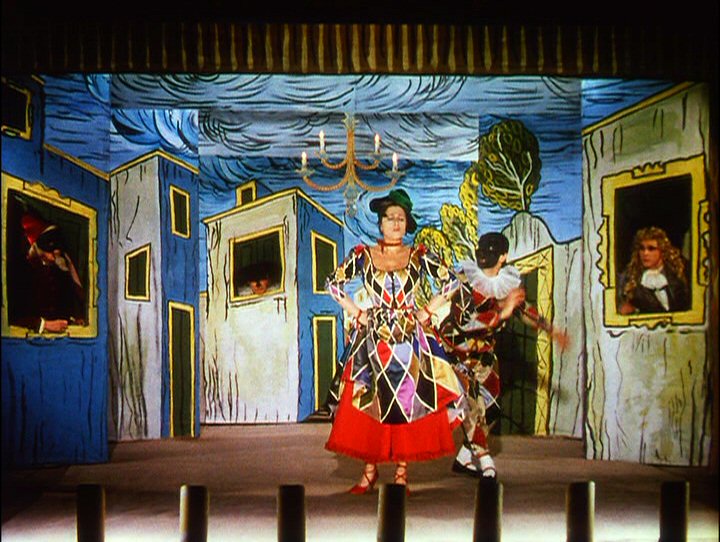
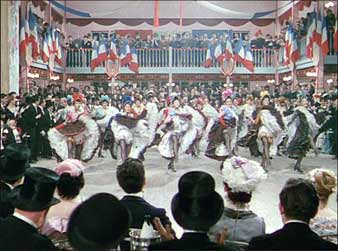
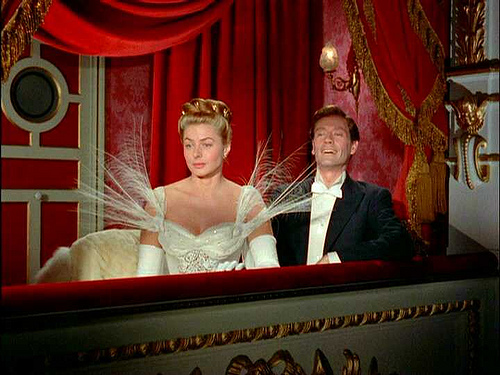
Jean Renoir’s Trilogy of Spectacle
by Jonathan Rosenbaum
Movie trilogies can be created by either filmmakers or critics. When Pier Paolo Pasolini wrote and directed The Decameron (1971), The Canterbury Tales (1972), and Arabian Nights (1973), he made no bones about calling them his Trilogy of Life. But when Michelangelo Antonioni followed L’avventura (1960) with La notte (1961) and L’eclisse (1962), the intention was mainly apparent in the titles and a few echoes noted by critics, such as the presence of building sites at the beginning of the first and at the end of the third. As for the so-called Koker trilogy of Where is the Friend’s House? (1986), Life and Nothing More… (1992), and Through the Olive Trees (1994), Iranian writer-director Abbas Kiarostami explicitly refuses to yoke them together in this fashion—–which hasn’t prevented many critics and programmers from doing so. Read more
This review of Frank Capra’s Broadway Bill (1934) first appeared in the August 7, 1992 issue of the Chicago Reader. –J.R.
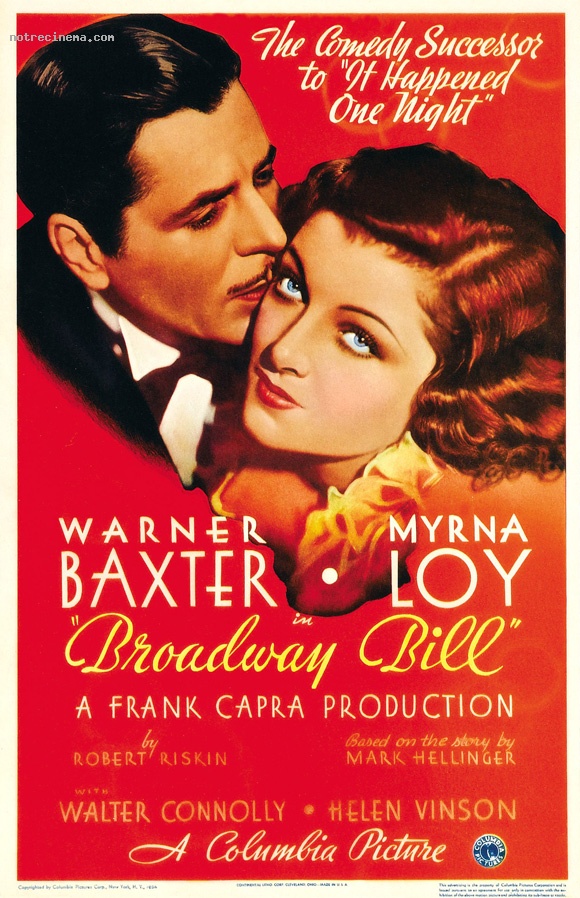
BROADWAY BILL
*** (A must-see)
Directed by Frank Capra
Written by Robert Riskin and Sidney Buchman
With Warner Baxter, Myrna Loy, Helen Vinson, Clarence Muse, Raymond Walburn, Walter Connolly, Margaret Hamilton, and Frankie Darro.

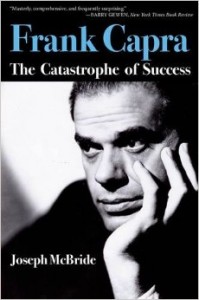
Though it’s surely a coincidence, the theatrical rerelease of Frank Capra’s Broadway Bill and the simultaneous publication of Joseph McBride’s Frank Capra: The Catastrophe of Success are mutually enhancing in a number of ways.
Capra’s 1934 Christmas release was made for Columbia, bought by Paramount, and withdrawn from circulation over 40 years ago, when Capra was preparing a remake called Riding High (1950) — a Bing Crosby musical with virtually the same plot and dialogue that was so unmemorable that despite numerous TV screenings the film critic for the Boston Globe claimed last month that it had never been made at all. The much feistier Broadway Bill, by contrast, has never turned up on TV, and apart from a few archival airings has remained unseen for over half a century. A breezy if edgy racing comedy laced with some serious ingredients, it isn’t nearly as good as The Bitter Tea of General Yen or It Happened One Night, both of which preceded it, but on the other hand it isn’t as cloying as the worst parts of its successors Mr. Read more
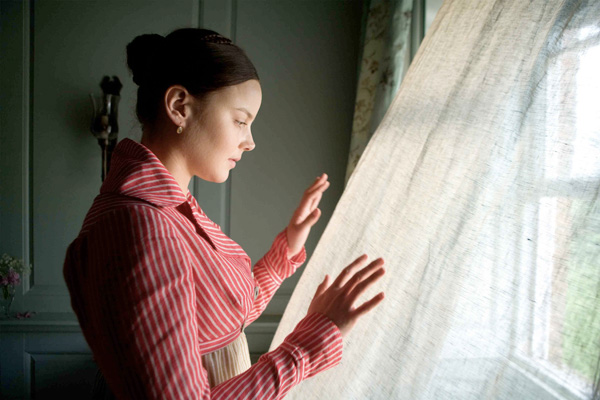
What’s most disconcerting about Jane Campion’s affecting evocation of Fanny Brawne and John Keats, which I caught up with tonight in Edinburgh, is that it has an exquisite soundtrack for me — erotic, tactile, essentialist in the best sense — only when Keats’ poetry remains unheard. Whether it’s being recited by Ben Wishaw as Keats or by Abbie Cornish as Brawne, the issue isn’t how or how well it’s being recited, which I have no particular quarrels with, but the fact that it gets recited at all. I was admittedly grateful in a way to hear Wishaw recite all of “Ode to a Nightingale” over the final credits, despite the distracting musical accompaniment, even while a good half of the audience was leaving the theater, because there, at least, it wasn’t competing with Campion’s filmmaking. But I’m less sure about the other employments of Keats’ writing in the film, even though the letters arguably seem more justifiable than the poetry, at least from a narrative standpoint.

One of Campion’s strongest suits has always been her eroticism, and the best part of A.O. Scott’s review in the New York Times (as it often is, for him as well as for Manohla Dargis) comes not in the review proper but in the squib at the end appended to the MPAA rating: “It is perfectly chaste and insanely sexy.” Read more
In memory and appreciation of Sidney Lumet (1924-2011). This appeared in the March 17, 2006 issue of the Chicago Reader. — J.R.
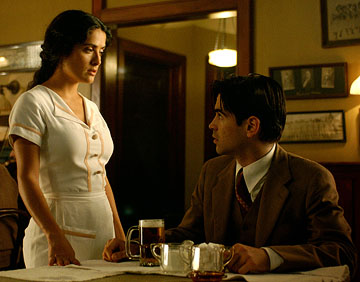
Ask the Dust *** (A must see)
Directed and written by Robert Towne
With Colin Farrell, Salma Hayek, Idina Menzel, Donald Sutherland, Eileen Atkins, and William Mapother
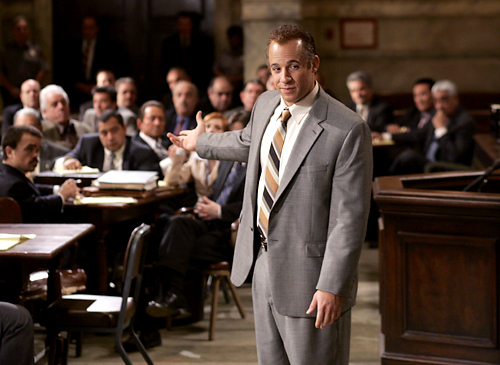
Find Me Guilty *** (A must see)
Directed by Sidney Lumet
Written by Lumet, T.J. Mancini, and Robert J. McCrea
With Vin Diesel, Ron Silver, Peter Dinklage, Linus Roache, Tim Cinnante, Annabella Sciorra, Raul Esparza, and Alex Rocco
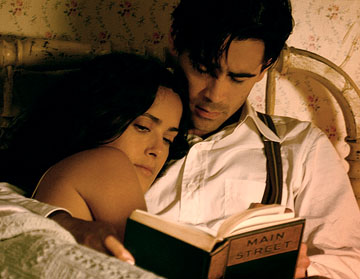
John Fante’s slim 1939 novel Ask the Dust, one of four autobiographical novels about his surrogate, Arturo Bandini, has a childlike lyricism that recalls William Saroyan and Jack Kerouac. “I climbed out the window and scaled the incline to the top of Bunker Hill. A night for my nose, a feast for my nose, smelling the stars, smelling the flowers, smelling the desert, and the dust asleep, across the top of Bunker Hill. The city spread out like a Christmas tree, red and green and blue. Hello, old houses, beautiful hamburgers singing in cheap cafes, Bing Crosby singing too.” In this novel Fante celebrates his 20-year-old self from a vantage point of almost a decade later, but unlike Saroyan and Kerouac, he also criticizes that earlier self. Read more
From the Chicago Reader (June 21, 1991). — J.R.
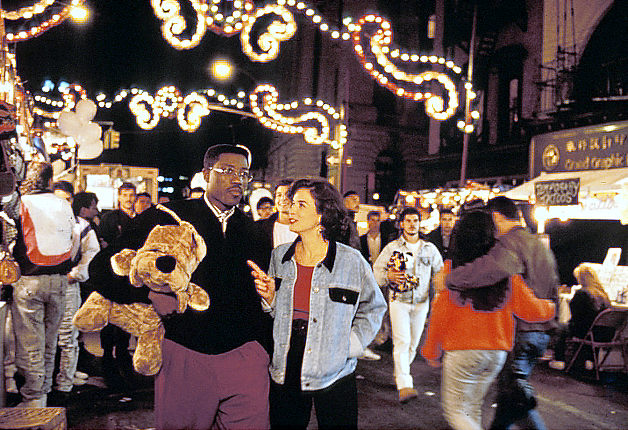
JUNGLE FEVER
**** (Masterpiece)
Directed and written by Spike Lee
With Wesley Snipes, Annabella Sciorra, Spike Lee, Samuel L. Jackson, Ossie Davis, Ruby Dee, Lonette McKee, John Turturro, Frank Vincent, and Anthony Quinn.
Trusting to luck means listening to voices. — Jean-Luc Godard in the 1960s
Compared to Do the Right Thing, Spike Lee’s Jungle Fever is inspired overreaching, an exciting mess — and conceivably even more important. If the earlier movie somehow marshaled its sprawling elements into a single story in a single setting with a single theme, this one has two settings (Harlem and Bensonhurst), three plot lines, and at least four themes (interracial romance, breaking away from one’s family, crack addiction, and corporate advancement for blacks), all of which are crammed together more willfully than logically, yielding a misshapen story that is neither singular nor plural in focus, but somewhere obscurely in between.
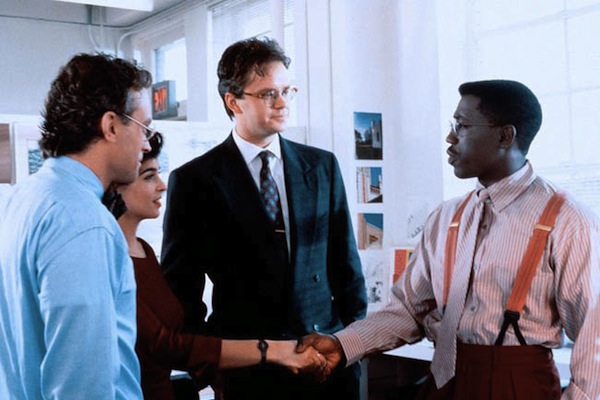
First plot: Flipper (Wesley Snipes), an upscale Afro-American architect with a wife and daughter living in Harlem, starts an affair with his new temp secretary, Angie (Annabella Sciorra), a single Italian American who lives with her working-class father and brothers in Bensonhurst. Flipper tells his best friend Cyrus (Spike Lee), who tells his wife (Veronica Webb), who tells Flipper’s wife, Drew (Lonette McKee), who responds by throwing Flipper out. Read more
The following article was written for the June 8, 2001 issue of the Chicago Reader, to coincide with the release of Jafar Panahi’s The Circle in Chicago — although a differently edited version was published. This is my original version, which I included in Movie Mutations: The Changing Face of World Cinephilia, a 2003 collection I coedited with Adrian Martin. (Lamentably but unsurprisingly, this was the only section of the book that was left out of the Persian translation.)
One indication of Panahi’s extraordinary courage, after his appalling incarceration in Tehran’s Evin prison back in March, was the fact that he expressly requested not to be accorded “special” treatment because of his status as an artist and filmmaker. It seemed worth reposting this article on December 21, 2010, not only because of the shocking sentence received by Panahi after his trial, but also to correct the original misdating of this article on this site and in Movie Murtations, which I learned about via David Bordwell’s site. — J.R.
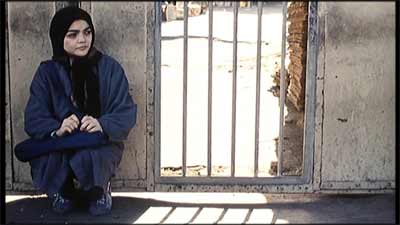
Squaring The Circle

Last month, I was taken aback by an email from a colleague — not a cranky stranger — waiting for me at my office computer one morning. Read more
In my more than 20 years at the Chicago Reader, whenever an old film came to town that had a Reader capsule on file by Dave Kehr, my long-term predecessor at that paper (who left the paper in the mid-1980s), I always had the option of either using that old capsule or writing a new one. On almost every occasion when this happened, I opted for the former — for my money, Dave was and is the best capsule reviewer in the business, bar none. But when it came to The Best Years of Our Lives, I eventually decided that I had to write a new one. Below are the two capsules in question:
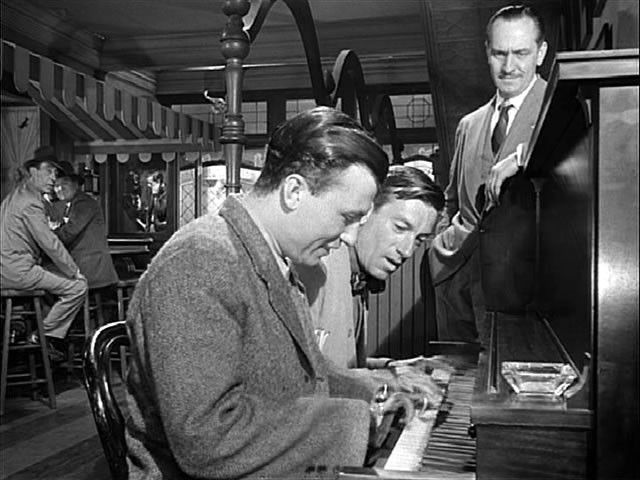
Perceived in 1946 (to the tune of nine Academy Awards) as a sign that the movies had finally “grown up,” William Wyler’s study of a group of men returning to civilian life after the war was a tremendous commercial success and helped to create Hollywood’s postwar highbrow style of pseudorealism and social concern. The film is very proud of itself, exuding a stifling piety at times, but it works as well as this sort of thing can, thanks to accomplished performances by Fredric March, Myrna Loy, and Dana Andrews, who keep the human element afloat. Read more
This was published as my ninth one-page column in Cahiers du Cinéma España; it ran in their January 2009 issue (No. 19). — J.R.

It’s by no means unusual for a “retired” film scholar such as myself to find more work as a freelancer since my retirement late last February than I did for most of the previous two decades as a staff reviewer for the Chicago Reader. Two of my contemporaries, both former academics and both friends of mine — the slightly younger David Bordwell and the slightly older James Naremore — have told me that they’re busier nowadays than they were when they were teaching. But what seems more surprising, at least to me, is how much of my time recently has been consumed by my participation in panels and symposia, both in print and in person, about the alleged death of film criticism. The October issue of Sight and Sound is full of ruminations on this subject, under such headings as “Who needs critics?” and “critics on critics”; so is the Autumn issue of Cineaste, where the stated topic is “Film Criticism in the Age of the Internet: A Critical Symposium”. A week from now, I will be flying from Chicago to the New York Film Festival to speak on a panel called “Film Criticism in Crisis?” Read more
Adapted from “Problemes d’accès: Sur les traces de quelque films et cinéastes ‘de festival,’” translated by Jean-Luc Mengus, Trafic no. 30, été 1999. — J.R.
“Festival film”: a mainly pejorative term in the film business, especially in North America. It generally refers to a film destined to be seen by professionals, specialists, or cultists but not by the general public because some of these professionals decide it won’t or can’t be sufficiently profitable to warrant distribution. Whether these professionals are distributors, exhibitors, programmers, publicists, or critics is a secondary issue, particularly because these functions are increasingly viewed today as overlapping, and sometimes even as interchangeable.
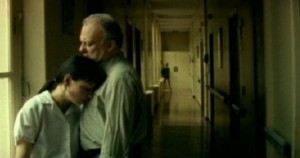
The two types of critic one sees at festivals are those (the majority) who want to see the films that will soon be distributed in their own territories, and those who want to see the films that they’ll otherwise never get to see — or in some cases films that may not arrive in their territories for a few years. The first group is apt to be guided in their choices of what to see by distributors, or else by calculated guesses of what distributors will buy. The second group, if it hopes to have any influence, will ultimately seek to persuade potential distributors as well as ordinary spectators, but whether it functions in this way or not, its spirit is generally guided by cinephilia more than by business interests. Read more
This book review, which I’ve alluded to previously on this site, appeared in the November 2, 1980 issue of The Soho News. —J.R.
Under the Sign of Sontag
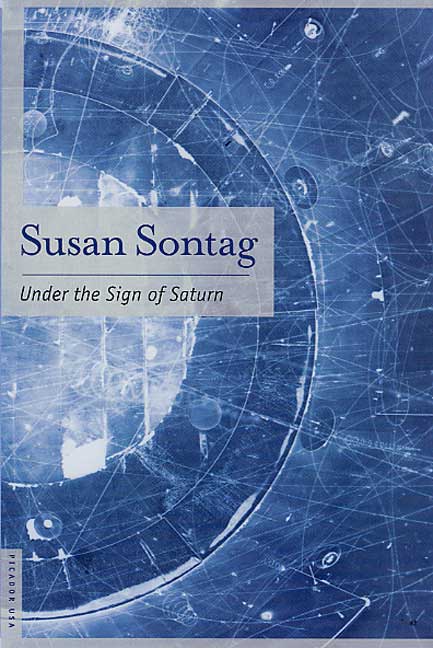
Under the Sign of Saturn
By Susan Sontag
Farrar, Straus & Giroux, $10.95

If, dialectically speaking, every book can be said to have an unconscious — a repressed subtext — one can find glimpses of the unconscious of this one in the misleading flap copy that quotes from an interview (“Women, the Arts, and the Politics of Culture,” Salmagundi 31-32) and mentions the inclusion of a “famous exchange on fascism and feminism” (apparently with Adrienne Rich, in the March 20, 1975 New York Review of Books), both regrettably missing from this slim volume of seven essays.
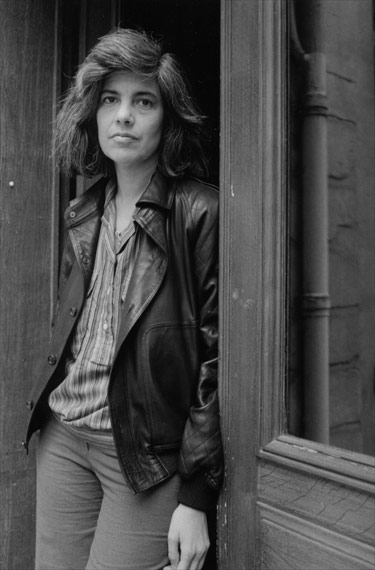
These omissions betray the absence of a gritty, indecorous social context — a sense of Sontag existing in the world, not merely staging grand Platonic shadow-plays in the theater of her mind. Much as Illness as Metaphor (1978) was partially structured around her refusal to allude once to her own personal struggle, this book discreetly, indirectly dances around the notion that the subject of every essay proposes a different kind of mirror to the author, a speculative self-portrait. Read more