From the Chicago Reader (September 1, 1998). — J.R.

The fascinating thing about this award-winning feature-length documentary (1996) by Duan Jinchuan from mainland China is that it often seems to approximate the work of Frederick Wiseman in showing us the everyday workings of contemporary society — although the society in this case is one we generally know little about. The focus here is on a neighborhood committee in Lhasa, Tibet, where citizens go to settle family disputes, petty thieves and other delinquents are chastised and advised, community finances are computed, and street vendors are regulated, among many other activities. This doesn’t register like a thesis-driven film, though the preparations for an official ceremony celebrating the Chinese occupation of Tibet towards the end certainly has its creepy side, and one that implicitly rhymes with the other forms of patriarchal rule that one has witnessed in most of the preceding segments. (JR) Read more
From the Chicago Reader (July 8, 1995). — J.R.
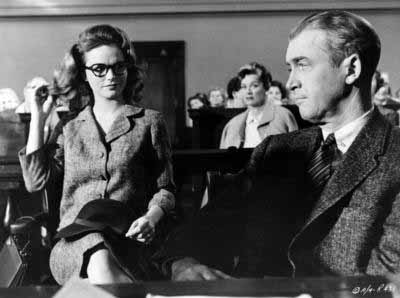
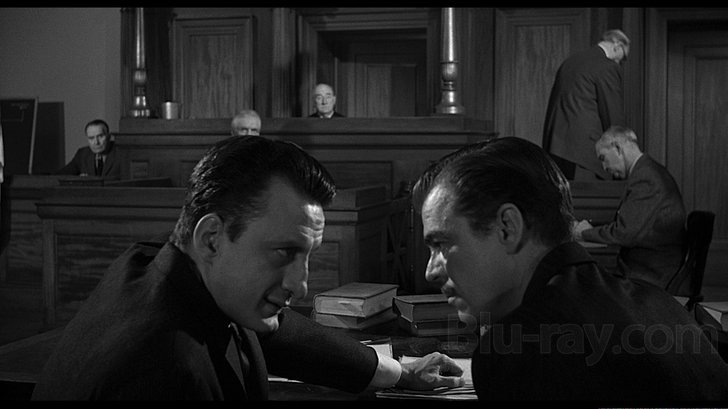
This 1959 release is a prime contender for Otto Preminger’s greatest film — a superb courtroom drama packed with humor and character that shows every actor at his or her best. James Stewart plays a small-town Michigan lawyer asked to defend an army lieutenant (Ben Gazzara) on a charge of murdering a local businessman who allegedly raped his flirtatious wife (Lee Remick); Boston lawyer Joseph Welch (of the army-McCarthy hearings), in his only screen performance, plays the judge; and George C. Scott is a lawyer working for the prosecution. There are also wonderful performances by Arthur O’Connell and Eve Arden, and even a cameo by Duke Ellington, who composed the memorable jazz score. As an entertaining look at legal process, this is spellbinding, infused by an ambiguity about human personality and motivation that is Preminger’s trademark, and the location shooting is superb. Adapted by Wendell Mayes from Robert Travers’s novel. 161 min.

 Read more
Written for The Unquiet American: Transgressive Comedies from the U.S., a catalogue/ collection put together to accompany a film series at the Austrian Filmmuseum and the Viennale in Autumn 2009. — J.R.

On the Riviera, an American multimillionaire (Gary
Cooper) with many ex-wives meets and romances the
daughter (Claudette Colbert) of a ruined Marquis
(Edward Everett Horton) and proposes marriage;
after she accepts, she learns about his former wives
and refuses to consummate their marriage, baiting
him with a string of pretended infidelities (including
one with a very young David Niven). This is an uncharacteristic
comedy of Ernst Lubitsch by virtue of its relative cruelty
and unpleasantness, both of which seem ascribable in
part to the writing team of Charles Brackett and Billy Wilder
-– who would later show similar traits in their scripts for
such noncomic films as The Lost Weekend (1945) and
Sunset Boulevard (1950) -– adapting here a not-very-
well-known French farce by Alfred Savoir, La huitième
femme de Barbe-Bleue. Paradoxically, 34 years later,
working with I.A.L. Diamond, Wilder would remember certain
aspects of this film -– above all, the depiction of an
obnoxious and wealthy American abroad and a tense
romantic dialogue conducted on a float in the Mediterranean
— in the much sweeter and clearly Lubitsch-inspired
Avanti! Read more
From Film Comment (July-August 1976). In some respects, I think this may be the best of all my many Journals for Film Comment, but for my readers who feel that my work is sometimes (or often) marred or even ruined by my strident tone, it may also be legitimately regarded as my worst. Among other negative consequences, Truffaut read my comments about THE STORY OF ADELE H. and wrote me an angry letter about them (which can be accessed, along with my response to it, on this site), I suspect (without actually knowing) that my passing comment about Pauline Kael may have sabotaged any hopes I’d had about ever becoming friends with her, and my friend (at the time) Gilbert Adair, cited just before the end of this piece, was furious about the over-the-top way I expressed my displeasure with Charles Barr in Movie. For better and for worse, I think this shows my writing at its most intense. -– J.R.
March 25 (London): A KING IN NEW YORK.Even on a Steenbeck, Chaplin’s penultimate feature and last extended performance has such a naked power of embarrassment and assault that one can see right away why so many have recoiled from it. Read more
Written for The Unquiet American: Transgressive Comedies from the U.S., a catalogue/ collection put together to accompany a film series at the Austrian Filmmuseum and the Viennale in Autumn 2009. — J.R.
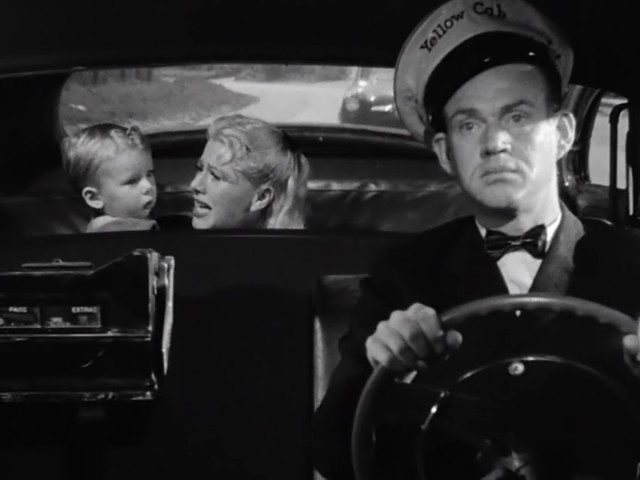
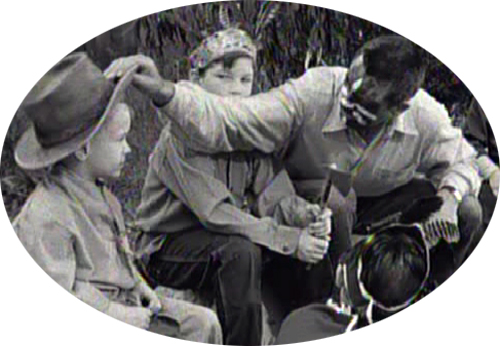
MONKEY BUSINESS (1952)
Although technically a fantasy, this characteristically
grim Howard Hawks comedy about the fear of aging
and the worship of youth is arguably one of his most
honest and realistic, therefore among the most frightening.
A chimpanzee in a chemistry lab manages to
create a youth potion accidentally ingested by the
middle-aged scientist-hero (Cary Grant), who regresses
first to his teens and then, after a second dose, to
his attitudes and behavior in grammar school, which
also happens eventually to his wife (Ginger Rogers)
and boss (Charles Coburn), thereby debunking a
good many myths about youth and happiness (such
as those involving carefree innocence) in the process.
Broadly speaking, this movie does for (and with)
ageism what Gentlemen Prefer Blondes, shot half a
year later (with some of the same cast members, including
Marilyn Monroe, Coburn, and George Winslow),
does for (and with) capitalism, albeit with less
celebratory cynicism and more visible despair. This
doesn’t mean, of course, that it isn’t funny; at least
four Hollywood pros (Ben Hecht, Charles Lederer,
I.A.L. Read more
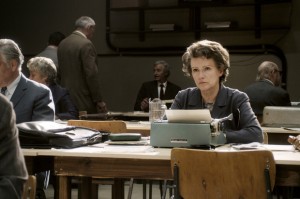
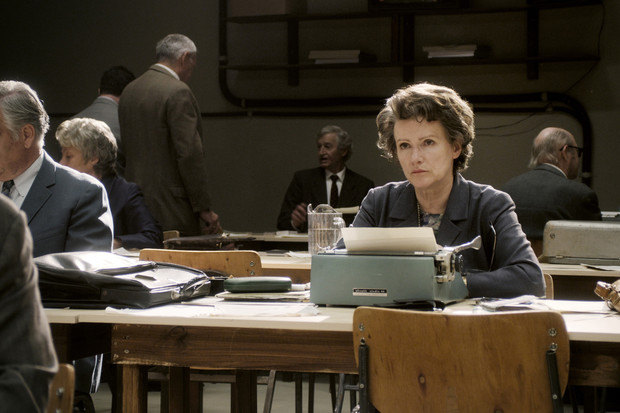
I never expected to see any Margarethe von Trotta movie more than once, but Hannah Arendt proved to be well worth a second look. Some of my reasons for going back are undoubtedly personal; Arendt’s husband, Heinrich Blücher, astutely played in the film by Axel Milberg, is by far the greatest teacher I’ve ever had, two of whose seminars at Bard College I was fortunate to take, and Arendt’s Eichmann in Jerusalem, the main focus of the film, appeared in The New Yorker during the same period. The controversy it sparked among New York intellectuals at the time made it the major topic of discussion among visiting speakers; I can recall lengthy conversations I had or overheard with Harold Rosenberg and Dwight Macdonald, among many others who came to campus during that period. (Lionel Abel, perhaps the most intemperate of Arendt’s foes, also came, but as I recall I went out of my way to avoid broaching the subject with him.) And there were plenty of snack-bar dialogues at Bard with Blücher on the same subject.

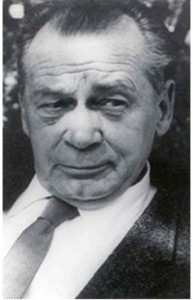
For me, part of the singularity of both Blücher and Arendt (whom I met only briefly, once in their Riverside Drive apartment) was the degree to which art, politics, philosophy, moral seriousness, and a remarkable passion for ethics interfaced in their discourse and lives with an unflagging intensity, and what I cherish most about von Trotta’s movie is the degree to which she — and, above all, Barbara Sukowa as Arendt — capture this. Read more
From the Chicago Reader (September 1, 1992). — J.R.

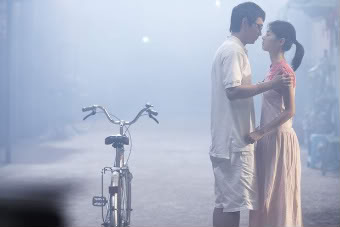
Lee Myung-sei’s delightful Korean comedy about the trials and tribulations of a young married couple (Park Joong-hoon and Choi Jin-sii, both charming and resourceful actors) offers eloquent testimony to the stylistic importance of Frank Tashlin (The Girl Can’t Help It, Artists and Models, Will Success Spoil Rock Hunter?) as an international legacy. Tashlin’s background as an animator — his graphic talent, his formal ingenuity, his taste for bright primary colors — and his flair for satire of contemporary lifestyles both seem fully present in this lively and inventive feature. It isn’t that Lee has necessarily seen or studied Tashlin’s work, but Tashlin’s bag of tricks has become an automatic part of everyone’s resources, and this comedy fully exploits it (1991). (JR)
 Read more
From the February 5, 1988 Chicago Reader. — J.R.
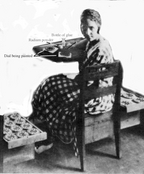
RADIUM CITY
Directed by Carole Langer
Thanks largely to the influence of auteur criticism, most of our aesthetically oriented writing about film since the 60s has been concerned with style. But one could argue that such an emphasis has tended to divert attention from what might be considered even more important — namely, form and content. “Whatever its sophistication,” Roland Barthes wrote in Writing Degree Zero, “style always has something crude about it: it is a form with no clear destination, the product of a thrust, not an intention. . . . Its frame of reference is biological or biographical, not historical . . . it rises up from the writer’s myth-laden depths and unfolds beyond his area of control.”
Perhaps only in an area like Hollywood moviemaking, where the artist seldom has final control over either the form or the content, can style be raised to the level of an ultimate principle. Yet because Hollywood continues to dominate our screens as well as the ways that we think about movies in general, the notion of style is also routinely applied to Bresson, Godard, Kubrick, and Tarkovsky, when surely form and content, not style, is what their best films are about. Read more

While eagerly awaiting the publication of the aptly named Images of the Mind: The Essential Raymond Durgnat, a definitive collection edited by Henry K. Miller that the British Film Institute will apparently publish later this year, I’ve just found time to experience the pleasure of a remarkable 1992 documentary with half of the same title, Jarmo Valkola’s 45-minute Images of the Mind: Cinematic Visions by Raymond Durgnat — a film now available at newly revamped Durgnat web site that manages to be both a wonderful portrait of the greatest of all English film critics (1932-2002), speaking as both a fan and as a friend over the last three decades of his life (as well as one-time house mate, circa 1977-78), and a brilliant lecture by Ray about the nature of film, the history of the English character in the 20th century, and the art of Michael Powell. Indeed, the only thing that can be said to be dated about this remarkable film is the fact that it cites Durgnat’s still-unpublished book about Powell as one of his publications. Otherwise, it impressively predates the recent film criticism on film that can be found in the work of Kevin Lee and Volker Pantenburg, among many others. Read more
From Scenario, Vol. 4, No. 1, Spring 1998. –- J.R.
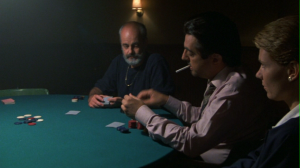
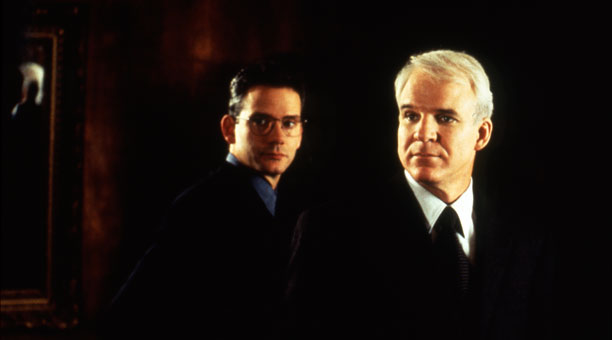
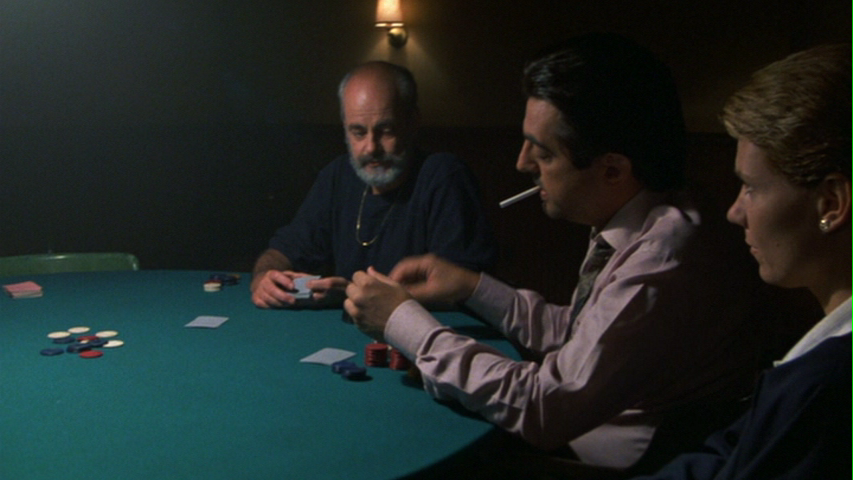
“Hitchcock lives!” I was inspired to write at the head of my review of House of Games, David Mamet’s first feature, in 1987. Ten years later, Mamet’s fifth feature, The Spanish Prisoner, boasts plenty of Hitchcockian elements of its own. But this time I’m not as prone to employ the same assertion.
The difference has less to do with Hitchcockian influence than with the use of that influence — the issue of whether Mamet is borrowing something substantive from the Master of Suspense, or drawing upon Hitchcock only when it suits his strategies. But one of the salient differences I find between reading the script of The Spanish Prisoner and seeing it realized is the difference between finding a Hitchcockian thriller on the page and not quite seeing one on the screen. Both are clearly Mamet creations, but the first comes closer to showing Hitchcock’s special qualities in tandem with Mamet’s, whereas the second shows them shooting off in separate directions.
Put somewhat differently, the distinction has a lot to do with issues that seem central to any evaluation of Hitchcock as well as Mamet -– namely, the ethics and aesthetics of deception, which are intimately tied to the ethics and aesthetics of representing a real world where deception becomes possible. Read more
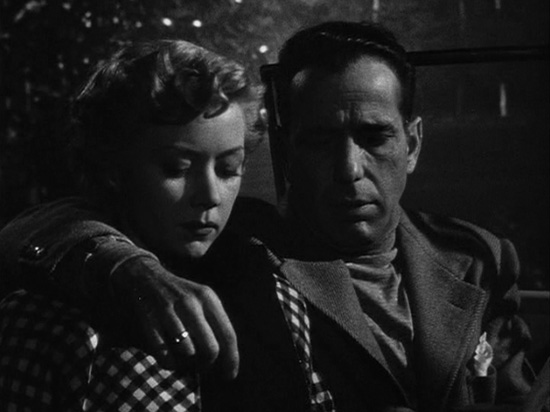
Recommended Reading: An excellent piece about In a Lonely Place, and Nicholas Ray more generally, by J. Hoberman in this week’s Village Voice. My only (minor) quarrel is with the following phrase: “An ex-Communist who was never persecuted, and must have wondered why…” From Bernard Eisenschitz’s definitive biography, one can pretty clearly surmise that Ray was protected from the Blacklist by Howard Hughes, for whom he was a sort of patch-up man, semipermanently on tap — something he must have been perfectly aware of. [7/17/09] Read more
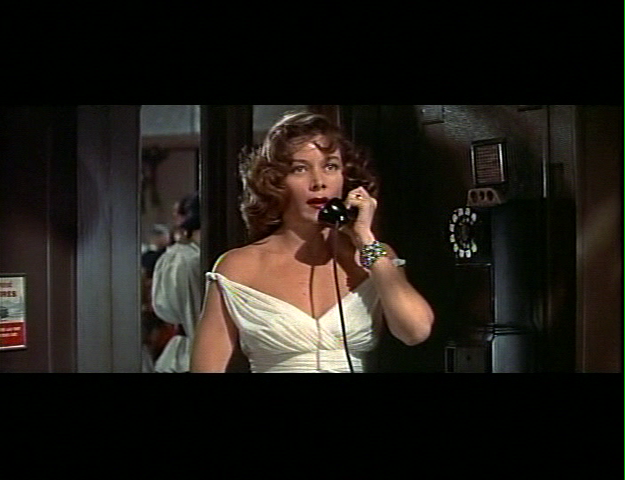
VINCENTE MINNELLI: THE ART OF ENTERTAINMENT, edited by Joe McElhaney, Detroit: Wayne State University Place, 2009, 458 pp.
In spite of my disappointment that Mademoiselle — Minnelli’s extraordinary centerpiece in The Story of Three Loves and surely one of his greatest films — gets virtually ignored here, this is a terrific critical collection, so I’m very grateful to Girish Shambu’s blog for calling my attention to it. Among the many treasures to be found here are what appears to be the very best French criticism about Minnelli, expertly translated by Bill Krohn, Jean-Pierre Coursodon, and Brian O’Keefe, including Raymond Bellour (on Brigadoon), Serge Daney (separate pieces on The Pirate and The Cobweb as they each appear on French TV), Jean Douchet (separate pieces on The Four Horsemen of the Apocalypse and Two Weeks in Another Town), Emmanuel Burdeau (who also has two pieces), and Jean-Loup Bourget. There are also sturdy contributions by, among others, Krohn himself, Scott Bukatman, Thomas Elsaesser, Adrian Martin, James Naremore, Dana Polan, Robin Wood, and two essays apiece by Geoffrey Nowell-Smith, David A. Gerstner, and the editor, Joe McElhaney.
Back in the mid-1980s, I published a survey about Minnelli’s work on video, titled (I believe) “In Dreams Begin Responsibilities,” which I seem to have misplaced — something I’m mentioning now only because I’ve often thought that this particular phrase from William Butler Yeats perfectly describes Minnelli’s auteurist thematics. Read more
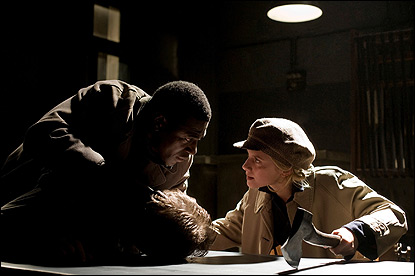
Recommended Reading: “When Jews Attack” by Daniel Mendelsohn, a two-page spread in the August 24 & 31 issue of Newsweek, begins to help me account for what I find so deeply offensive as well as profoundly stupid about Inglourious Basterds [sic sic — or maybe I should say, sic, sic, sic]. A film that didn’t even entertain me past its opening sequence, and that profoundly bored me during the endlessly protracted build-up to a cellar shoot-out, it also gave me the sort of malaise that made me wonder periodically what it was (and is) about the film that seems morally akin to Holocaust denial, even though it proudly claims to be the opposite of that. It’s more than just the blindness to history that leaks out of every pore in this production (even when it’s being most attentive to period details) or the infantile lust for revenge that’s so obnoxious. When Mendelsohn asks, “Do you really want audiences cheering for a revenge that turns Jews into Nazis, that makes Jews into `sickening’ perpetrators?”, he zeroes in on what’s so vile about this gleeful celebration of savagery. He also clarifies the ugly meaning of Tarantino’s final scene when he points out that Nazis carved Stars of David into the chests of rabbis before killing them — a fact I either hadn’t known before or had somehow managed to suppress. Read more
The following was written for the May 1976 issue of Monthly Film Bulletin. —J.R.
Screwball Squirrel
U.S.A., 1944
Director: Tex Avery
Cert—U. dist—Ron Harris. p.c—MGM. p—Fred Quimby. story—Heck Allen. col—[originally made in Technicolor]. anim—Preston Blair, Ed Love, Ray Abrams. m—Scott Bradley. 248 ft. 7 min. (16 mm.).
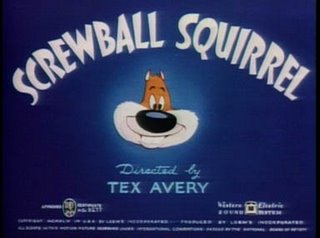
After beating up Sammy Squirrel — an effeminate Disney-like creature who purports to be the hero of the cartoon — Screwy Squirrel enters a phone booth and calls Meathead the dog to get another plot going. After an extended chase, Meathead tries to end the cartoon, but Screwy offers him one more chance to catch him. The results are immediately complicated by the fact that both confess to have been twins all along; a revived Sammy joins the group.



As Joe Adamson had ungrammatically but aptly noted, “Screwy Squirrel is Daffy Duck taken one step further that he absolutely has to.” A thoroughly demented character who lasted through five cartoons in the mid-Forties (Screwball Squirrel, Happy-Go-Nutty, Big Heel-Watha, The Screwy Truant, and Lonesome Lenny), he seems important in Avery’s career not so much for his own intrinsic qualities — monotonously aggressive mania and not much else — as for the wild bouts of anti-illusionist high jinks and comparable assaults on the audience that he provoked in his creators. Read more
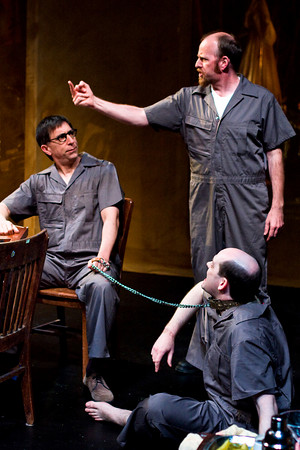
As a fan of the directorless Theater Oobleck dating all the way back to its second show in Chicago (David Isaacson’s riotous Three Who Dared: A Play on the Movies, in June 1988), with particularly fond memories of Jeff Dorchen’s The Slow and Painful Death of Sam Shepard (December 1988) and Ugly’s First World (October 1989) as well as Mickle Maher’s When Will the Rats Come to Chew Through Your Anus? (January 1990), I regret having somehow lost touch with their singular repertory of literary and political shotgun marriages in recent years. A recent visit to Dorchen’s brilliantly excessive Strauss at Midnight at the the Chicago DCA Theater (66 E. Randolph), which runs through July 19, reminded me of how much heat and liberating anger and laughter they can generate.
This play has something to do with Saul Bellow (Isaacson), posthumously still tainted by his former association with Allan Bloom (Troy Martin), and, through Bloom, with Leo Strauss (David Shapiro), condemned to a hell in which he has inhabit the same quarters as Neil Simon’s Odd Couple (Brian Nemtusak and H.B. Ward doing fine, surreal spinoffs of Jack Lemmon and Walter Matthau), not to mention Niccolo Machiavelli (Scott Hermes) and In the Heat of the Night‘s Virgil Tibbs (D’wayne Taylor). Read more