I’ve been asked more than once to comment on Sylvain Chomet’s recent animated feature based on a Jacques Tati screenplay — something I’ve frankly been avoiding, for reasons that I’ll try to explain.
Last February 16, I received a very lengthy email from Richard Tatischeff Schiel McDonald, identifying himself as the middle grandson of Tati, and expressing his upset and anger about this film, which I was hearing about for the first time from him, and requesting that I make some of the information he was conveying to me better known if I planned to write about the film. I wrote him back the next day, and a week later he wrote me again: “I must admit to finding myself in a slightly uncomfortable position in making public the origins of my grandfather’s original l’Illusionniste script which until recently had been a very private family matter. My intentions are not to discredit my grandfather but hopefully by telling what is a very sad story I can shine a light onto a neglected chapter of his life that in part led to the creation of his professional body of work. My grandmother and all his stage acquaintances during the 1930’s/40’s always maintained that he was a great colleague as a friend and artist; he unfortunately just made a massive mistake that because of the time and circumstances he was never able to correctly address. Read more

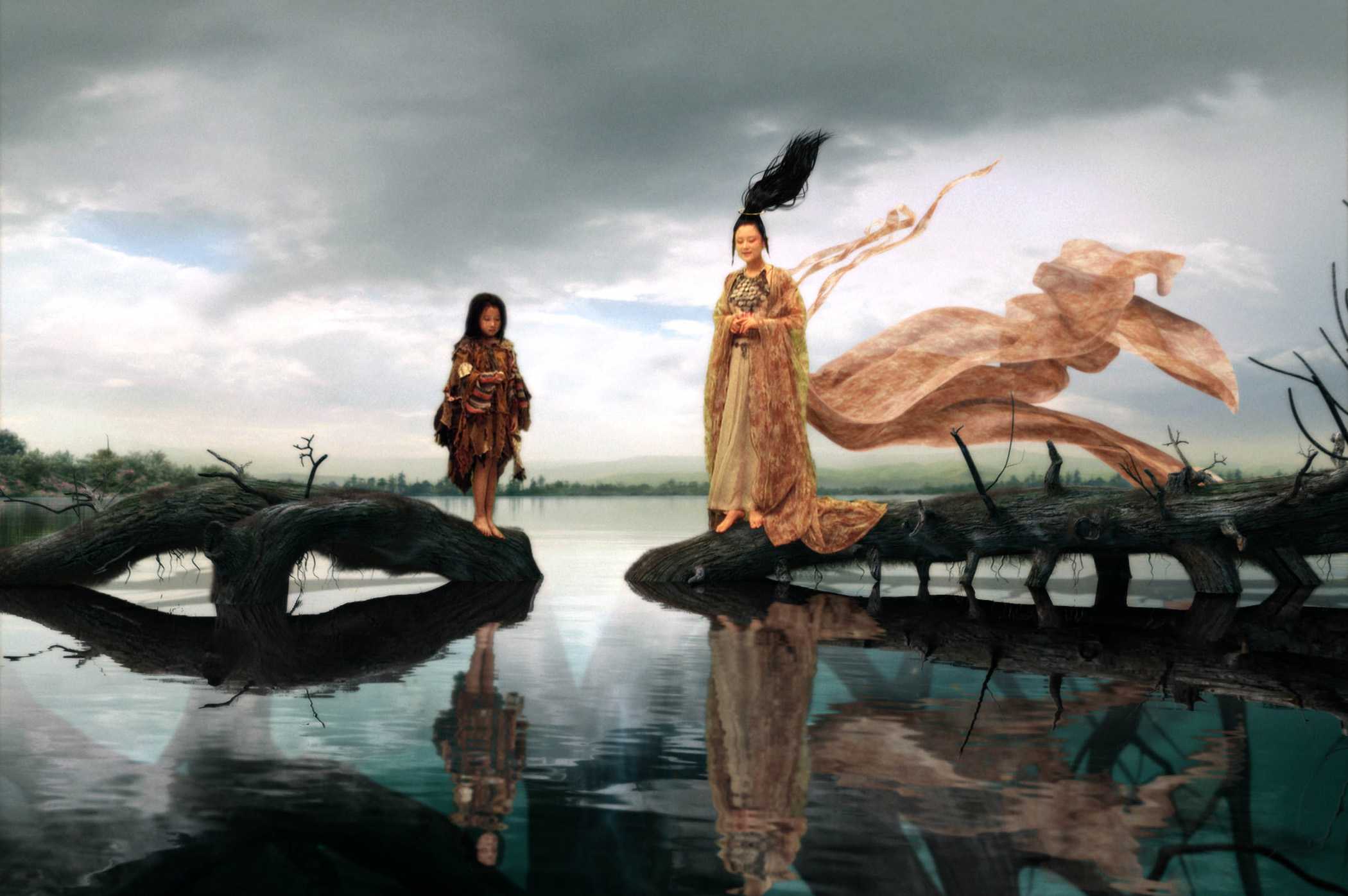
Chen Kaige clearly intended this Chinese fantasy-action spectacle to top Zhang Yimou’s Hero, and I must admit that I prefer it to the earlier movie: the digital effects are sometimes excessive, yet Chen’s story of a loyal slave, his master, and a wealthy, seemingly doomed princess is more affecting, especially in the closing stretch. Chen’s original U.S. distributor, the Weinstein Company, ordered him to shorten the movie from its original running time of 128 minutes and then dropped it. (It’s worth recalling that his 1996 feature Temptress Moon was severely damaged by Miramax’s recutting.) Now Warner Independent Features is releasing the abbreviated, 102-minute version, and it’s well worth checking out. PG-13. Century 12 and CineArts 6, Esquire, Landmark’s Century Centre.
 Read more
My latest column for Caimán Cuadernos de Cine, submitted about a week before flying to Europe (Bologna and Paris). — J. R.
En movimiento: Bulle Ogier as Hidden Star
Jonathan Rosenbaum
I have a special reverence for film criticism on film — by which I mean criticism on, by, through, and about film. A few of the gems in this hallowed category are Alphaville (as criticism of silent German Expressonist cinema), audio-visual essays about Ivan the Terrible by Yuri Tsivian and Joan Neuberger, Céline et Julie vont en bateau (as criticism of 1950s Hollywood melodrama), Los Angeles Plays Itself –and now a beautiful 2024 documentary by Eugénie Grandval about a great actress-auteur (one of the four writers-actresses who gave us Céline et Julie) whom I first discovered at a memorable midnight Paris screening of Rivette’s L’amour fou circa 1971: Bulle Ogier, portrait d’une étoile cachée.
She was indeed a hidden star because her gestures were typically synecdochical, tremors suggesting unfathomable depths. (Marguerite Duras once said, “Bulle is not the nouvelle vague, she’s absolute vagueness.”) For me Ogier was an essential part of all of Rivette’s key features. The only major exception is Paris nous apparient, his first, but that’s a film I cherish in part for its vulnerability as an amateur effort, its passionate embrace of bohemian losers — arguably the same properties that keep Rivette’s cinema excluded from the BFI Film Classics as it was established by its founder and canonizer, David Meeker. Read more
Published by the web site Fandor on January 4, 2011. — J.R.
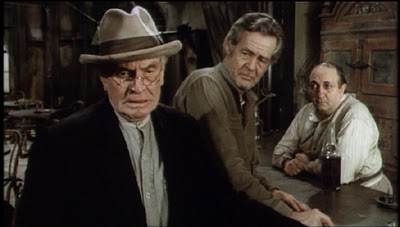
It’s widely and justly believed that the two greatest plays of Eugene O’Neill (1888-1953) were both written near the tail end of his career — The Iceman Cometh, completed in 1939 and first staged in 1946, and Long Day’s Journey into Night, completed in 1941 and produced only posthumously, in 1956. What’s less widely known is that the action of both plays unfolds during the same summer, 1912, when O’Neill was 24, after having attempted to commit suicide the previous spring. As his biographers Arthur and Barbara Gelb note in their 2000 O’Neill: Life with Monte Cristo (New York: Applause), “the plays follow almost literally the chronology of O’Neill’s youthful years, with Iceman (written first) set in ‘summer 1912’ and Long Day’s Journey (which can be regarded as its sequel) set on ‘a day in August, 1912’.”
Both late masterpieces are obsessive distillations of a lifetime of brooding, with the three-hour 1962 film version of Long Day’s Journey into Night directed by Sidney Lumet and the four-hour 1973 film version of The Iceman Cometh directed by John Frankenheimer having served, for many filmgoers, as the versions of reference. Read more
From the Chicago Reader (December 17, 2004). I’m wondering now (August 2015) whether I underrated Spanglish as much as I overrated As Good As It Gets. But the fact that I keep changing my mind about James L. Brooks probably says as much about me as it says about him. (In March 2016, having just reseen this, I like it still more, although, as always with Brooks, some irritations remain.) — J.R.
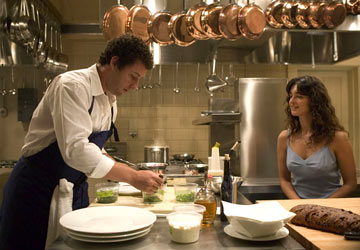
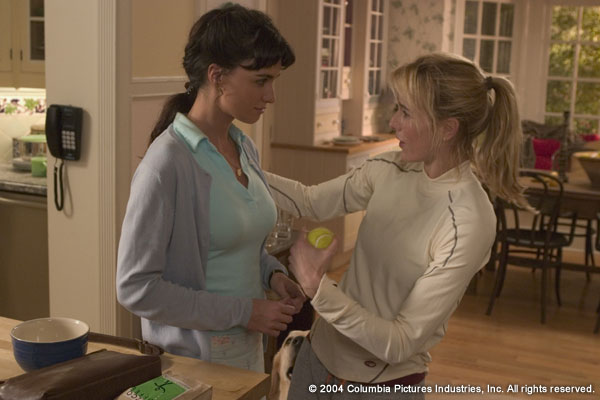
Spanglish
** (Worth seeing)
Directed and written by James L. Brooks
With Adam Sandler, Tea Leoni, Paz Vega, Cloris Leachman, Shelbie Bruce, Sarah Steele, and Ian Hyland
One reason I can’t regard Pauline Kael as a great film critic is her unshakable belief that she needed to see a movie only once — that she could immediately form an opinion and never have to revise it. She was thought of as an industry gadfly, but her blind faith in first impressions often fit industry calculations perfectly, helping to validate things like test-marketing and seeing movies as disposable.
I readily admit that changing one’s mind about movies days or years later can also be a problem. But we outgrow some films and mature enough to value the challenges of others. Read more
From the Chicago Reader (July 1, 1988). Criterion has released an elaborately bonus-filled Blu-Ray of this comedy. — J.R.
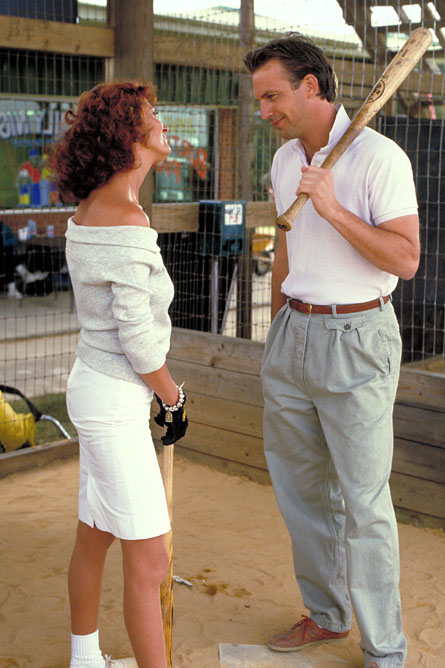
BULL DURHAM
*** (A must-see)
Directed and written by Ron Shelton
With Kevin Costner, Susan Sarandon, Tim Robbins, Trey Wilson, Robert Wuhl, and Jenny Robertson.


I cannot tell a lie: Bull Durham gave me so much old-fashioned moviegoing pleasure the first time around, in spite of my complete lack of interest in baseball, that I wasn’t too concerned about the sources of my fun. Entertaining movies are often deft at discouraging reflection. But two weeks later, when I went back to see this one again — mainly to refresh my memory — I came out feeling a little embarrassed about how and why I’d been taken in.
It’s not that the movie doesn’t have its share of singular virtues, especially considering that it’s Ron Shelton’s first feature as a director (he also wrote the script). Genuine star performances — as opposed to those in hyped-up vehicles like Big, Red Heat, The Presidio, and Big Business — are not all that commonplace these days, and Shelton gets them here from both Kevin Costner and Susan Sarandon. He also strikes a very satisfying balance between the fast and furious dialogue — much of it slangy, staccato jargon that reflects Shelton’s ball-playing background — and the transitional montage sequences, overlaid with pop songs, that allow us to glide and drift between the gabfests. Read more
From the Chicago Reader (November 16, 1990). This film has recently come out on Blu-Ray. — J.R.

JACOB’S LADDER
*** (A must-see)
Directed by Adrian Lyne
Written by Bruce Joel Rubin
With Tim Robbins, Elizabeth Pena, Danny Aiello, Matt Craven, Pruitt Taylor Vince, Jason Alexander, and Patricia Kalember.
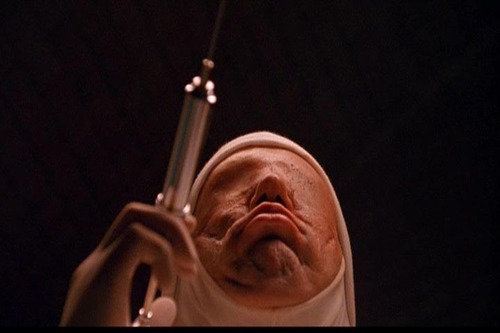
“Around twenty-four hundred years ago Chuang Tzu dreamed that he was a butterfly and when he awakened he did not know if he was a man who had dreamed he was a butterfly, or a butterfly dreaming he was a man.” The sense of metaphysical free-fall conveyed in this sentence from Jorge Luis Borges’s great essay “A New Refutation of Time” is like the disorientation one feels after watching a gripping and involving movie — a movie like Jacob’s Ladder, for instance. Like Chuang Tzu, one isn’t quite sure whether one has just left a dream, just entered one, or embarked on some magical if unsettling combination of the two. I tend to be partial to movies that traffic in these systematic displacements of reality — starting with Alain Resnais and Alain Robbe-Grillet’s masterpiece Last Year at Marienbad (1962), the locus classicus of this genre, continuing through much less radical examples like Fellini’s 8 1/2 (1963), and extending even to minor forays like last summer’s Total Recall. Read more
From the Chicago Reader (March 29, 2002). — J.R.
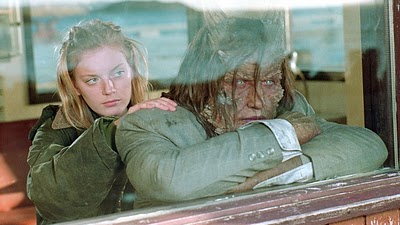

No Such Thing ** (Worth seeing)
Directed and written by Hal Hartley
With Sarah Polley, Robert John Burke, Helen Mirren, Baltasar Kormakur, Paul Lazar, Annika Peterson, and Julie Christie
The Sleepy Time Gal *** (A must-see)
Directed and written by Christopher Munch
With Jacqueline Bisset, Martha Plimpton, Nick Stahl, Amy Madigan, Frankie R. Faison, Carmen Zapata, Peggy Gormley, and Seymour Cassel.

On March 29 two new American independent features of some importance will debut. Hal Hartley’s No Such Thing — not one of his best movies — will open at Pipers Alley, and Christopher Munch’s The Sleepy Time Gal, which I prefer, will premiere exclusively on the Sundance cable channel. Chances are, a lot more people will see the Munch film, though they’ll have to be subscribers to the Sundance Channel or have a friend who is.
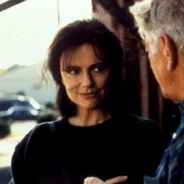
Considering these two films together is a breach of reviewing etiquette: movies that premiere in theaters are supposed to be in a different category than movies that premiere on TV. I first saw the Munch film, about a woman dying of cancer, last fall on video at the Vancouver International Film Festival, and I remember looking forward to seeing it on the big screen.
Read more
From Film Quarterly, Fall 2009. Note: Peter Thompson’s complete work as a filmmaker, along with many extras, is available here. There is also a web site devoted to his work at chicagomediaworks.com — J.R.
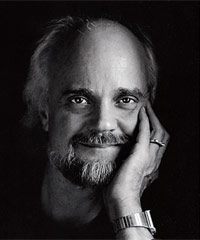
It would hardly be an exaggeration to call Peter Thompson the best Chicago filmmaker you never heard of. His half a dozen films, four shorts and two features, span 28 years, and their continuities and discontinuities with one another seem equally important. Pertinent to all six films are diverse aspects of Thomson’s background: as a classical guitarist who studied with Andrès Segovia in Siena, as an undergraduate and graduate student in comparative literature (University of California, Irvine), as a onetime Navy photojournalist who teaches photography at Columbia College Chicago, and even as a first cousin of the special effects pioneer Douglas Trumbull.(Full disclosure: Thompson has been a friend for almost two decades — and a neighbor for roughly half that time — but it was my enthusiasm for his first two films that initially sparked our friendship.)
His shorts come in two pairs, each one a diptych. Two Portraits (1982, 28 minutes) is devoted to his parents and each portrait works with a minimalist expansion of limited footage juxtaposed with offscreen voices—those of Thompson and his late father in the first part, Anything Else, and those of his mother reading from her diaries in the second part, Shooting Scripts. Read more
From the Chicago Reader (January 20, 1989). — J.R.
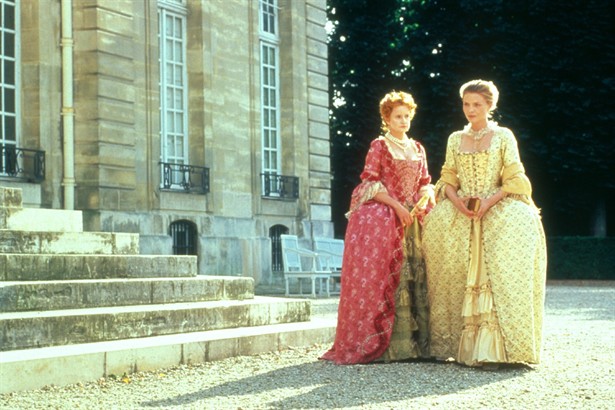
DANGEROUS LIAISONS
** (Worth seeing)
Directed by Stephen Frears
Written by Christopher Hampton
With Glenn Close, John Malkovich, Michelle Pfeiffer, Swoosie Kurtz, Keanu Reeves, Mildred Natwick, and Uma Thurman.
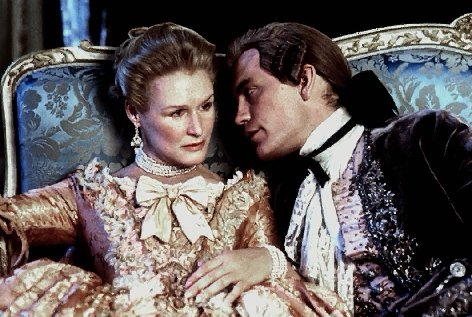
Choderlos de Laclos’ Les liaisons dangereuses, first published more than 200 years ago, is one of the greatest novels ever written, but one would never guess it from the watchable but shallow comedy-melodrama of manners that Christopher Hampton and Stephen Frears have extracted from it. They’ve stuck fairly close to the general outlines of the original plot, but they’ve jettisoned the form entirely, so that what remains is a distortion as well as a simplification of what is conceivably the best French novel of the 18th century.
Admittedly, Roger Vadim’s updated French film adaptation of 30 years ago, set partially at a contemporary ski resort, was no less reductive, and a third film version presently being prepared by Milos Forman, Valmont, is unlikely to avoid similar problems. Laclos’ 1782 masterpiece is an epistolary novel consisting of 175 letters written by at least ten separate characters, preceded by a “Publisher’s Note” and an “Editor’s Preface” and accompanied by several “editorial” footnotes throughout — an intricate dialectical construction that offers us several independent and often contradictory versions of practically everything that happens, and more than one interpretation of what all the various events mean. Read more
From the Chicago Reader (October 1, 1999). — J.R.

I recently heard about an American teenager visiting Wales who insisted on calling the Welsh people she met English. When it was pointed out to her that the Welsh didn’t like being identified that way, she said she was sorry but that’s what she’d been taught in school — and it would be too complicated for her to change what she called them.
Given the isolationism of Americans, which seems to grow more pronounced every year, an event like the Chicago International Film Festival has to be cherished. This year it’s offering the city 108 features from 31 countries — 32 from the U.S. and 76 from elsewhere, 49 of them U.S. or North American premieres, as well as five programs of shorts and five tributes. Consider them cultural CARE packages, precious news bulletins, breaths of fresh, or stale, air from diverse corners of the globe — even bad or mediocre foreign movies have important things to teach us. However you look at them, they’re proof that Americans aren’t the only human beings and that the decisions Americans make about how to live their lives aren’t the only options — at least not yet. Read more
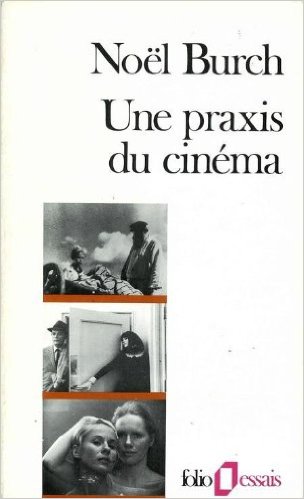
For its 100th issue (Winter 2o16), the French quarterly Trafic asked its contributors to select a particular book that had a formative influence on him or her. Here is my contribution. — J.R.
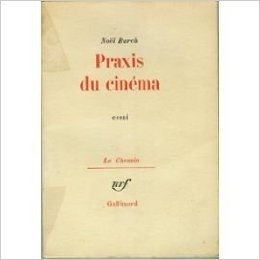
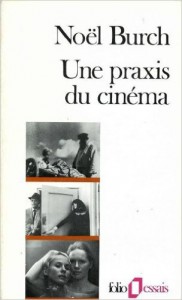
I still have the original Gallimard edition, probably the most tattered and thumbed-through French book that I own, published in 1969, the same year that I moved to Paris from New York — the title missing the article (Une Praxis du cinéma) that is now found on the 1986 edition. I can even recall purchasing this book at Le Minotaure, a Surrealist bookstore on Rue des Beaux Arts, a short distance from my rented flat on Rue Mazarine, and the ridiculous advertising slip (against which Burch rightly protested), “Contre toute théorie,” that enclosed it.
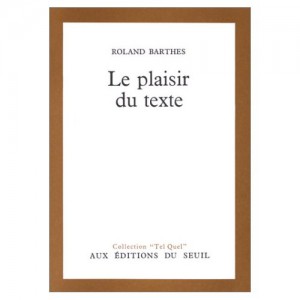
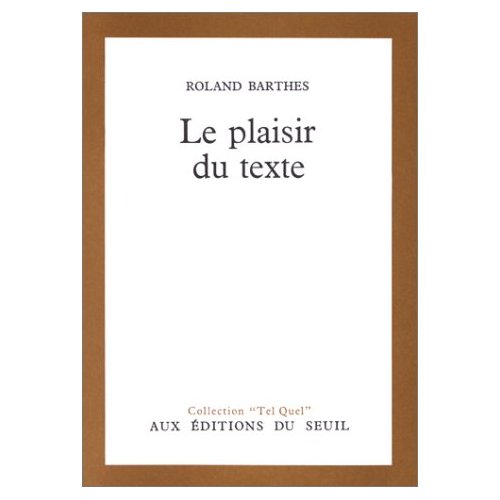
By this time, I’d already read — or at least tried to read, back in New York — earlier drafts of some of the chapters when they had appeared in Cahiers du Cinéma, and may have also read Godard’s praise of one of those chapters in one of his interviews. Due to a crippling disability in learning languages, much of which I still suffer from today, I had to read those chapters with the aid of a French-English dictionary, even though Burch’s French—the French of an American émigré — was far easier to follow than the French of Roland Barthes in Le plaisir du texte, published four years later, which eventually became my other key French text of this period. Read more
From the Soho News (December 23, 1980). — J.R.

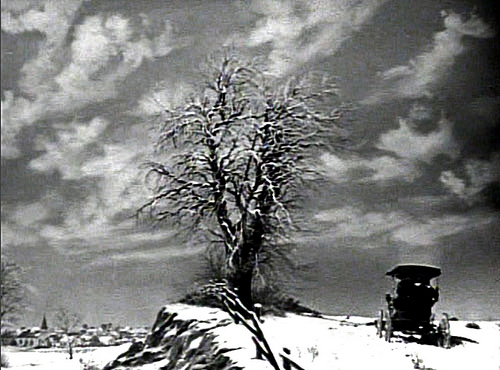
“This film was made in violent contrast to Citizen Kane,” François Truffaut once wrote of The Magnificent Ambersons, Orson Welles’ second feature, “almost as if by another filmmaker who detested the first and wanted to give him a lesson in modesty.” In comparable fashion, Alain Resnais — a rationalist surrounded by surrealist nightmares — has often described some of his films as being made in reaction (and contradistinction) to the ones that preceded them.
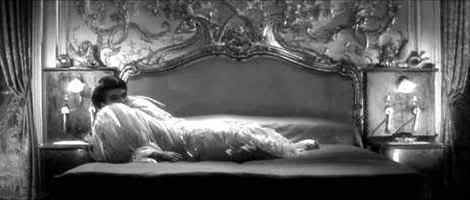
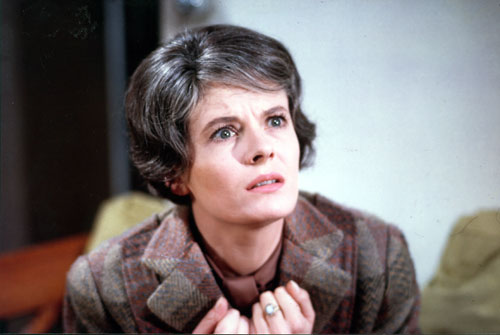
Thus the subjective, highly mobile camera of the apolitical Last Year at Marienbad (1961) was countered by the objective, stationary camera setups and political contexts of Muriel (1963). And similarly, the proliferating dreamlike fictions and Lovecraftian enchantments of Providence (1977) have led to the documentary, demonstration-style demeanor and scientific wit of Mon Oncle d’Amérique (1980), his latest film — a movie that also attempts to combine elements from his nonfiction shorts and previous fictional features.


It’s been seven years since I last interviewed Resnais — on a soundstage at Epinay-sur-Seine, a Parisian suburb where he was shooting Stavisky… Greeting him recently at his Park Lane suite, I still found him almost awesomely handsome at 58, and no less delicate, modest, and cordial in his manner, despite a continuing shyness that he has come some distance in mastering. Read more
From the Summer 1972 issue of Sight and Sound. This was my first contribution to that magazine. — J.R.
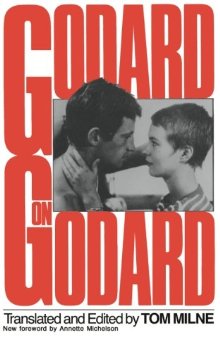
Godard’s collected criticism (1) is many things at once: informal history (1950–1967) of the arts in general and film in particular, spiritual and intellectual autobiography, a theory of aesthetics, a grab bag of puns. For those who read the pieces when they first appeared — chiefly in the yellow-covered Cahiers du Cinéma and the newspaper format of Arts — it was frequently ill-mannered gibberish that began to be vindicated (or amplified) when the films followed, retrospectively becoming a form of prophecy:
Each shot of MAN OF THE WEST gives one the impression that Anthony Mann is reinventing the Western, exactly as Matisse’s portraits reinvent the features of Piero della Francesca . . . in other words, he both shows and demonstrates, innovates and copies, criticizes and creates.
For those who encounter the films first, it is likely to seem like an anthology of footnotes serving to decipher and augment what may have once seemed like ill-mannered gibberish on the screen. But for those more interested in continuity than cause and effect, it rounds out a seventeen-year body of work — from an article on Joseph Mankiewicz in Gazette du Cinéma to the “Fin du Cinéma” title concluding WEEKEND — that has already transformed much of the vocabulary and syntax of modern narrative film, further illustrating a style that has passed from avant-garde to neoclassical in less than a decade. Read more
From the Chicago Reader (November 17, 1995). — J.R.
Soft and Hard (A Soft Conversation Between Two Friends on a Hard Subject)
**** (Masterpiece)
Directed and written by Anne-Marie Miéville and Jean-Luc Godard
With Godard and Miéville.
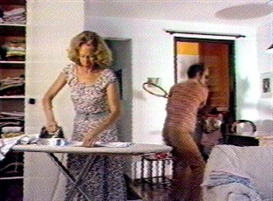
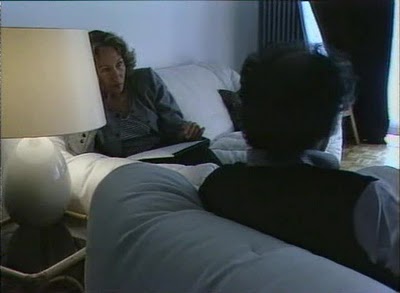
A 48-minute video that’s premiering in Chicago ten years after it was made, Jean-Luc Godard and Anne-Marie Miéville’s Soft and Hard (A Soft Conversation Between Two Friends on a Hard Subject) is so far in advance of most films and videos made today about the essential properties of both media that it makes not so much Chicago but contemporary Western culture feel like an intellectual backwater. It was commissioned by and originally broadcast on England’s Channel Four, and although most of Godard and Miéville’s talk is in French and subtitled, the funding source is acknowledged in several ways: by the video’s English title, by English intertitles throughout, by many stills from Hollywood pictures (including Frankenstein, Scarface, Rear Window, and the 1948 Joan of Arc) employed as punctuation, by an early sequence of Godard speaking in English on the phone about business arrangements for his film King Lear, and by a brief but moving exchange in English between Godard and Miéville that concludes the work. Read more