Written for MUBI, who published it in January 2024.
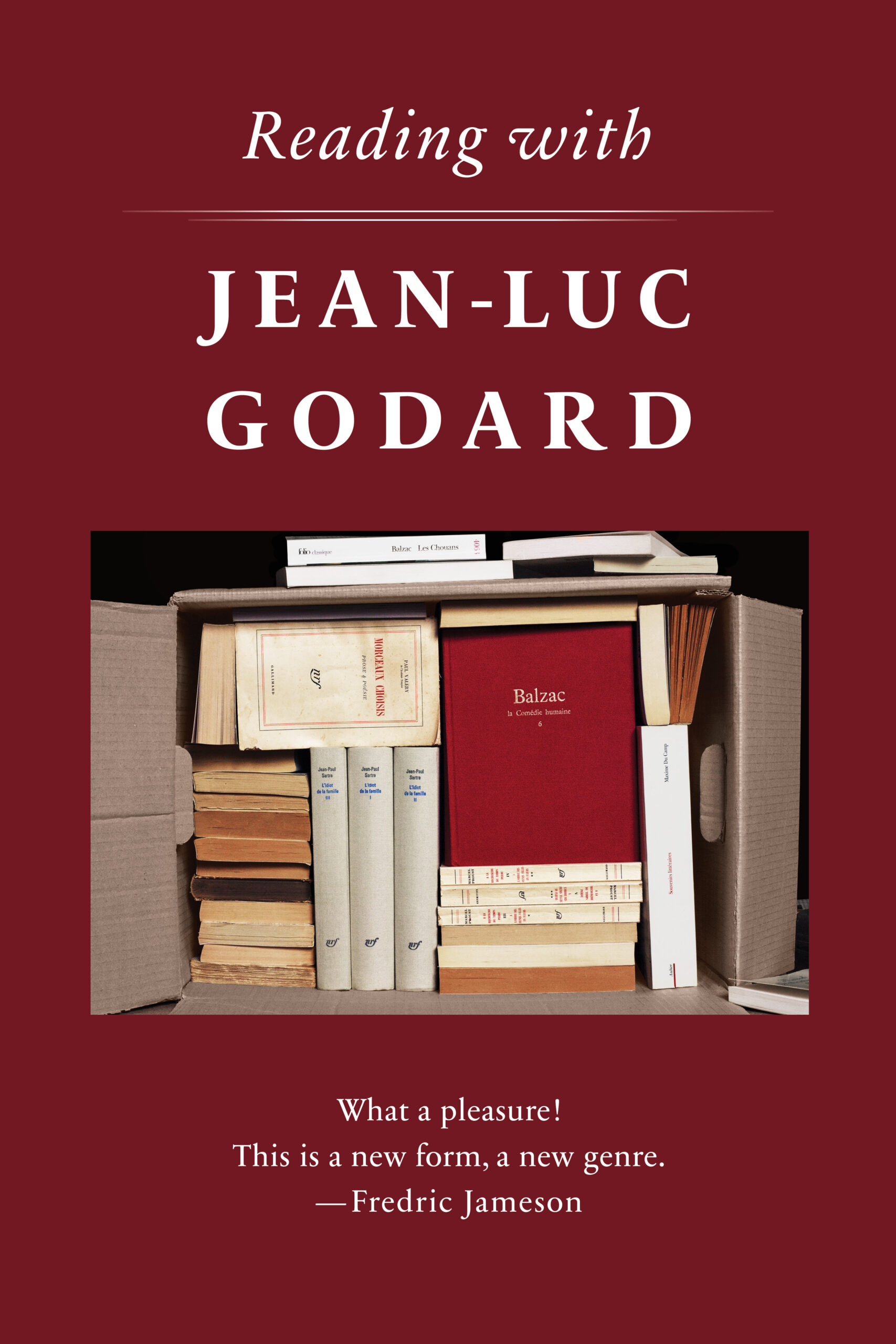
According to the literary scholar Fredric Jameson, who contributes an enthusiastic preface and afterword, Reading with Jean-Luc Godard — a compendium of 109 three-page essays by 49 writers from a dozen countries — launches “a new form” and “a new genre”. It can be described as a user-friendly volume designed to occupy the same space between academia and journalism staked out by MUBI while proposing routes into Godard’s work provided by his eclectic reading — a batch of writers ranged alphabetically and intellectually from Louis Aragon, Robert Ardrey, Hannah Arendt, and Honoré de Balzac to François Truffaut, Paul Valéry, A.E. Van Vogt, and Virginia Woolf. (Full disclosure: I contributed one of the two pieces on Truffaut, devoted to how his best piece of Alfred Hitchcock criticism helped to shape Godard’s and why Truffaut omitted that major text from his own books.) Some authors, such as Marguerite Duras, Martin Heidegger, and Edgar Allan Poe, get more than one entry, and coeditor Timothy Barnard wrote all four of those devoted to André Malraux. Indeed, he and coeditor Kevin J. Hayes are responsible for almost half of the entries.
One of the book’s fringe benefits is canonical, offering a list of writers that includes many obscure names worthy of discovery. Read more
Trevor Vartanoff, one of the frequenters of this web site, has just come up with an invaluable gift to me and to others — an alphabetical master index of all (or almost all) the postings here, complete with links. .#.(2024): Ooops. Here’s the correct link to the other link: https://jonathanrosenbaum.net/2023/09/a-master-index-to-this-site-with-links-as-of-october-1-2012/
***
Featured Texts:
*Corpus Callosum
*CORPUS CALLOSUM
12 Monkeys
12 and Holding
15th Annual Festival of Illinois Film and Video
2 Oxford Companion Entries (Albert Brooks and découpage)
2 or 3 Things I Know About Her
2001: A Space Odyssey
2046
20th International Tournee of Animation
29th Chicago International Film Festival: Mired in the Present
4 Little Girls
4
60s Wisdom
7 Women
8 1/2
8 Mile
84 Charlie Mopic
9 1/2 Weeks with Van Gogh
A Bankable Feast [BABETTE’S FEAST]
A Beauty and a Beast
A Bluffer’s Guide to Bela Tarr
A Breakthrough And A Throwback
A Brief History of Time
A Brighter Summer Day
A Bronx Tale
A Christmas Commodity: SCROOGED
A Cinema of Uncertainty
A Constant Forge
A Couple of Kooks [MY BEST FIEND]
A Cut Above [HENRY: PORTRAIT OF A SERIAL KILLER]
A Depth in the Family [A HISTORY OF VIOLENCE]
A Dialogue about Abbas Kiarostami’s SHIRIN
A Different Kind of Swinger [GEORGE OF THE JUNGLE]
A Different Kind of Thrill (Richet’s ASSAULT ON PRECINCT 13)
A Dry White Season
A Family Thing
A Far Off Place
A Few Eruptions in the House of Lava
A Few Things Well [A LITTLE STIFF]
A Film of the Future
A Fish Called Wanda
A Force Unto Himself [on Hou Hsiao-hsien]
A Great Day in Harlem
A History of Violence
A Home of Our Own
À la recherche de Luc Moullet: 25 Propositions
A Little Transcendence Goes a Long Way
A Lucky Day
A Major Talent [on SWEETIE]
A Man Escaped
A Midnight Clear
A Moment of Innocence
A New Leaf
A Nightmare on Elm Street 4: The Dream Master
A Page of Madness
A Perfect World
A Perversion of the Past
A Place Called Chiapas
A Place in the Pantheon: Films by Bela Tarr
A Place in the World
A Price Above Rubies
A Prophet in His Own Country [Jon Jost retrospective]
A Quirky Cowboy Classic [on THE THREE BURIALS OF MELQUIADES ESTRADA]
A Radical Idea [HALF NELSON & THIS FILM IS NOT YET RATED]
A Road Not Taken (The Films of Harun Farocki)
A Room With No View [ORPHANS]
A Russian in Hollywood [SHY PEOPLE]
A Scanner Darkly
A Short Film About Killing and A Short Film About Love
A Single Girl
A Soldier’s Daughter Never Cries
A Stylist Hits His Stride (ETERNAL SUNSHINE OF THE SPOTLESS MIND)
Perhaps it is time to study discourse not only according to its expressive values, or in its formal transformations, but also according to its modes of existence: the modes of circulation, attribution and appropriation of discourse vary with each culture. . . . [T]he effect on social relationships can be more directly seen, it seems to me, in the interplay of authorship and its modifications than in the themes or concepts contained in the works.
— Michel Foucault, “What Is an Author?”
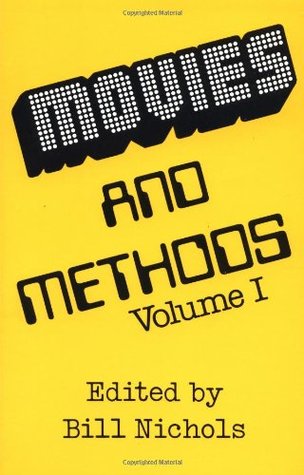
It seems likely that Hollywood Directors 1914–1940 and Movies and Methods[*] are the two most interesting anthologies of writing about film recently published in English. Each marks a substantial foray beyond the standard recycling operations of most anthologies, making available a wealth of helpful material that is otherwise hard to come by. An easy enough assessment, on the face of it, yet one that conceals a nagging question: what do we mean by “interesting” and “helpful”? In what way can both books be considered deserving of the same ambiguous adjectives? How far do they allow themselves to be considered within the same universe of discourse?