From Movies of the Fifties, edited by Ann Lloyd (London: Orbis Publishing, 1982). Prior to this, it was published in one of the “chapters” of The Movie in 1981 or 1982, but I’m no longer clear about which one. — J.R.
For two centuries, Japan chose to isolate itself from the rest of the world. Then, in 1894, the American Commodore Perry sailed into Tokyo Bay and ‘rediscovered’ the Japanese islands. Yet nothing was known about Japanese cinema in the West for almost another century. The difference was that whereas Perry had come upon a country that appeared technologically backward, the west encountered a cinema that was, on the evidence of the films that began to be shown in the Fifties, every bit as advanced as its own.
By and large western recognition and appreciation of Japanese films can be said to have dated from the appearance of key movies at the Venice and Cannes Film Festivals.Akira Kurosawa’s Rashomon (1950) won the Golden Lion at Venice in 1951 and the same honor was bestowed upon four films by Kenji Mizoguchi in the succeeding years. The films were: Saikaku Ichidai Onna (1952, The Life of Oharu),Ugetsu Monogatari (1953, Tales of the Pale and Silvery Moon After the Rain), Sansho Dayu (1954, Sansho the Bailiff ) and Yokihi (1955, The Empress Yang Kwei-Fei). Read more
From Film Comment, July-August 2000; slightly tweaked in April 2023.
MADADAYO Akira Kurosawa, Japan, 1993
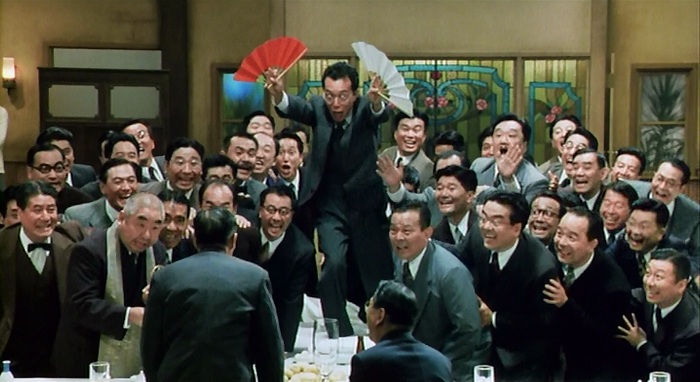
Given the unwarranted abuse that has greeted the final works of so many major filmmakers – an honor roll stretching from Anatahan to Eyes Wide Shut that also takes in the precious, misunderstood last features of Dreyer, Ford, Hitchcock, Ivens, Lang, Renoir, Preston Sturges, and Tati – one shouldn’t be too quick about dismissing Kurosawa’s curious swan song, released when he was 83, five years before his death. Based on several books by the popular sketch and essay writer Hyakken Uchula and parcelled out in a series of separate episodes, Madadayo focuses on the declining years of a retired German professor (Tatsuo Matsumura) and his interactions with his adoring former students (all male), his wife (Kyoko Kagawa), and two household cats. The title literally means “not yet” – a child’s teasing, sing-songy reply to the question “Are you ready?” is a game of hide-and-seek. And by essentially saying this for 134 minutes, not once but many times, and at a snail’s pace, all the way up through the concluding dream sequence, this limpid octogenarian’s film is bound to try some people’s patience. For those who locate Kurosawa’s achievement exclusively in the samurai action films he made with Toshiro Mifune in the Fifties and Sixties, it may be an outright insult.Read more