My review of Thomas Pynchon’s lamentable Inherent Vice, for Slate (August 3, 2009). Much less lamentable — actually quite good in spots — is Pynchon’s more recent Bleeding Edge, which I prefer to everything of his since Vineland. But even more lamentable, in my opinion, is Paul Thomas Anderson’s adaptation of Inherent Vice, which even after a second viewing strikes me on most counts as his worst film to date. (I’d been hoping for something more transformative, such as Norman Mailer’s superb film adaptation of his own worst novel, Tough Guys Don’t Dance.) Despite a few glancing virtues (e.g., Josh Brolin’s Nixonesque performance) and the (so far) unsubstantiated enthusiasm of many of my smarter colleagues, Anderson’s film strikes me as being just as cynical as its source and infused with the same sort of misplaced would-be nostalgia for the counterculture of the late 60s and early 70s, pitched to a generation that didn’t experience it, as Bertolucci’s The Dreamers. [Postscript, January 27, 2015: The first semiplausible defense of the film that I’ve read can be found here.] [A second postscript, January 23, 2023: It’s too bad that it’s impossible for most of us now to know whether Pynchon has retired or if he has another book in the works.] Read more
From the Chicago Reader (February 11, 1994). — J.R.
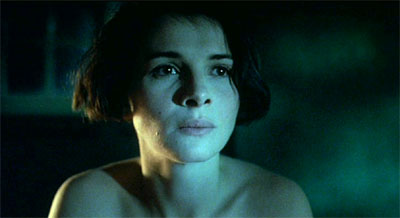
*** BLUE
(A must-see)
Directed by Krzysztof Kieslowski
Written by Kieslowski and Krzysztof Piesiewicz
With Juliette Binoche, Benoit Regent, Florence Pernel, Charlotte Very, Helene Vincent, Emmanuelle Riva, and Philippe Volter.
Indisputably the work of a master, to a much greater degree than anything else around at the moment, Krzysztof Kieslowski’s first feature without reference to his native Poland is sufficiently contemporary and allegorical to take the future of Europe, and a “unified” Europe at that, as one of its themes. Palpably concerned with loss and regeneration, suffering and transcendence, Blue calls to mind some of the better late works of Ingmar Bergman in its powerful sense of dramatic concentration; it doesn’t have quite the undertow of neurosis that presumably made those films so exemplary for Woody Allen, but it does have a much bolder grasp of the movements and vagaries of consciousness.
In the opening moments of Blue the leading character, Julie (Juliette Binoche), loses both her husband, a famous French composer, and her five-year-old daughter in a car crash; the remainder of the film charts her mental and spiritual recovery. The film’s remarkable economy is already apparent in the opening shot — a close-up of the spinning right front wheel of the car, seen from behind, as it speeds down a highway. Read more