Daily Archives: October 7, 2025

The Example of KATZELMACHER

This is the last in a series of four essays I wrote in 2008 about Fassbinder films for Madman, the Australian DVD label. The others, on The Bitter Tears of Petra von Kant, Ali: Fear Eats the Soul, and Martha, have already been posted on this site. — J.R.
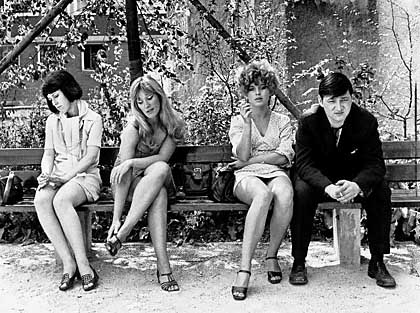
Katzelmacher is only the second feature of Rainer Werner Fassbinder, yet the gulf that separates it from its predecessor, Love is Colder Than Death, is enormous. His first feature, shot over 24 days in April 1969, was later described by its writer-director as the first of his “cinema” films, apparently because its minimal story about petty gangsters seems conceived in relation to genre films. It premiered at the Berlin Film Festival in June, where it was roundly booed and received mixed reviews; it seems fairly safe to conclude that if Fassbinder had made nothing else, most of us would never have heard of him.

This is no doubt why Fassbinder’s somewhat mysterious epigraph for Katzelmacher, credited to his friend and collaborator Yaak Karsunke, reads like a directive to himself: ”It’s better to make new mistakes than to perpetuate the old ones to the point of unconsciousness.” Another directive, more ironic, crops up in one of the film’s final lines of dialogue — “We need a bit of order here” —- which has formal as well as political implications. Read more
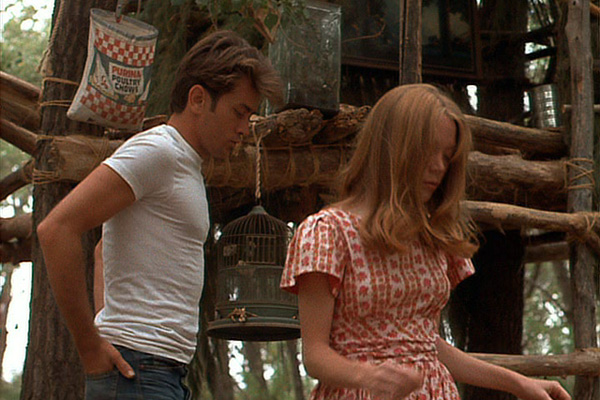
Badlands (1974 review)

This appeared in the November 1974 issue of Monthly Film Bulletin. The ironic aftermath of the final sentence in my review is that another five years would pass before the release of Malick’s second feature, and then 20 more before the release of his third. — J.R.

Badlands

U.S.A., 1973                                                        Director: Terrence Malick

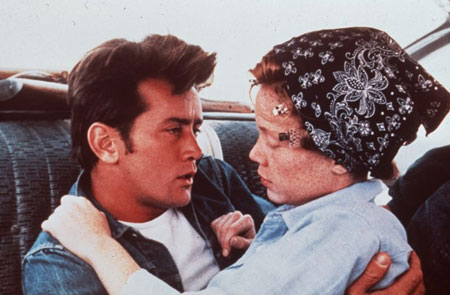
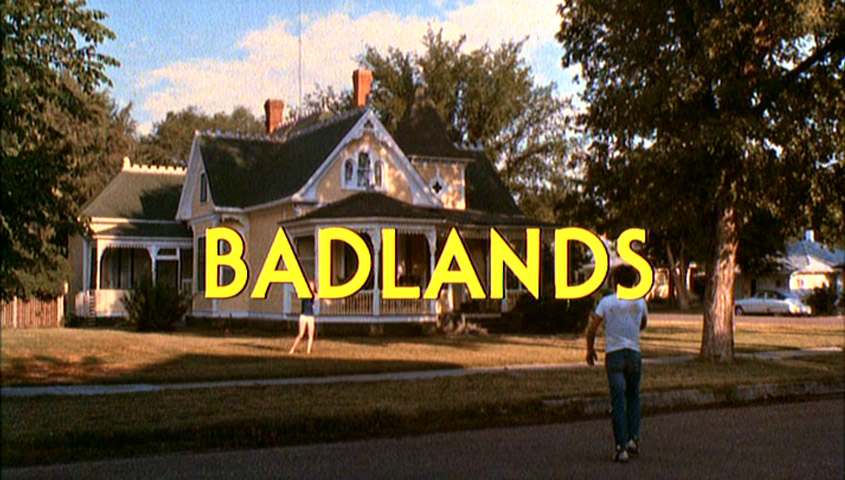
It would hardly be an exaggeration to call the first half of Badlands a revelation -– one of the best literate examples of narrated American cinema since the early days of Welles and Polonsky. Compositions, actors, and lines interlock and click into place with irreducible economy and unerring precision, carrying us along before we have time to catch our breaths. It is probably not accidental than an early camera set-up of Kit on his garbage route recalls the framing of a neighborhood street that introduced us to the social world of Rebel Without a Cause: the doomed romanticism courted by Kit and dispassionately recounted by Holly immediately evokes the Fifties world of Nicholas Ray -– and more particularly, certain Ray-influenced (and narrated) works of Godard, like Pierrot le fou and Bande à part. Terrence Malick’s eye, narrative sense, and handling of affectless violence are all recognizably Godardian, but they flourish in a context more easily identified with Ray. Read more