From Sight and Sound (Summer 1975). I think I probably did a better job with The Godfather 33 years later, when I wrote something about it for Filmkrant. — J.R.
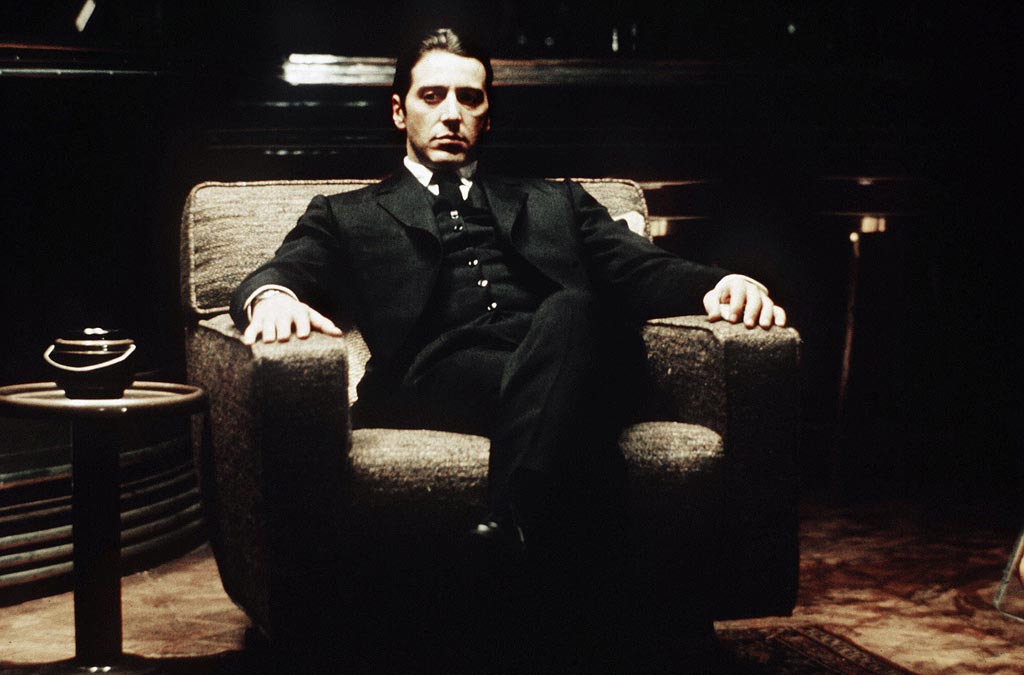
The Godfather Part II
‘I believe in America,’ declares an undertaker in portentous close-up at the start of The Godfather, appealing to Vito Corleone (Marlon Brando) to dispatch an act of vengeance on his behalf. The sequel begins and ends with close-ups of Michael (Al Pacino), Vito’s youngest son and successor: in the first his hand is being kissed off-screen by yet another supplicant; in the last he sits alone biting his knuckle, with his wedding ring clearly in evidence — an apt symbol of his solitary dominion, with the Corleone family virtually destroyed so that its hollow emblems and relics might be preserved. The most obvious achievement of The Godfather Part II (CIC) over its predecessor can be seen in the quiet authority of this framing device, which tells us everything we need to know about the fate of the Corleones without recourse to rhetorical hectoring; its most obvious limitation is that it essentially tells us nothing new.
Perhaps more than anyone else in Hollywood, Francis Ford Coppola epitomizes the man in the middle. Read more
My column for the Summer 2016 issue of Cinema Scope. — J.R.


J.P. Sniadecki’s feature-length The Iron Ministry (2014), available on DVD from Icarus Films, is by far the best non-Chinese documentary I’ve seen about contemporary mainland China. (Just for the record, the best Chinese documentary on the same general subject that I’ve seen is Yu-Shen Su’s far more unorthodox—and woefully still unavailable — 2012 Man Made Place; a couple of snippets are available on YouTube and Vimeo.) Filmed over three years on Chinese trains, it’s full of revelatory moments, and not only in its surprisingly outspoken interviews: the non-narrative stretches, which compare quite favourably with the more abstract portions of Lucien Castaing-Taylor and Véréna Paravel’s Leviathan (2012), are pretty stunning as well. Skip this one at your peril.
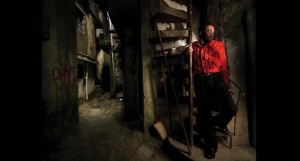
Second Run’s very first Blu-ray — Pedro Costa’s Horse Money (2015) — is gorgeously transferred, and has splendid extras: Costa’s 2010 short film O nosso homem, essays by Jonathan Romney and Chris Fujiwara, an introduction to Horse Money’s introduction by Thom Andersen, and Laura Mulvey’s conversation with Costa at London’s ICA. The extras on Criterion’s Blu-ray of Jean-Luc Godard’s Band of Outsiders (1964) are too numerous to mention here, but suffice it to say that just about every intertextual reference in this cherished object are teased out in one way or another. Read more
From the February 2014 Artforum; their title was “Beyond Good and Evil”. — J.R.

Claude Lanzmann, The Last of the Unjust, 2013, 16 mm and 35 mm, color and black-and-white, sound, 218 minutes. Claude Lanzmann and Benjamin Murmelstein.
THE LAST OF THE UNJUST, the latest of Claude Lanzmann’s footnotes and afterthoughts to his 1985 masterpiece, Shoah, functions even more than that earlier film as a dialectical palimpsest, so its successive layers — which remain in perpetual dialogue with one another — should be identified at the outset:
December 1944: Benjamin Murmelstein, a Vienna rabbi, is appointed by the Nazis as the third (and last) Jewish “elder” of Theresienstadt (Terezin, in Czech), a “model” or “showcase” ghetto set up in the former Czech Republic in 1941, his two predecessors having been executed the previous May and September. Murmelstein retains this position through the war’s end. Then, after spending eighteen months in prison for his collaboration with the Nazis, he is acquitted of all charges (although still widely despised as a traitor) and moves to Rome.
1961: Murmelstein publishes a book in Italian, Terezin: Il ghetto-modello di Eichmann, describing the suffering of the ghetto’s inhabitants.
1975: Lanzmann films an interview with Murmelstein over a week in Rome — the first interview that he films for Shoah, although he later decides to discard it, donating the unedited footage to the United States Holocaust Memorial Museum in Washington. Read more
Part of a roundtable discussion with David Edelstein, Roger Ebert, Sarah Kerr, and A.O. Scott in Slate, December 26, 2001. Sorry that I can’t furnish the post from David that led to it. Note: let your cursor hit the first illustration below. — J. R.
Dear David (and Roger, Sarah, and Tony),
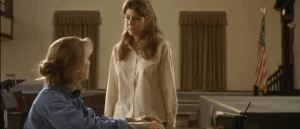
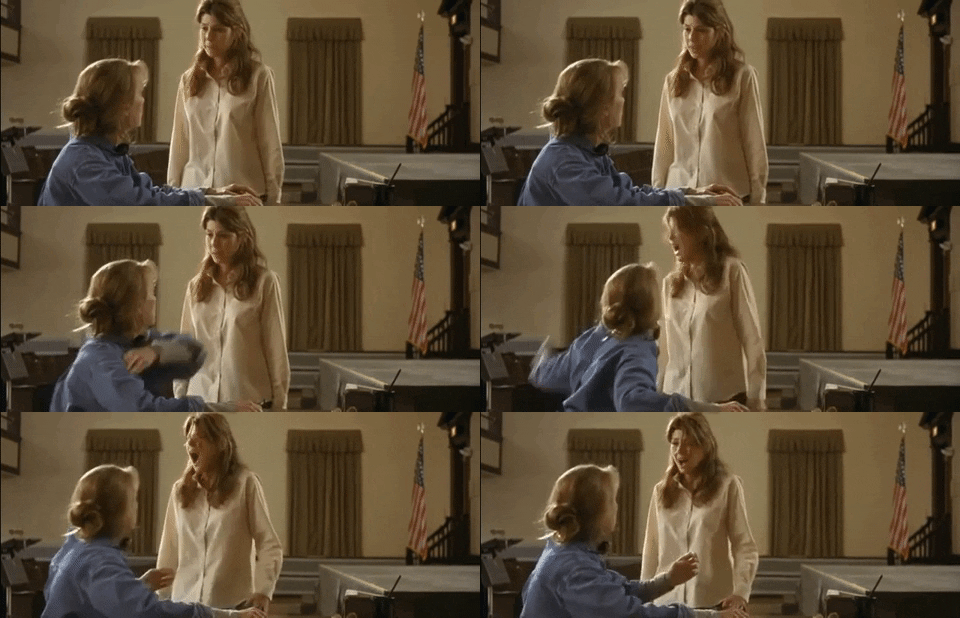
I appreciate your evocation of Sept. 11 at the start of your letter — a defining moment for us all — as well as your conflicted thoughts about vigilantism, and how these impact on your movie tastes. For me, there’s no conflict of this kind, because I’m afraid revenge strikes me as something less than an adult aspiration or concern — accounting both for why I think Mandela’s South Africa is far ahead of the United States in this respect and why In the Bedroom, a very well-made film, doesn’t interest me much. (The only moment I recall making my pulse race was when Spacek slapped Tomei.) As you’re the first to point out, Osama Bin Laden is also obsessed with vengeance — though surely not just for “slights against his brand of Islam.” Other beefs might include the deaths of about a million innocent Iraqis (the American Friends Service Committee’s estimate last spring) — collateral damage that Madeleine Albright told us she had no regrets about, despite the fact that it arguably only strengthened Saddam Hussein — as well as many other lethal forms of meddling in the Middle East, some of them slights against both humanity and common sense.
Read more
From The Movie, Chapter 108, 1982. -– J.R.
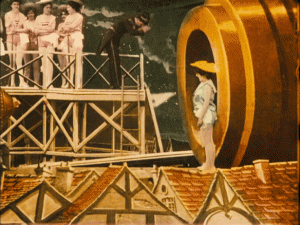
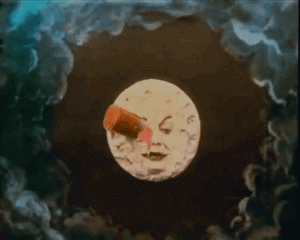
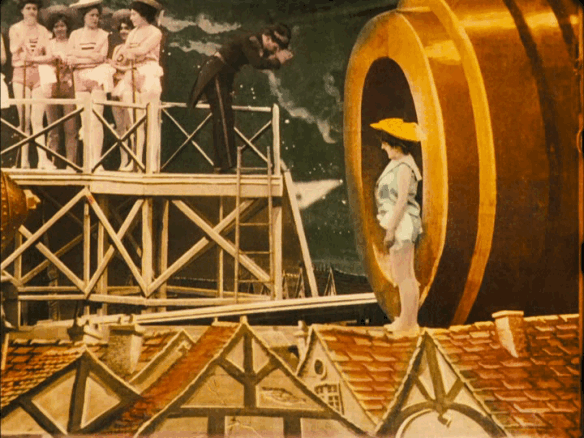
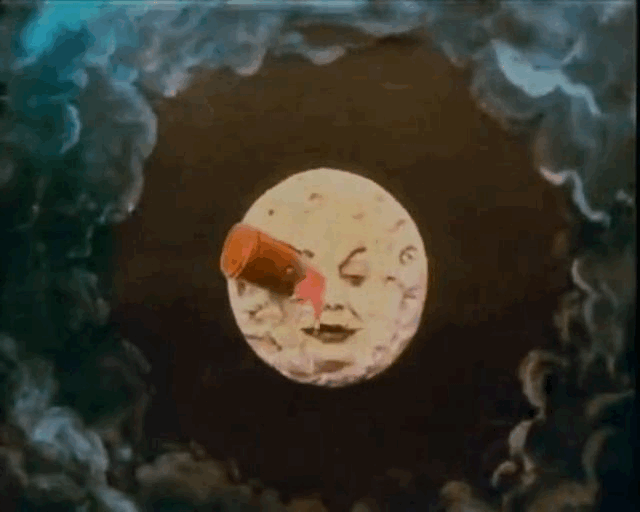
The earliest principles of editing shots together were perhaps no more simple or complex than those of bricklaying; they served, at any rate, to perform the same sort of basic architectural function. In an early narrative film by Georges Méliès, Le Voyage dans la lune (1902, A Trip to the Moon), elaborately staged tableaux in front of a stationary camera — the filmmaker himself called them ‘artificially arranged scenes’ — succeed one another through the medium of dissolves. A bevy of chorus girls waves goodbye to a rocket ship fired from a cannon (one tableau), the moon is seen approaching (another tableau, effected through a moving, artificial moon rather than a moving camera), and the rocket ship lands splat in the eye of the Man in the Moon (still another tableau). By the time Méliès was making Le Tunnel sous la Manche ou le Cauchemar Franco-Anglais (l907, Tunneling the English Channel), five years later, his visual structures were more complex, so that an entire narrative could proceed in the form of individual split-screen diptychs. In each of them, an Englishman and Frenchman attempt to cross the channel towards each other from opposite sides of the screen. Read more
Commissioned by the French quarterly Trafic for its 102nd issue (Summer 2017). — J.R.
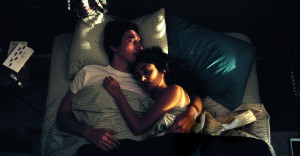
1. Jarmusch as dialectician
For some time now, Jim Jarmusch has been operating as an
autocritical dialectician in his fictional features. Politically as
well as commercially, The Limits of Control offers a sharp
rebuke to his preceding film, Broken Flowers, by following
Bill Murray as a protagonist — a bored and diffident Don Juan
roaming across the United States to visit four of his former
lovers, in order to discover which one he impregnated with
a son — with Isaach de Bankolé as a protagonist, a hired
assassin in Europe pursuing Bill Murray in the role of Dick
Cheney as he hides out in a bunker until the assassin
finally strangles him with a guitar string. But even more
striking is the radical contrast between Jarmusch’s most
elitist feature (and in many ways my least favorite), Only
Lovers Left Alive, about a romantic, middle-aged married
couple played by Tilda Swinton and Tom Hiddleston —
vampires named Adam and Eve who evoke junkies, rock
stars, and Pre-Raphaelite artists, living on separate
continents in Tangier and Detroit — and Jarmusch’s
most populist feature (and one of my favorites),
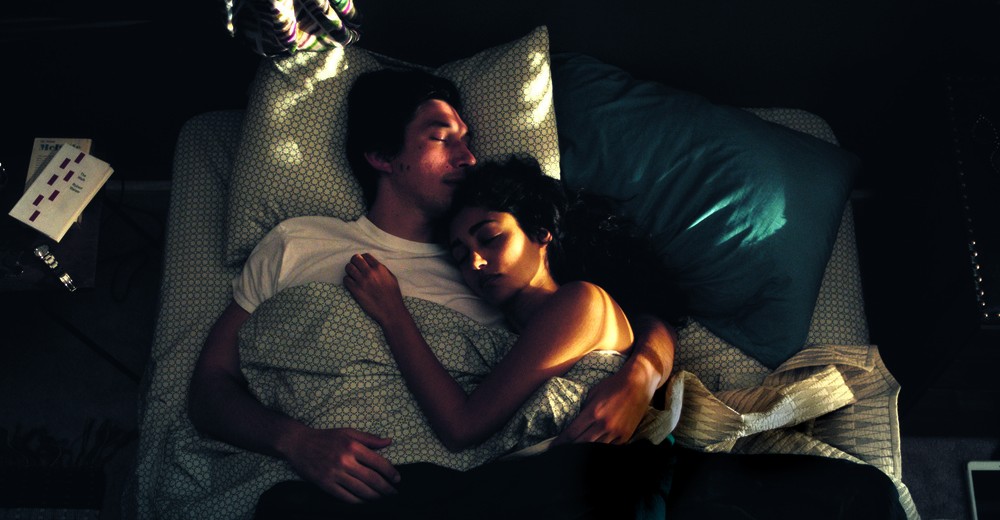
Paterson, about a younger romantic couple living together
in Paterson, New Jersey, a bus driver named Paterson
(Adam Driver) who writes poetry in his spare time and a
housewife named Laura (Golshifteh Farahani) who cooks,
specializes in creating black and white décor and clothing,
and is learning to play the guitar. Read more
From The Village Voice (May 13, 2008). — J.R.
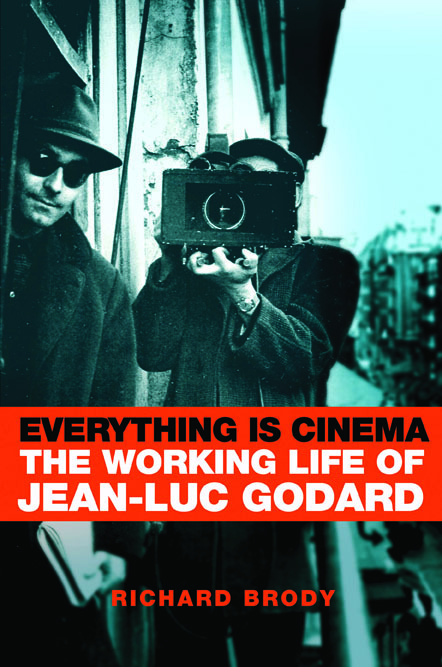
Everything Is Cinema: The Working Life of Jean-Luc Godard
By Richard Brody
Metropolitan Books, 701 pp., $40
Will we ever get a critical biography of Welles, Kubrick, or Eastwood as good as Brian Boyd’s two volumes on Vladimir Nabokov? Probably not. Novelists basically have friends, relatives, and editors to be interviewed, but with high-profile movie directors, one also has to contend with countless employees, potential as well as actual. And the complications introduced by showbiz gossip about mythical and controversial figures are endless: While these stories make for compulsive reading, they interfere with criticism and scholarship.
With all that extra and unwieldy baggage in tow, a biographer may find it impossible to create a critical through-line that’s both persuasive and comprehensive. Even in the best books of this kind, either the life overrides the films (as in Joseph McBride’s Frank Capra: The Catastrophe of Success) or the criticism trumps the biography (as in Chris Fujiwara’s Jacques Tourneur: The Cinema of Nightfall). And taking on a maven as prolific, innovative, and constantly changing as Jean-Luc Godard, biographer Richard Brody is clearly asking for trouble.
Perhaps the most impressive thing about Brody’s Everything Is Cinema: The Working Life of Jean-Luc Godard is that it’s 700 large-format pages long, yet winds up seeming too short — a tribute to both the author and his 77-year-old subject. Read more
From Sight and Sound (Autumn 1984). –- J.R.
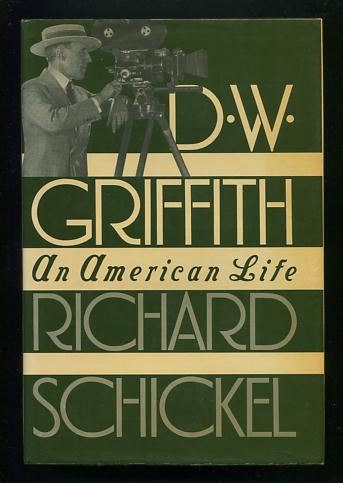
D.W. GRIFFITH: An American Life
by Richard Schickel
Pavilion, £15.00
Arriving on the heels of Donald Spoto’s Hitchcock and Richard Koszarski’s Stroheim, Richard Schickel’s massive biography of Griffith manages to steer a middle course between the compulsive narrative thrust of the former and the more scholarly negotiation of diverse hypotheses pursued by the latter. Grappling with a life and personality that surprisingly proves to be no less private and elusive than Hitchcock’s, Schickel confidently leads the reader through over six hundred pages of text without ever resorting to Spoto’s questionable tactic of baiting one’s interest with the promise of scandalous revelations. And if his scholarship in certain areas raises more questions than Koszarski’s -– see the helpful remarks of Griffith scholar Tom Gunning in the June American Film, particularly about the Biograph period -– he can still be credited with plausibly ploughing his way through an avalanche of contradictory and incomplete data.
Schickel’s task is, of course, more formidable than Spoto’s or Koszarski’s, encompassing some seventy-odd years and nearly five hundred films. Earlier efforts by Barnet Bravermann and Seymour Stern to compose a Griffith biography never reached completion (although Schickel has relied heavily on Bravermann’s material). Read more
I’m saddened that Andrew Sarris (1928-2012) didn’t live longer than 83, even though he had a very rich and rewarding career as a film critic.
This book review appeared in the sixth issue of Cinema Scope (Winter 2001) and is reprinted in Goodbye Cinema, Hello Cinephilia. — J.R.
The American Cinema Revisited
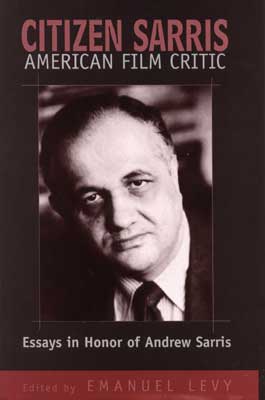
Citizen Sarris, American Film Critic:
Essays in Honor of Andrew Sarris
Edited by Emanuel Levy
The Scarecrow Press, 2001
Ironically, my enemies were the first to alert me to the fact that I had followers.
— Andrew Sarris, Confessions of a Cultist (1970)
One of the main emotions aroused in me by the 40 or so contributions to the millennial Festschrift Citizen Sarris is nostalgia –- specifically, a yearning for the era three or four decades ago when something that might be described as a North American film community was slowly emerging and recognizing its own existence.
This was just before academic film studies, radical politics, drugs and diverse other developments splintered that community into separate and mainly non-communicating cliques and ghettos, accompanied by an intensification of studio promotion that eventually took infotainment beyond its status as a minor industry and into an arena where advertising was coming close to defining as well as monitoring the whole of film culture, thus phasing out individual voices -– or at the very least bunching them together in sound bites, pull quotes, bibliographies and adjectival ad copy. Read more
The best scene from Orson Welles’s Don Quixote
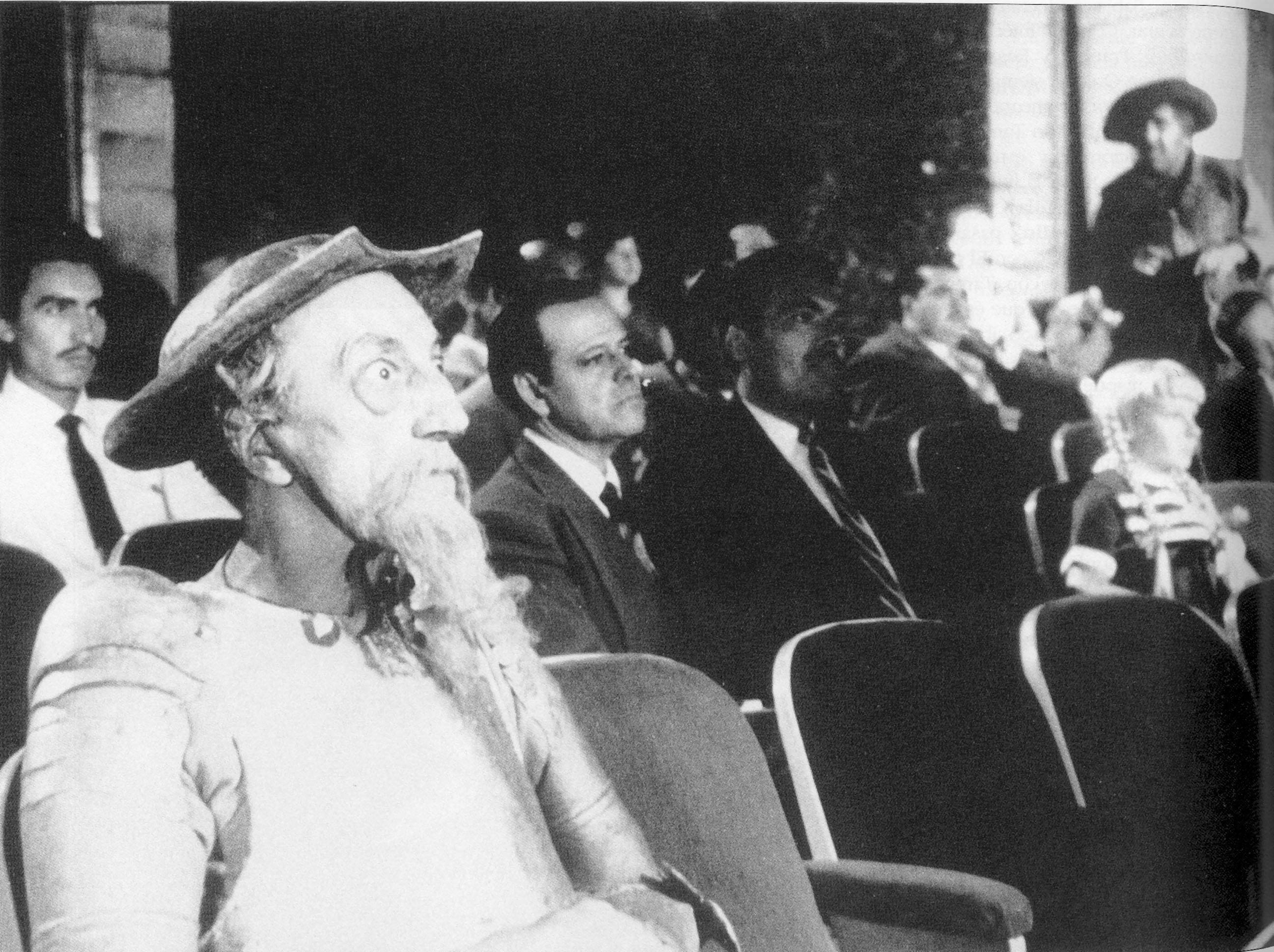
I hope I can be forgiven for promoting a piece of my own promotion. It seems worth doing in this case because an hour-long interview with me by Mara Tapp about my latest book, Discovering Orson Welles, taped for CAN TV19 and showing on Sunday, October 21, at 5 PM and then again on Monday, October 22, at noon, entitled “Unseen Orson Welles,” includes a silent, five-minute sequence from Orson Welles’ unfinished Don Quixote that is arguably the greatest sequence he shot for the film, even though it can’t be found in the execrable version cobbled together by Jesus Franco in 1992. It was shot in the mid-1950s in Mexico City, during the postproduction of Touch of Evil. It’s set in a movie theater, features child actress Patty McCormack as herself, Francesco Riguera (see photo) as Quixote, and Akim Tamiroff (perhaps Welles’s favorite character actor, who also appears in Mr. Arkadin, Touch of Evil, and The Trial) as Sancho Panza, and is fully edited by Welles.
“The Most Beautiful Six Minutes in the History of Cinema”
Thanks to Reader webmaster Whet Moser, here’s a scene from Welles’s Don Quixote, preceded by a few comments from me from an upcoming interview, “Unseen Orson Welles.”
Read more
Commissioned by MUBI for late October, 2019. — J.R.
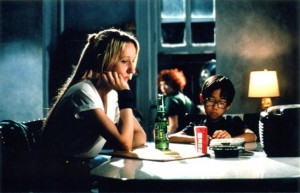
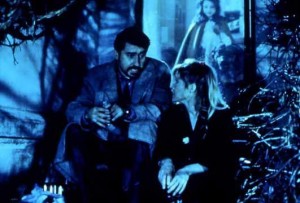
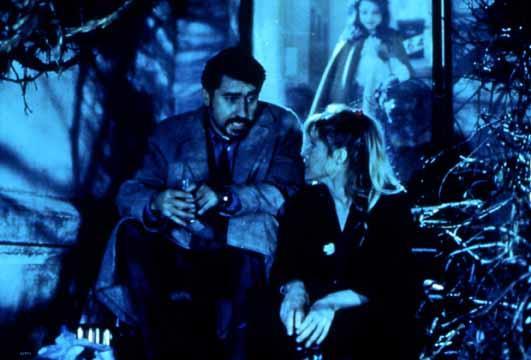
In Sara Driver’s too small yet varied filmography, her two fiction features, both poetic fantasies — Sleepwalk (1986) and When Pigs Fly (1993) — are bracketed by two other longer films, the 48-minute You Are Not I (a brilliant adaptation of a Paul Bowles story about sisters, narrated by a schizophrenic, 1981) and the 78-minute documentary Boom for Real: The Late Teenage Years of Jean-Michel Basquiat (2017). Sleepwalk stars Suzanne Fletcher, who also played the schizophrenic sister in You Are Not I; Boom For Real portrays both a highly interactive community and an eclectic artist inside it, which might also describe When Pigs Fly, a comedy inspired by Topper about a jazz pianist (Alfred Molina) living in an east coast port town populated by barflies and ghosts. Moreover, the community in Boom is basically Lower East Side Manhattan and more specifically the Bowery, the setting of Sleepwalk, as well as the New York neighborhood where Driver has lived with Jim Jarmusch for well over three decades. (She produced his first two features, and plays one of the zombies in The Dead Don’t Die.)
I’ve known Driver since the 1980s, and suspect that one reason why she hasn’t become better known is that she’s both a woman and a surrealist, a combination that isn’t widely recognized in this country. Read more
Written for the StudioCanal Blu-Ray of The Trial in the Spring of 2012. — J.R.

‘What made it possible for me to make the picture,’ Orson Welles told Peter Bogdanovich of his most troubling film, ‘is that I’ve had recurring nightmares of guilt all my life: I’m in prison and I don’t know why –- going to be tried and I don’t know why. It’s very personal for me. A very personal expression, and it’s not all true that I’m off in some foreign world that has no application to myself; it’s the most autobiographical movie that I’ve ever made, the only one that’s really close to me. And just because it doesn’t speak in a Middle Western accent doesn’t mean a damn thing. It’s much closer to my own feelings about everything than any other picture I’ve ever made.’

To anchor these feelings in one part of Welles’ life, he was 15 when his alcoholic father died of heart and kidney failure, and Welles admitted to his friend and biographer Barbara Leaming that he always felt responsible for that death. He’d followed the advice of his surrogate parents, Roger and Hortense Hill, in refusing to see Richard Welles until he sobered up, and ‘that was the last I ever saw of him….I’ve Read more
Chapter Two of my book Movie Wars: How Hollywood and the Media Limit What Films We Can See (Chicago: A Cappella Books, 2000). The cover below is that of the U.K. edition published by the Wallflower Press. — J.R.
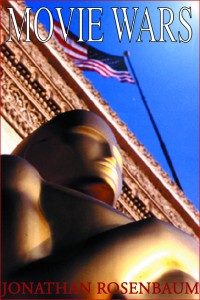
How often are aesthetic agendas determined by business agendas? This question is not raised often enough.Terminology plays an important role here. For example, once upon a time, previews of new releases were called “sneak previews” because the titles of these pictures weren’t announced in advance. Most industry people continue to use the term, despite the fact that the titles are announced and even advertised, so that the original meaning gets obfuscated: the only thing “sneaky” is the fact that they’re called “sneak previews.”This is a relatively trivial example of how terminology alienates us from what goes on in the world of movies. A more significant example is how we use an extremely loaded term like “independent.” An independent filmmaker traditionally meant a filmmaker who worked independently, free from the pressures of the major studios. If you believe what the media say about independent films, then the mecca for independent filmmaking would be the Sundance Film Festival, an event where independent films and filmmakers congregate annually. Read more
From the Chicago Reader (April 19, 1996). — J.R.

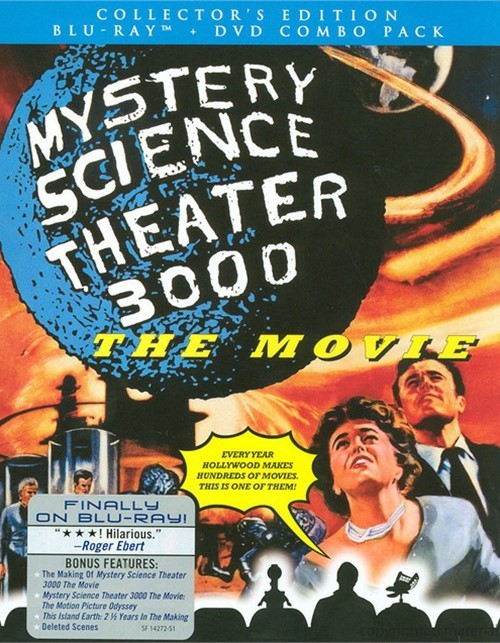
Mystery Science Theater 3000: The Movie 0 (no stars)
Directed by Jim Mallon
Written by Michael J. Nelson, Trace Beaulieu, Mallon, Kevin Murphy, Mary Jo Pehl, Paul Chaplin, and Bridget Jones
With Beaulieu, Nelson, Jeff Morrow, Rex Reason, Faith Domergue, and the voices of Mallon and Murphy.
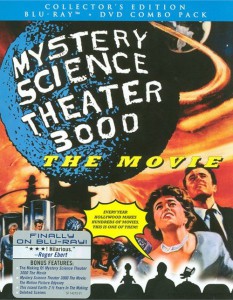
The premise of the recently discontinued cable-TV series on which this film is based is more or less as follows: a blustering mad scientist named Dr. Clayton Forrester (Trace Beaulieu) plots to take over the world. His plan? According to the Mystery Science Theater 3000: The Movie press book: “Find the worst movies ever made, show them to the entire population and bring the planet to its knees.” He kidnaps Mike Nelson (Michael J. Nelson) to serve as a guinea pig, takes him to the Satellite of Love, and makes him and his three robot pals — Tom Servo, Gypsy, and Crow — watch the Worst Movies Ever Made. But Mike and his friends confound the experiment by talking back to the screen and making wisecracks. We watch the movies too — or parts of them, since the lower portion of the screen is partially blocked by the silhouettes of Mike and two of the robots. Read more
The following essay was commissioned by Toronto filmmaker Ron Mann in 1992 for the book-spinoff of his documentary Grass. I wrote this around the same time that I reviewed Ghost Dog: The Way of the Samurai for the Chicago Reader, which helped to focus my conclusion; for more aspects of this argument, see “International Sampler”.—J.R.
What Dope Does to Movies
By Jonathan Rosenbaum
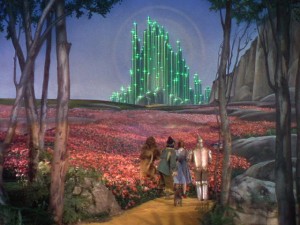
To the memory of Paul Schmidt
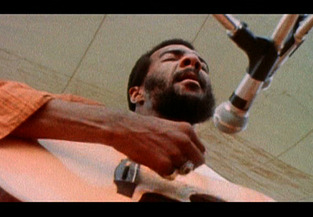
Consider how the camera cuts from Richie Havens’s face, guitar, and upper torso during his second number in Woodstock (1970) to a widening vista of thousands of clapping spectators, then to a much less populated view of the back of the bandstand, where there’s no clapping, watching, or listening — just a few figures milling about near the stage or on the hill behind it. What’s going on? This radical shift in orientation and perspective—a sudden movement from total concentration to Zenlike disassociation — is immediately recognizable as part of being stoned, and Michael Wadleigh’s epic concert film, which significantly has about the same duration as a marijuana high, is one of the first studio releases to incorporate this experience into its style and vision.
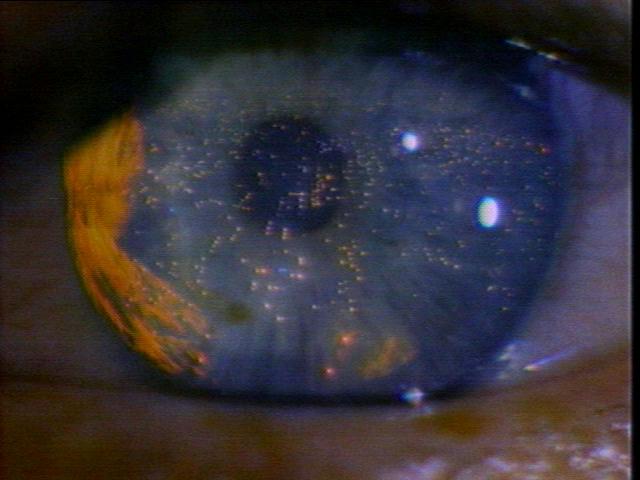
Or think of the way that Blade Runner (1982) starts: a long, lingering aerial view of Los Angeles in the year 2019, , punctuated by dragon-like spurts of noxious yellow flames, with enormous close-ups of a blue eye whose iris reflects those sinister, muffled explosions. Read more