From the Chicago Reader (May 17, 1996). — J.R.

The Umbrellas of Cherbourg
Rating **** Masterpiece
Directed and written by Jacques Demy
With Catherine Deneuve, Nino Castelnuovo, Anne Vernon, Marc Michel, Ellen Farner, Mireille Perrey, and Harald Wolff.
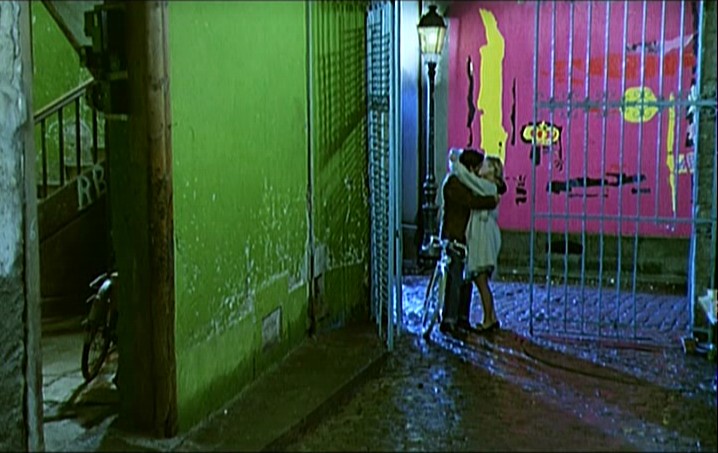
Let’s put it this way: It’s 1957, and a 20-year-old garage mechanic in Cherbourg knocks up his girlfriend just before he leaves for two years of military service in Algeria. Guy Foucher and Geneviève Emery — the daughter of a middle-class widow who helps her mother run a chic umbrella shop — make a handsome and devoted couple, and they swear eternal love to each other before he leaves, but he writes to her only infrequently. When Geneviève finds herself pregnant, her financially strapped mother, who’s never approved of her relationship with Guy, virtually stage-manages a proposal from a visiting diamond merchant who’s already helped her out of a financial crisis. By the time Guy returns from Algeria with a pronounced limp (the reason he didn’t write), Geneviève has married the diamond merchant and moved to Paris, and the umbrella shop has closed, to be replaced by a store selling washing machines.
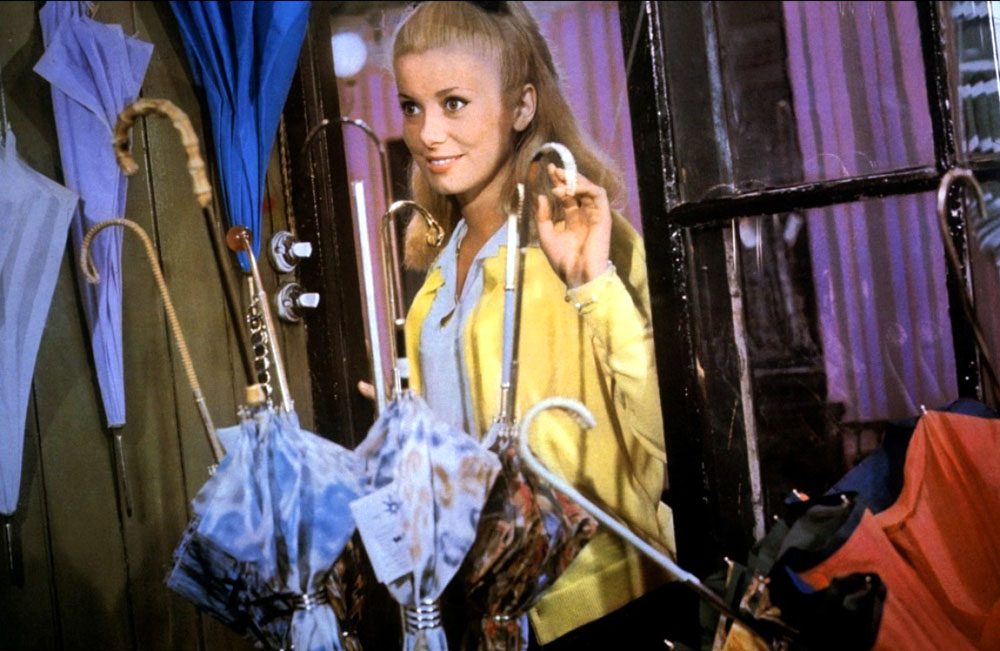
As luck would have it, I first saw Les parapluies de Cherbourg (1964) about two years too early — before my first trip to France. Read more
Posted on the Chicago Reader‘s blog, Bleader. — J.R.
Spike Lee’s best movie?

If my 20 best list for the past year could have been based purely on artistic criteria rather than on packaging and marketing categories, Spike Lee’s
When the Levees Broke: A Requiem in Four Acts — which premiered on HBO on two consecutive nights in late August, a year after the tragedy in New Orleans—would have belonged somewhere near the top. Although I missed the third act at the time, I’ve recently watched the whole thing on the recently released
three-disc DVD box set — which adds a fifth act called “Next Movement” as well as a slide show of photographs called “Water Is Rising,” accompanied (like the documentary itself) by a Terence Blanchard jazz score—and the experience as a whole is so powerful that I’m tempted to call this over four-hour documentary Lee’s masterpiece to date. For its remarkable cast of characters, its comprehensive and even epic treatment of a major catastrophe in all its multidimensional aspects, for its political and ethical clarity (as well as its focused and wholly justifiable anger), and above all, for its soul, it shows a maturity and balance that may be unparalleled in Lee’s work.
From the Chicago Reader (July 3, 1992). This marks my first encounter with Lars von Trier. — J.R.

ZENTROPA
*** (A must-see)
Directed by Lars von Trier
Written by von Trier and Niels Vorsel
With Jean-Marc Barr, Barbara Sukowa, Udo Kier, Ernst-Hugo Jaregard, Erik Mork, Jorgen Reenberg, Henning Jensen, Eddie Constantine, and the voice of Max von Sydow.
Lars von Trier’s Zentropa is the most exciting failure to come along in ages. This Danish-French-German-Swedish coproduction (known as Europa outside the United States), turning up here over a year after it received both the Jury Prize and the Technical Prize at Cannes, addresses so many fundamental contemporary questions about postmodernism, language, colonialism, the Common Market, coproduction, the future of European cinema, and our collective memory of World War II that one may feel a mite churlish pointing out that its technique ultimately overwhelms the themes and characters. After all, exercices de style worthy of the name are not exactly plentiful these days, and Zentropa is an especially dazzling example — vastly more impressive than Barton Fink or Kafka or Shadows and Fog, to cite only the first rough counterparts that come to mind. It has so much to say and do, in fact, that its failure to get everything said and done has to be weighed against the failure of most other recent movies to say or do anything at all beyond the barest commercial minimum. Read more
