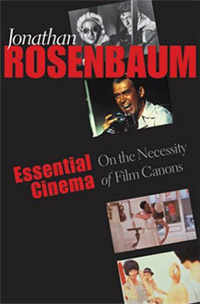
A slightly different version of the Introduction to my 2004 collection, Essential Cinema: On the Necessity of Film Canons. — J.R.
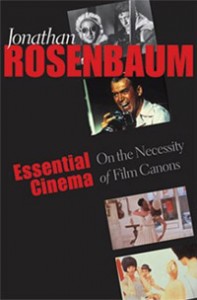
Introduction
As the son and grandson of small-town exhibitors — a legacy explored in detail in my first book, Moving Places: A Life at the Movies (1980/1995) — I find it difficult to pinpoint with any exactitude when my film education started. But I can recall two pivotal early steps during my freshman year at New York University in 1961, when I was an English major still aspiring to become a professional novelist: taking the first and only film course I’ve ever had in my life and purchasing my first film magazine.
The course was an introductory survey taught by the late Haig Manoogian, who was serving as Martin Scorsese’s mentor in production courses around the same time. For me, it mainly afforded me my first opportunity to see The Birth of a Nation, The Last Laugh, and a few other film history staples; since I had no interest in making movies — or at this point in writing about them — I couldn’t work up much enthusiasm for such matters as “story values” that Manoogian tended to emphasize. Read more
From the Chicago Reader (October 4, 1996); also reprinted in my collection Essential Cinema. — J.R.

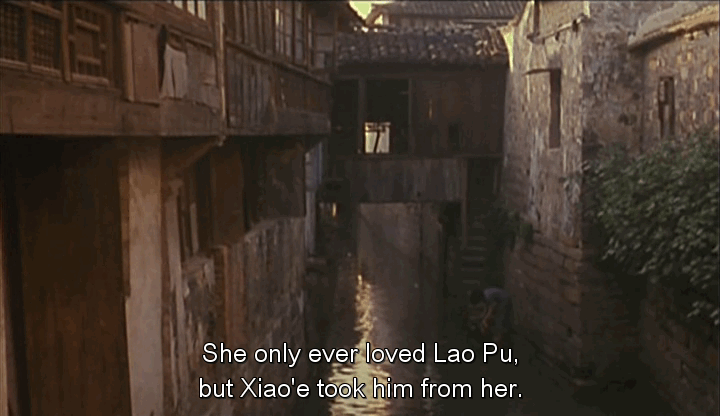
Blush
Rating **** Masterpiece
Directed by Li Shaohong
Written by Ni Zhen and Li
With Wang Ji, Wang Zhiwen, He Saifei, Zgang Liwei, Wang Rouli, Song Xiuling, Xing Yangchun, Zhou Jianying, and Cao Lei.
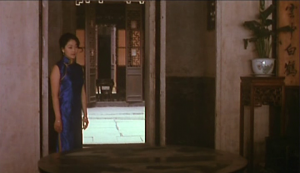
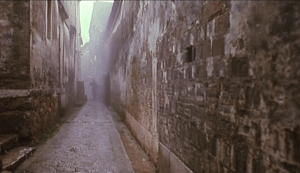
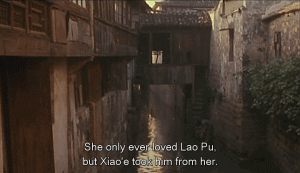
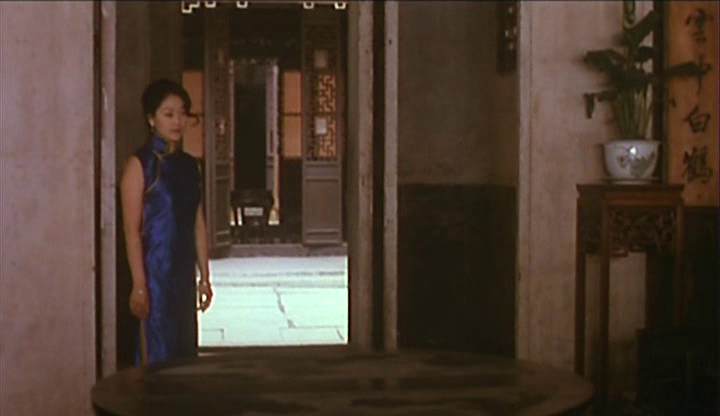
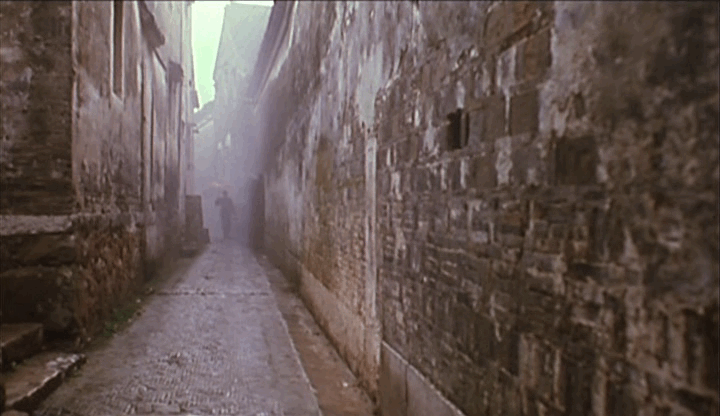
The use of multiple perspectives in Chinese painting was not for the purpose of making a hologram, nor was the use of parallel perspectives for the purpose of retaining the true dimensions of the objects represented. What was desired was rather a point of view which transcended that of the individual. The apparent horizon and vanishing point employed by Renaissance perspective made the image seem concrete, but demanded substantial identification with a particular viewer. Such images were perceived as both individual and momentary, seen by a particular person at a particular time. Chinese painting strove for a timeless, communal impression, which could be perceived by anyone, and yet was not a scene viewed by anyone in particular.
Chinese paintings did not portray reality; the world which the viewer entered was the realm of literature or philosophy, a realm which transcended nature. To enjoy a long tableau with small figures, one must shift one’s line of sight left and right, or up and down, a necessary condition for the appreciation of Chinese visual representation. Read more
From the Chicago Reader (September 1, 1988). — J.R.
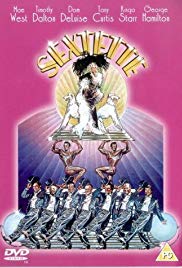
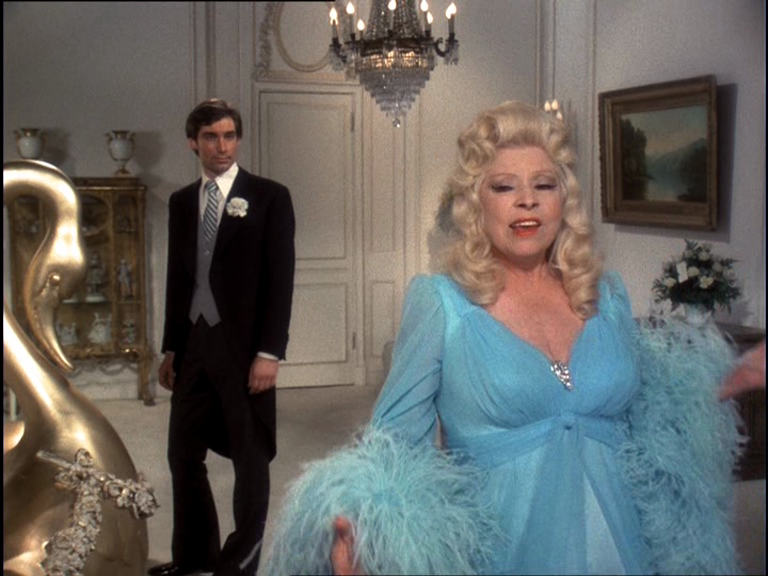
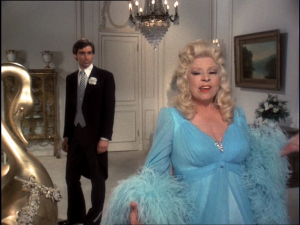
Mae West’s swan song to cinema at age 86 is one of the world’s all-time worst movies, but that doesn’t detract at all from its immense charm and lewd fascination. Based on West’s own play, produced by two wealthy English fans in their early 20s, directed after a fashion by Ken Hughes (reportedly many hands were involved), and including such standbys as Timothy Dalton, Tony Curtis, Dom DeLuise, Ringo Starr, George Hamilton, Alice Cooper, Keith Moon, Walter Pidgeon, Rona Barrett, and George Raft, this inept but heartfelt 1978 tribute to West’s talent and worldview often defies description. It’s amateur filmmaking at its most delirious, complete with a rousing production-number version of “Hooray for Hollywood”; West herself remains visibly sedated but indefatigably game throughout. 91 min. (JR)
 Read more