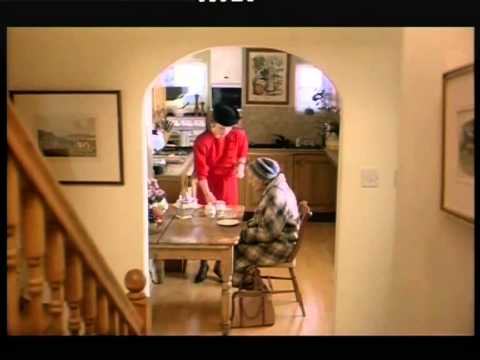
Krzysztof Kieslowski’s major work (1988) consists of ten separate films, each running 50-odd minutes and set mainly around two high-rises in Warsaw. The films are built around a contemporary reflection on the Ten Commandmentsspecifically, an inquiry into what breaking each of them in today’s world might entail. Made as a miniseries for Polish TV, these concise dramas can be seen in any order or combination; they don’t depend on one another, though if you see them in batches you’ll notice that major characters in one story turn up as extras in another. One of Kieslowski’s best ideas was to use a different cinematographer for each film (with the exception of the third and ninth), though the script is more important here than the mise en scene. In Polish with subtitles. (JR) Read more
From the Chicago Reader (November 1, 1988). — J.R.

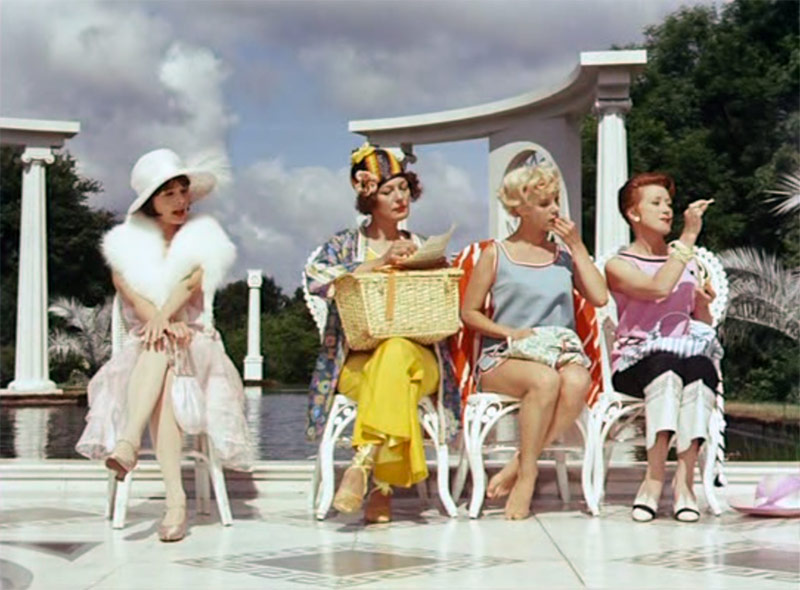
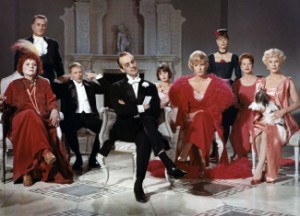
One of the rarest things in contemporary cinema — an underrated Ingmar Bergman film. Made in 1964, after The Silence, this color comedy (also known as Now About These Women) follows the mishaps of a music critic who visits a famous cellist he’s writing a book about. Ostensibly Bergman’s revenge against critics, as Pale Fire was for Vladimir Nabokov, this odd venture features Jarl Kulle, Georg Funkquist, and many of Bergman’s best actresses: Eva Dahlbeck, Harriet and Bibi Andersson, Karin Kavli, and Gertrud Fridh. (JR)
 Read more
From the Chicago Reader (March 1, 2001). — J.R.
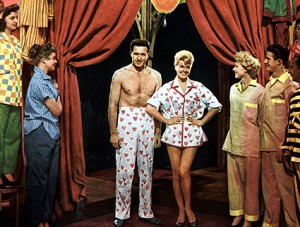
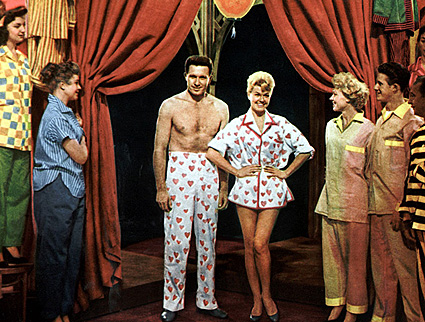
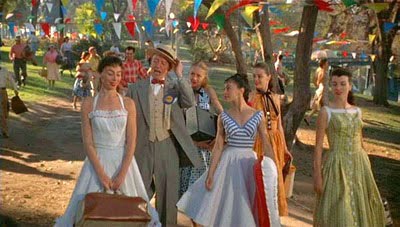
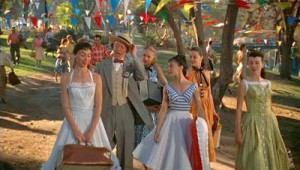
Film scholar Jane Feuer has argued that the Hollywood musical is a politically conservative genre, a notion challenged by the Warners musicals of the 30s, Bells Are Ringing (1969), and this exuberant, underrated 1957 movie. Adapted from George Abbott’s Broadway hit, it concerns a strike in a pajama factory, with Doris Day as the shop steward and John Rait as her boss. Though the sexual politics are far from progressive, this is the sort of labor musical that inspired Jean-Luc Godard’s admiration. Bob Fosse’s airy choreography is terrific, and so is the score, which includes “Seven and a Half Cents” and a steamy “Steam Heat”. Stanley Donen directed with verve and energy. 101 min. (JR)
 Read more
From the Chicago Reader (April 21, 1988). — J.R.
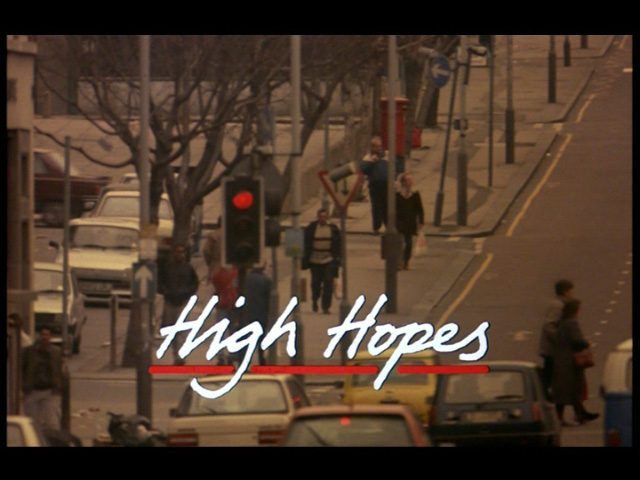
HIGH HOPES
*** (A must-see)
Directed and written by Mike Leigh
With Philip Davis, Ruth Sheen, Edna Dore, Philip Jackson, Heather Tobias, Leslie Manville, David Bamber, Jason Watkins, and Judith Scott.
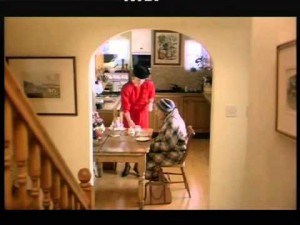
One of the most interesting things about Mike Leigh’s up-to-the-minute bulletin from Thatcher England is its title. Because this wonderful English movie is partly a comedy, and because it’s very much about the way that Londoners live nowadays, one would assume a title like High Hopes is ironic. Among most of my English friends, the expectations currently expressed about their country’s future couldn’t be much lower; and at first glance, there’s nothing in this movie to contradict their pessimism.
But take a second look at Leigh’s movie — which is sharp and funny and broad enough to warrant it — and you might find some reason for revising this opinion. England is after all a country of survivors, and one of the best ways of surviving in extreme situations (say, the London blitz) is to assume the worst and start from there. That’s what the leading characters and heroes of High Hopes do, a very charismatic, funky post-hippie couple named Cyril (Philip Davis) and Shirley (Ruth Sheen). Read more
Clemens Klopfenstein’s evocative poetic fantasy proceeds with a highly illogical plot as if it were the most natural thing in the world. A Swiss philologist flying from Zurich to Stockholm suffers a plane crash, swims ashore, and finds himself in Macao, along with the plane’s pilot. After he tries repeatedly and unsuccessfully to phone his wife in Switzerland, he gradually realizes that he and the pilot are dead, and they attempt to escape from their affable oriental paradise. (His wife, meanwhile, discovers that the plane crashed into the Baltic Sea.) Vividly shot by Klopfenstein himself, this haunting and pleasurable Swiss drama has such a compelling mood that you can almost taste it; the dreamy night scenes, shot through a blue filter, convey some of the ambience of tinted silent films. With Max Ruedlinger, Christine Lauterburg, Hans-Dieter Jendreyko, and Shirley Wong (1988). (JR) Read more
Whatever else you might say about this weird, creepy, and funny independent item by Guy Maddin, it’s certainly different (1988). Although this is a black-and-white sound picture (with occasional sepia and tinting), the ambience is mainly neo-Nordic silent cinema crossed with surrealism; it’s basically played for deadpan laughs, with a fair amount of gore and black humor. Around the turn of the century two patients (Kyle McCulloch and Michael Gottli), who occupy adjacent beds at a primitive and impoverished hospital near Winnipeg, swap yarns about their lives, and strange coincidences coalesce from their separate stories. If you’re in search of something unusual, you should definitely check this out. With Angela Heck and Margaret-Anne MacLeod. 77 min. (JR) Read more
The Gene Siskel Film Center’s monthlong retrospective on French director Luc Moullet peaks this week with screenings of some of Moullet’s best work. Both parts of his career are represented–his neoprimitive beginnings, when he shamelessly flaunted his lack of money and technique while alluding to Hollywood genres (The Smugglers, A Girl Is a Gun), and his mature mastery as a comic performer and a director, when he pushed situations to hilarious extremes (The Comedy of Work, Opening Tries).
Shot in black and white, The Smugglers (1967, 81 min.) is the closest thing to a testament in Moullet’s oeuvre; despite some derisive allusions to adventure thrillers, the tone is closer to sweet-tempered absurdism, with throwaway gags about backpackers and imaginary borders in the French Alps. It screens with the miniature epic Opening Tries (1988, 15 min.), which shows Moullet’s baroque ingenuity at trying to remove a twist-off cap from a large bottle of Coke. (Sat 4/15, 5 PM, and Mon 4/17, 6 PM) The delirious and erotic color “western” A Girl Is a Gun (1971, 77 min.) is Moullet’s feature Une Aventure de Billy le Kid with funny English dubbing. Jean-Pierre Leaud and Rachel Kesterber costar with some scene-stealing landscapes. (Sat 4/15, 3 PM, and Wed 4/19, 6 PM)
The Comedy of Work (1987, 90 min.) Read more
From a 1989 catalog that I did for the Walker Art Center, Cinema Outsider: The Films of William Klein. — J.R.
William Klein on His Film Work
Klein made the following remarks in a telephone conversation with Jonathan Rosenbaum in early November 1988.



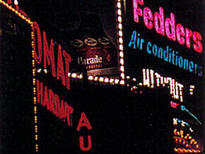
On Broadway by Light (1958) and Orson Welles
I did this book on New York: black-and-white, grungy photographs. People said, ‘What a put-down — New York is not like that. New York is a million things, and you just see the seamy side.” So I thought I would do a film showing how seamy New York was, but intellectually, by doing a thing on electric- light signs. How beautiful they are, and what an obsessive, brainwashing message they carry. And everybody is so thankful for this super spectacle. Anyway, I think it’s the first Pop film.
Afterwards, I went from New York to Paris on a boat. We were on the pier with all our suitcases when I saw Orson Welles with a cigar and a little attaché case – that’s all he had as luggage. I went up to him and said, “Listen, I’ve just shot a film. Would you like to see it?” I showed it to him in the boat’s movie theater, and he said, “This is the first film I’ve ever seen in which the color is absolutely necessary.” Read more
From the January 6, 1989 Chicago Reader. — J.R.
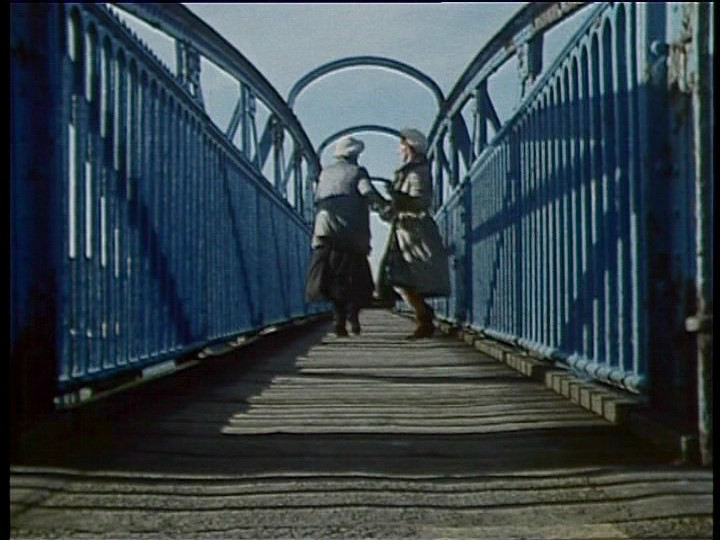
For me, the ten best movies of 1988 are the ones I would profit most from seeing again and the ones I’ve profited most from thinking about. Their value, in other words, lies not merely in the immediate pleasure they offered but also in their aftereffects — the way they set with me for weeks and months after I saw them, sometimes growing and ripening with time.
I tend to be wary of critics’ lists and awards that are unduly weighted toward recent films — particularly because it’s much harder to evaluate a movie at the time of its release than it is weeks, months, or even years later. Perhaps the key occupational hazard of film critics is the pressure to remain stuck in a continuous present, and to serve the whims of the marketplace by confusing what’s recent with what’s genuinely new. Measuring a given week’s offerings only against each other narrows the difference between criticism and advertising by basing everything on consumption — reducing the universe of films to the few releases that happen to be available for consumption at any given moment rather than reflection.
On the basis of my own reflection, it turns out that six of my favorite movies of 1988 opened in Chicago during the first half of the year; I saw a couple others either then or earlier, and the remaining two in July and September. Read more
As far as I know, this is the only surviving remnant, at least on paper, of a lecture I gave at what may have been the first international and academic conference devoted to Orson Welles, held at New York University in May 1988. The footnotes haven’t survived. — J.R.
Note: The following is a revised version of a paper which was initially structured around four lengthy excerpts from the Huckleberry Finn radio show presented on The Campbell Playhouse. In order to make this adaptation, I have eliminated all of my remarks about music and sound effects and given more emphasis to allusion and description rather than citation. Interested readers are urged to consult the radio show, available on Mark 56 Records (no. 634), P.O. Box One, Anaheim, CA 92805. [April 2015: This can now be accessed online and for free here.]

Huckleberry Finn was broadcast on The Campbell Playhouse on March 17, 1940, during the period when Orson Welles was commuting every week between Hollywood and New York. Herman Mankiewicz was working on the first draft of the Citizen Kane script at the time. Three and a half months had passed since the final version of the film script of Heart of Darkness had been completed, and two months since the final script of The Smiler with the Knife. Read more
MUBI’s posting of this film prompted me to repost the following. — J.R.

Like so much (too much) of contemporary cinema, Rodney Ascher’s Room 237 is at once entertaining and reprehensible. Alternating between the extravagant commentaries of five analysts of Kubrick’s The Shining (Bill Blakemore, Geoffrey Cocks, Julie Kearns, John Fell Ryan, Jay Weidner), it refuses to make any distinctions between interpretations that are semi-plausible or psychotic, conceivable or ridiculous, implying that they’re all just “film criticism” and because everyone is a film critic nowadays, they all deserve to be treated with equal amounts of respect and/or mockery (assuming that one can distinguish between the two) -– that is, uncritically and derisively, with irony as the perpetual escape hatch. Thus we’re told, in swift succession, that The Shining is basically about the genocide of Native Americans, the Holocaust, Kubrick’s apology for having allegedly faked all the Apollo moon-landing footage, the Outlook Hotel’s “impossible” architecture, and/or Kubrick’s contemplation of his own boredom and/or genius. Images from the movie and/or digital alterations of same are made to verify or ridicule these various premises, or maybe both, and past a certain point it no longer matters which of these possibilities are more operative. Unlike his five experts, Ascher won’t take the risk of being wrong himself by behaving like a critic and making comparative judgments about any of the arguments or positions shown, so he inevitably winds up undermining criticism itself by making it all seem like a disreputable, absurd activity. Read more

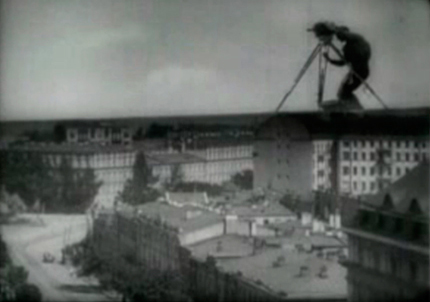
1. For me, there have been quite a few surprises in the results of Sight and Sound’s latest ten-best poll of film critics around the world — not so much the displacement of Citizen Kane from first place (which it occupied for half a century, ever since the second poll in 1962) by Vertigo, something that was bound to happen sooner or later, as the first appearance of The Man with a Movie Camera (in eighth place, with 68 votes). And, perhaps most startling of all, seeing Sátántangó tied with Jeanne Dielman, Psycho, and Metropolis (each of which received 64 votes), or seeing Abbas Kiarostami (represented by Close-Up, in 42nd place — in an incongruous six-way tie with Gertrud, Pather Panchali, Pierrot le fou, Playtime, and Some Like It Hot) doing better than Charlie Chaplin (represented by City Lights, in 50th place, tied with La jetée and Ugetsu Monogatari).


“Let’s remember,” Roger Ebert recently blogged, “that all movie lists, even this most-respected one, are ultimately meaningless.” But he goes on to note, correctly, that “In the era of DVD, all of the [50-odd] films on the list are available; in 1952, unless you had unusual resources, most of them could be found only in a few big cities,” which is far from meaningless. Read more

I can’t remember precisely when it was that I first met Elliott in Paris, but I’m sure it was in the early 70s, and I suspect it was the late Carlos Clarens, another Cinematheque regular, who introduced us, most likely after some Palais de Chaillot screening. It wasn’t much later when I discovered we were neighbors living a few blocks apart — me in a small, sunless flat on Rue Mazarine, Elliott in a large room stuffed with all sorts of arcane memorabilia at the Hotel de Verneuil on Rue de Verneuil. He was already a pack-rat then, especially when it came to his collection of clippings, and he continued to live that way years later when he eventually moved back to New York — first to a hotel on lower 5th Avenue, then to a roomy loft in Soho on West Broadway. It was a tragic moment for him when he had to move out of the latter place, leaving behind or giving up many of his treasured possessions (including, as I recall, a table once owned by Robert Ryan). And only a few days ago, at the Viennale, hearing about the ravages of Sandy on New York and environs, my friends and I were concerned about whether or not Elliott was okay. Read more
On October 14, 2012 I received the sad news from Pierre Bayle d’Autrange that his longtime partner Eduardo de Gregorio, also a longtime friend of mine (since 1973), died Saturday night at the St. Louis Hospital in Paris, not long after his 70th birthday.
I wrote the following for the festival catalogue of the Buenos Aires Festival of Independent Film in 2004, to accompany a retrospective of Eduardo’s films — as far as I know, the only such retrospective that was ever held. It is also reprinted — along with a short essay of the same length on Sara Driver (also the subject of a BAFICI retrospective that year)– in “Two Neglected Filmmakers,” a piece included in my most recent collection, Goodbye Cinema, Hello Cinephilia as well as here. — J.R.
Eduardo de Gregorio’s Dream Door

It must be a bummer to be an Argentinian writer and/or filmmaker and constantly get linked to Jorge Luis Borges. It must be especially hard if you’re Eduardo de Gregorio, whose first major screen credit is on an adaptation of “Theme of the Traitor and Hero” for Bernardo Bertolucci’s 1970 feature The Spider’s Strategm.
I don’t mean to question the credentials of de Gregorio as a onetime student of Borges — just the appropriateness of a too-narrow understanding to impose on a singular body of work that owes as much to cinematic references as to literary ones, and one that indeed juxtaposes the two almost as freely as it juxtaposes different languages and historical periods (while including all the cultural baggage that comes with each of them). Read more
An expanded edition of my book with Mehrnaz Saeed-Vafa, Abbas Kiarostami (University of Illinois Press, 2004), was published in Argentina by Los Rios, translated into Spanish by Luciana Borrini and Julián Aubrit. (A stil more expanded edition appeared in English much later, in 2018.) One of the two texts added to the Argentinian edition, my essay “Watching Kiarostami Films at Home,” is already available on this site, as are an essay about Shirin I wrote for the Cinema Guild DVD and an earlier dialogue I had with Mehrnaz about the film. Here is the other addition, written by Mehrnaz expressly for the expanded edition. — J.R.

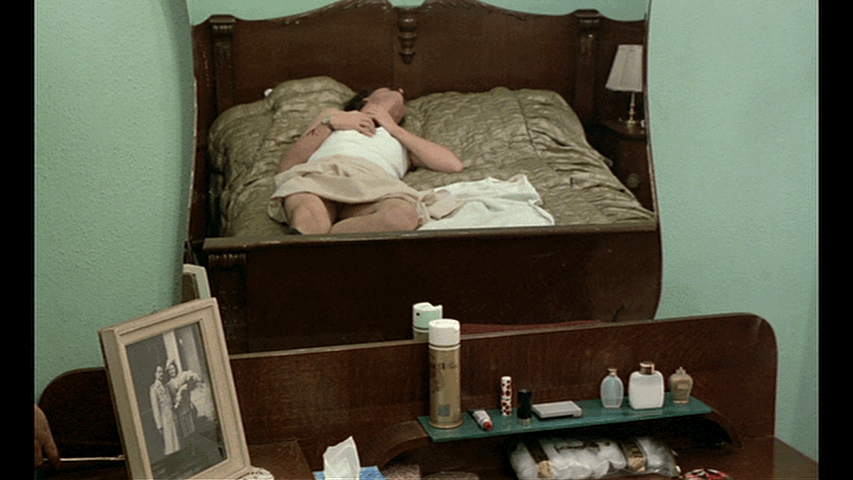
Reflections on Like Someone in Love (2012)
By Mehrnaz Saeed-Vafa

I
A phone conversation between Chicago (Saeed-Vafa) and Rome (Kiarostami), March 17, 2013:

MS: When you talked about Shirin in one of your interviews, you said that it was a unique film that could have changed your career, if you had made it earlier. What did you mean by that?
AK: I wished I had made Shirin earlier to get a better emotional understanding of women. Shirin was like a silent, wordless interview with 117 women. You could tell that they were all thinking silently about their private relationships, and we could see their emotions in their faces. Read more