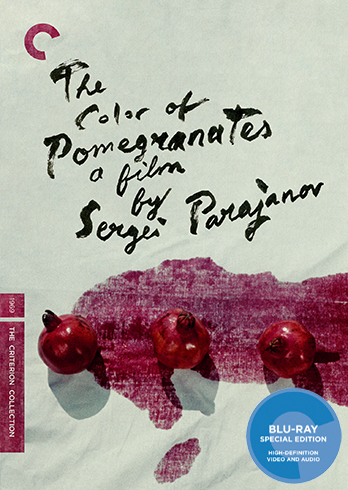
The following was published in the Chicago Reader on March 25, 1988. Criterion’s edition of The Color of Pomegranates (see below) has prompted this reposting, even though a good many of the details, including the title, are now out of date. On a more timely note, check out the beautiful new restoration of Paradjanov’s long-unseen and very beautiful Kiev Frescoes, — J.R.
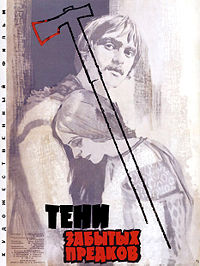
THE FILMS OF SERGEI PARADJANOV
by Jonathan Rosenbaum
There are few people of genius in the cinema; look at Bresson, Mizoguchi, Dovzhenko, Paradjanov, Bunuel: not one of them could be confused with anyone else. An artist of that calibre follows one straight line, albeit at great cost; not without weakness or even, indeed, occasionally being farfetched; but always in the name of the one idea, the one conception. –- Andrei Tarkovsky, Sculpting in Time
After 15 years of enforced inactivity, the greatest living Soviet filmmaker is finally back at work again, but it’s astonishing how little we still know about him––about his art, his life, or even his name. You won’t find him in Ephraim Katz’s Film Encyclopedia or in the indexes of books by Pauline Kael, Stanley Kauffman, or John Simon (among others), and as far as I know, no one anywhere has ever written a book or monograph about him. Read more
Here are ten of the 40-odd short pieces I wrote for Chris Fujiwara’s excellent, 800-page volume Defining Moments in Movies (London: Cassell, 2007). — J.R.
Scene

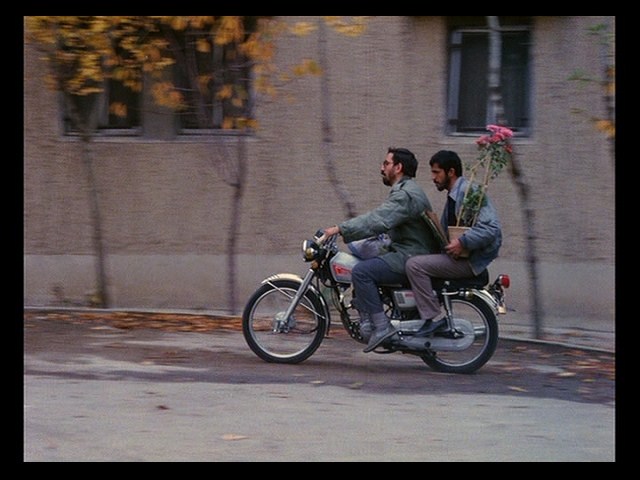
1990 / Close Up – The motorcycle ride of Makhmalbaf and Sabzian.
Iran. Director: Abbas Kiarostami. Cast: Mohsen Makhmalbaf, Hossein Sabzian. Original title: Nema-ye Nazdi.
Why It’s Key: A convicted imposter finally meets the man he’s been impersonating, and they set off together to visit the family that was fooled.
Hossein Babzian, a bookbinder, emerges from a jail sentence for having impersonated famous filmmaker Mohsen Makhmalbaf in order to ingratiate himself with the well-to-do Ahankhah family, pretending he was planning a movie about them. He’s greeted by the real Makhmalbaf, arriving on his motorbike to take him to visit the Ahankhahs, and filmmaker Abbas Kiarostami and his crew, who have arranged this meeting, are filming the entire encounter from a distance. We hear them saying that Makhmalbaf’s lapel mike is faulty, and notice that the dialogue between Makhmalbaf and Sabzian (“Do you prefer being Makhmalbaf or being Sabzian? I’m tired of being me”) periodically becomes inaudible — on the street, after Sabzian climbson the back of the motorbike, and when they stop briefly for Sabzian to buy flowers for the Ahankhans. Read more
From the Chicago Reader (February 20, 1998). — J.R.
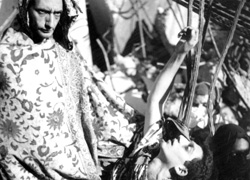

Scotch Tape
Rating *** A must see
Directed by Jack Smith
With Jerry Sims, Ken Jacobs, and Reese Haire.
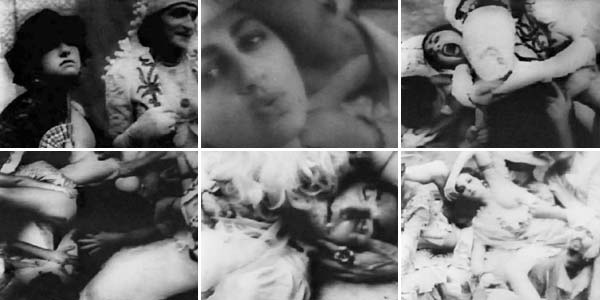
Flaming Creatures
Rating **** Masterpiece
Directed by Jack Smith
With Francis Francine, Sheila Bick, Joel Markman, Judith Malina, Dolores Flores, Marian Zazeela, and Smith.
You’d never imagine this from the mainstream press, but experimental film is on the rise again, as a taste as well as an undertaking — even if it’s often returning in mutated forms like video or in areas of filmmaking where we least expect it. At the Rotterdam International Film Festival three weeks ago, hundreds of Dutch viewers, most of them in their 20s, stormed the largest multiplex in Holland — one of the best-designed facilities I know of, suggesting an unlikely cross between a Borders and a Beaubourg, a mall and an airport — to see work that’s thought to have little or no drawing power in this country. They watched short experimental videos from Berlin, London, and Providence, Rhode Island, at a crowded weekday afternoon program called “City Sounds.” They watched Blue Moon, a charismatic Taiwanese feature by Ko I-cheng whose five reels can be shown in any order (they all feature the same characters and settings, but whether the five plots match up chronologically or as parallel fictional universes — signifying flashbacks, flash-forwards, or variations on a theme — is left to the viewer). Read more