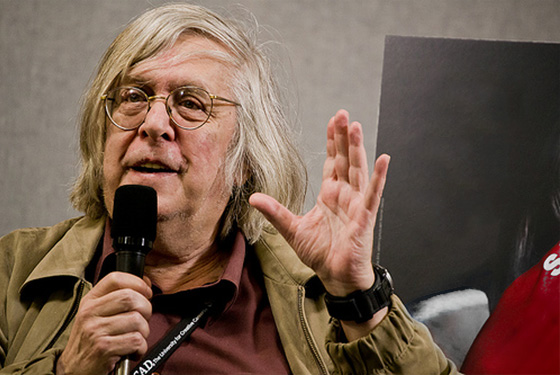
As far as I know, this is the only surviving remnant, at least on paper, of a lecture I gave at what may have been the first international and academic conference devoted to Orson Welles, held at New York University in May 1988. The footnotes haven’t survived. — J.R.
Note: The following is a revised version of a paper which was initially structured around four lengthy excerpts from the Huckleberry Finn radio show presented on The Campbell Playhouse. In order to make this adaptation, I have eliminated all of my remarks about music and sound effects and given more emphasis to allusion and description rather than citation. Interested readers are urged to consult the radio show, available on Mark 56 Records (no. 634), P.O. Box One, Anaheim, CA 92805. [April 2015: This can now be accessed online and for free here.]
Huckleberry Finn was broadcast on The Campbell Playhouse on March 17, 1940, during the period when Orson Welles was commuting every week between Hollywood and New York. Herman Mankiewicz was working on the first draft of the Citizen Kane script at the time. Three and a half months had passed since the final version of the film script of Heart of Darkness had been completed, and two months since the final script of The Smiler with the Knife. Read more
MUBI’s posting of this film prompted me to repost the following. — J.R.
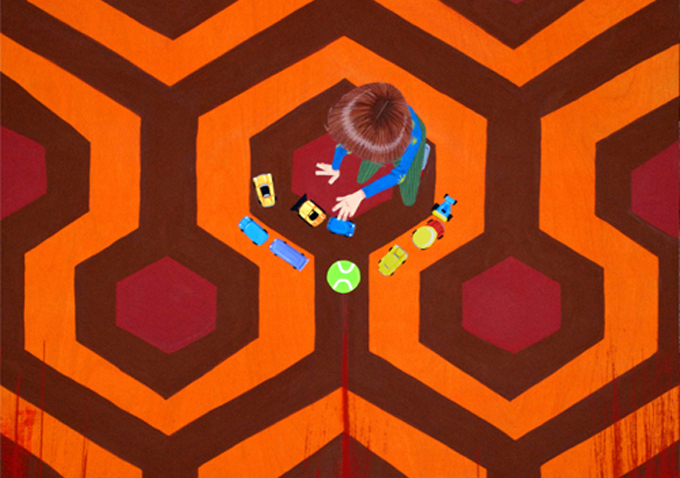
Like so much (too much) of contemporary cinema, Rodney Ascher’s Room 237 is at once entertaining and reprehensible. Alternating between the extravagant commentaries of five analysts of Kubrick’s The Shining (Bill Blakemore, Geoffrey Cocks, Julie Kearns, John Fell Ryan, Jay Weidner), it refuses to make any distinctions between interpretations that are semi-plausible or psychotic, conceivable or ridiculous, implying that they’re all just “film criticism” and because everyone is a film critic nowadays, they all deserve to be treated with equal amounts of respect and/or mockery (assuming that one can distinguish between the two) -– that is, uncritically and derisively, with irony as the perpetual escape hatch. Thus we’re told, in swift succession, that The Shining is basically about the genocide of Native Americans, the Holocaust, Kubrick’s apology for having allegedly faked all the Apollo moon-landing footage, the Outlook Hotel’s “impossible” architecture, and/or Kubrick’s contemplation of his own boredom and/or genius. Images from the movie and/or digital alterations of same are made to verify or ridicule these various premises, or maybe both, and past a certain point it no longer matters which of these possibilities are more operative. Unlike his five experts, Ascher won’t take the risk of being wrong himself by behaving like a critic and making comparative judgments about any of the arguments or positions shown, so he inevitably winds up undermining criticism itself by making it all seem like a disreputable, absurd activity. Read more