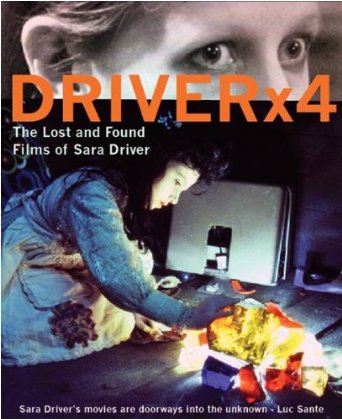
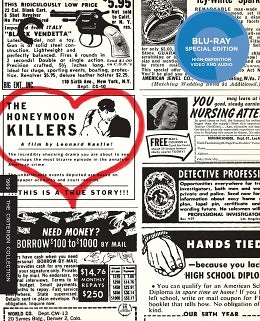
Program notes for this double feature at Manhattan’s Public Theater, March 8-13, 1983. A few of the arguments here, such as the comparison of Driver with Straub, strike me now as forced, but when I recall that students in the Downtown Whitney program during the same period compared You Are Not I abusively to The Twilight Zone (and were equally reluctant to regard John Ford as a serious artist when Straub praised him), I think my polemics were warranted….A happy postscript: both films are now available in excellent digital restorations (see below). -– J.R.
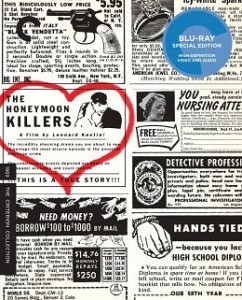
Slow yet relentless in their narrative progressions, deliberately nonspecific in their period settings, and equally unimaginable in anything but black and white, YOU ARE NOT I (1981) and THE HONEYMOON KILLERS (1969) are both startling and achieved first films about the triumphs of inexorable wills — each made with a kind of rigor and passion that seem oblivious to the whims of fashion. Small wonder that François Truffaut should be enthusiastic about the earlier film, with its accelerating montage of breathless love letters, its flighty camera movements and implacable bursts of Mahler; or that Jean-Marie Straub should be enthusiastic about the later one (“I liked your film ten times better than Roger Corman’s Edgar Allen Poe movies”), with its integral use of dialectics in conception and treatment alike. Read more
A program note for the 1997 San Francisco International Film Festival. — J.R.
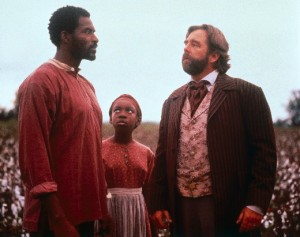
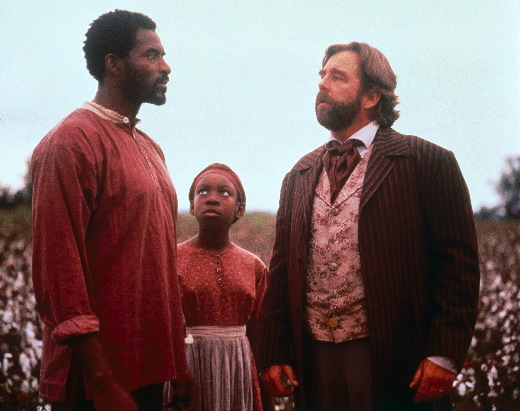
In this intense drama of courage and humanity in the face of the brutality of slavery, a plantation slave named Nightjohn (Carl Lumblv) defies the law by teaching another slave, a l2-year-old girl named Sammy (Allison Jones), how to read and write. The only other slave on the plantation who even knows the alphabet had a thumb and forefinger chopped off as punishment. Working with a theme akin to that of Ray Bradbury’s novel (and François Truffaut’s film) Fahrenheit 451 — though it’s given a substantially different edge by being set in the past rather than the future — Nightjohn views illiteracy as a central adjunct of slavery. The film isn’t merely a history lesson about people who lived some 165 years ago but a story with immediate relevance. Part of what’s so wonderful about it is its use of fairy-tale feeling to focus on real-life issues, not to evade or obfuscate them. Nightjohn’s ambience is placed at the service of myth — myth that embodies a lucid understanding of both slavery and literacy. Sammy and Nightjohn may sometimes come across as superhuman, but the world they inhabit and seek to change is in no sense fanciful. Read more
From the Chicago Reader (January 12, 1990). — J.R.
American TV watchers, eat your hearts out! These four selections from “Ten to Eleven” — a series of short, experimental “essay” films made for German television by the remarkable German filmmaker Alexander Kluge, to be shown here on video — are not always easy to follow in terms of tracing all their connections, but they’re the liveliest and most imaginative European TV shows I’ve seen since those of Ruiz and Godard. Densely constructed out of a very diverse selection of archival materials, which are manipulated (electronically and otherwise) in a number of unexpected ways, these historical meditations often suggest Max Ernst collages using the cultural flotsam of the last 100 years. Why Are You Crying, Antonio? relates fascism, opera, and domesticity; Articles of Advertising historicizes ads in a number of novel ways; Madame Butterfly Waits offers a compressed history of opera and its kitschy successors in pop culture; and the self-explanatory The Eiffel Tower, King Kong, and the White Woman makes use of comics, movies in the 1890s, a quote from Heidegger, and multiple images of the famous ape and tower. These are apparently fairly recent works. A Chicago premiere. (Randolph St. Read more