From The Soho News (January 14, 1981). — J.R.
“When I came to New York in September,” English avant-garde filmmaker and film theorist Peter Gidal tells me, “I noticed that almost every film review that I read used food metaphors and digestion metaphors to talk about art and cinema. Because consumption, digestion and predigestion is the dominant mode in this country. It’s just one signifier of the attempt to break with materialism and process, and to anthropomorphize everything.”
An “English” label should be assigned to Gidal only after some qualification. Born in 1946, he grew up in Mount Vernon, N. Y., and Switzerland and attended Brandeis University before settling in London in the late 60s. Although his accent sounds more redolent of Manhattan than of London, he has spent only two of the past 21 years in the U.S.
Regarding his opposition to food metaphors (as well as narrative), he recalls a drinking cup that he used as a kid for drinking milk. “It had a house on the outside, and on the inside, as you gradually drank, you could see the words, ‘The End.'”
“Which ties up with the idea of closure,” I suggest pedantically, referring to a discussion we’ve been having about Action at a Distance, his latest film. Read more
From the Chicago Reader (May 28, 1993). — J.R.
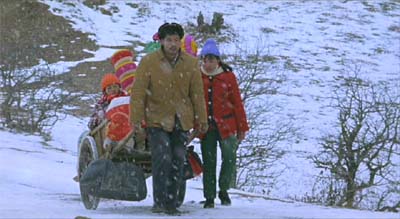
THE STORY OF QIU JU
**** (Masterpiece)
Directed by Zhang Yimou
Written by Liu Heng
With Gong Li, Lei Lao Sheng, Liu Pei Qi, Ge Zhi Jun, and Yang Liu Chun.
For a comedy that takes bureaucratic negotiation as one of its overriding themes, Zhang Yimou’s The Story of Qiu Ju has negotiated quite a bit for its director from the Chinese government, bureaucracy and all. This is only one of the film’s many ironies. Another is that in the course of showing us much more of China’s particularity than ever before Zhang has realized his most universal and accessible film to date, offering a virtual reproach to the artiness of its predecessors.
Until this feature was made, Zhang’s previous two films, Ju Dou (1990) and Raise the Red Lantern (1991), both huge international successes, were banned in China. Zhang was widely regarded as both a dissident and a scandalous figure, thanks to his adulterous relationship with his leading lady, Gong Li (who has played in all five of his features), which was given much publicity in abusive newspaper articles under the byline of his estranged wife. At least one semireliable commentator thinks it may have been this scandal more than the political meanings of Ju Dou and Raise the Red Lantern (dramas about the persistence of Chinese feudalism set in the early part of this century) that led to their suppression. Read more
From the Chicago Reader (December 15, 1989). — J.R.
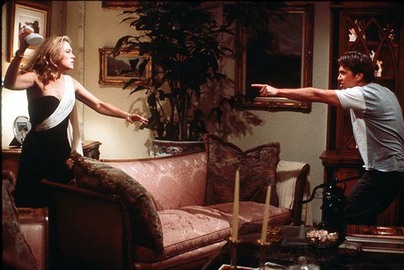
THE WAR OF THE ROSES
*** (A must-see)
Directed by Danny DeVito
Written by Michael Leeson
With Michael Douglas, Kathleen Turner, DeVito, Marianne Sagebrecht, Sean Astin, and Heather Fairfield.
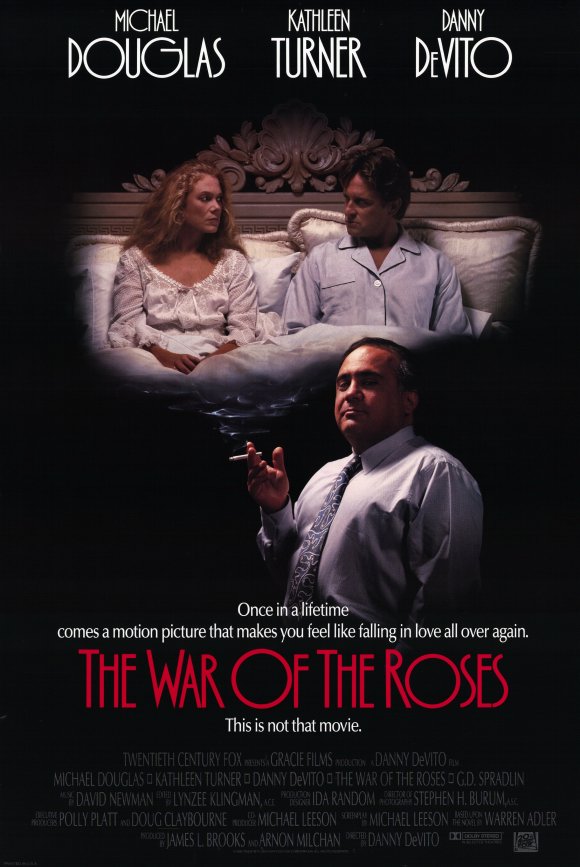
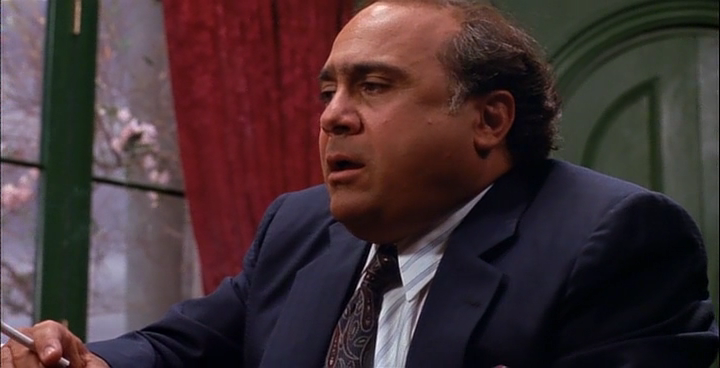
The proper tone for Danny DeVito’s second feature is set by a very short Matt Groening cartoon that precedes every print. A brief cadenza on familial hatred and violence is played out in a therapist’s office, where most of the hatred and violence is directed at the therapist, uniting the family in the process. The War of the Roses opens with another sort of therapist — Danny DeVito as high-priced lawyer Gavin D’Amato — talking to a client in his office. The landscape outside D’Amato’s office looks unusually fake, and DeVito’s delivery seems as self-consciously overarticulated as some of Woody Allen’s recent performances — to mix a metaphor, one can almost see the chalk marks in his verbal punctuation — but both of these oddities actually serve the story he is about to tell about a marriage and its demise.
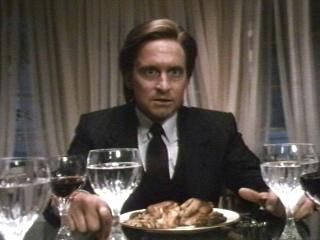
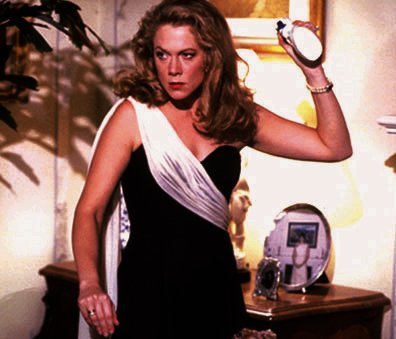
Unlike the therapist in the Groening cartoon, D’Amato stands mostly outside the story he is telling, and he clearly represents the voice of reason rather than part of the problem. Read more