From the July 1980 issue of Omni. Portions of this are derived from a lecture I gave at the Venice film festival the previous year, which is reprinted in my first book, Moving Places: A Life at the Movies (1980). A lot of the terminology used here seems pretty quaint now. — J.R.
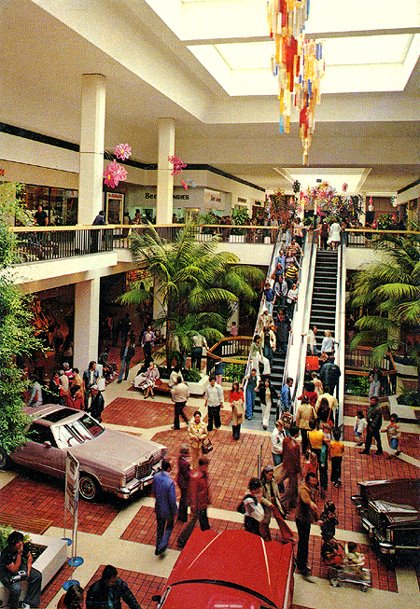
Speculating on what movies of the future will be like, it’s hard to get very far without some notion of the changing needs of the audience. A crucial part of this change can be detected in where we see movies. According to present signs, it seems pretty clear that most of the films we’ll see will be either in homes or in shopping malls.
“Once inside a mall, shoppers have few decisions to make,” the magazine Dollars & Sense recently noted. “Corners are kept to a minimum so the customers will flow along from store to store, propelled, as the developers say, by `retail energy’.” It’s a description that fits several recent movie blockbusters — and others we can expect to see in the future.
By contrast, the movie houses that traditionally cropped up near the centers of towns — public gathering places, not unlike the municipal squares they were often adjacent to — are quickly becoming nostalgic emblems of another era. Read more
From Monthly Film Bulletin, July 1976 (Vol. 43, No. 510). –- J.R.
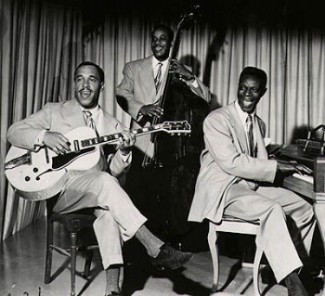
Nat King Cole Trio
U.S.A., 1948
Director: Josh Binney
Dist—TCB. p.c–All-American. p–Glucksman. m/songs–“Oo Kickerooni”, Rooney”, ‘”Now He Tells Me”, “Breezy and the Bass” performed by–Nat “King” Cole (piano, vocals), Johnny Miller (bass), Oscar Moore (guitar). No further credits available. 262ft. 7 mins. (16 mm.).

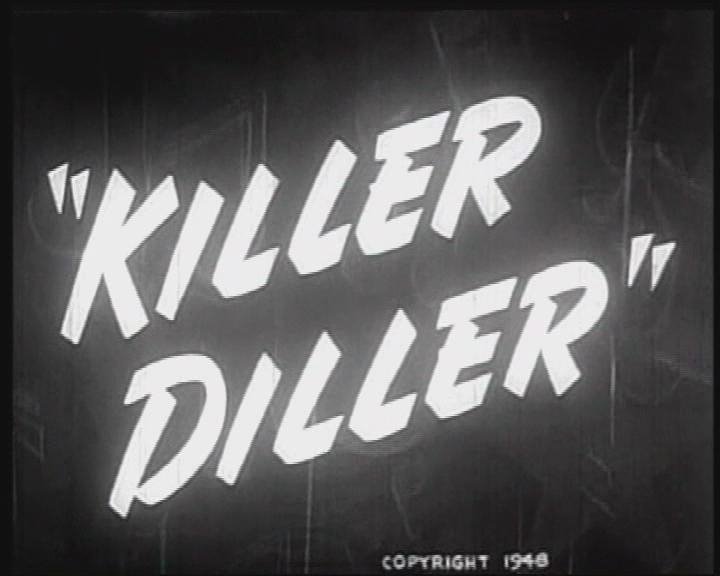
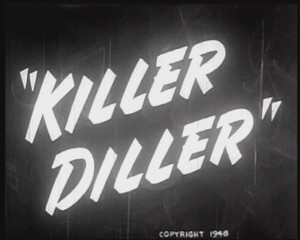
A musical extract from the Forties black feature Killer Diller — made, like Jivin in Be-bop, exclusively for black audiences — this short illustrates Cole’s remarkable piano playing in a concert, as well as certain aspects of the cooler and more commercial vocal style which he eventually adopted. A graceful, inventive soloist, whose style virtually bridges swing and bebop, with long, perfectly articulated lines which have influenced pianists for three successive decades, he also conveys an unmistakable stage presence — sitting almost perpendicular to the piano while performing difficult runs effortlessly in a manner that is nearly as ‘visual’ as Chico Marx’s. Moore and Miller also takes solos, and the latter is highlighted on “Breezy and the Bass”, a fast virtuoso piece based on the chords of “I Got Rhythm”; “Now He Tells Me” features Cole’s smooth mock-hip singing of the period, exuding a kind of throwaway charm that remains irresistible.
From Monthly Film Bulletin, February 1977 (Vol. Read more
From the Chicago Reader (May 27, 1988)….Seeing a more recent Konchalovsky picture, the powerful Holocaust drama Paradise, at Mar del Plata, I was reminded of what a terrific filmmaker he can be, which whetted my appetite to resee his powerful Runaway Train (a recent Twilight Time Blu-Ray that was waiting for me when I returned to Chicago). — J.R.
SHY PEOPLE
*** (A must-see)
Directed by Andrei Konchalovsky
Written by Konchalovsky, Gerard Brach, and Marjorie David
With Jill Clayburgh, Barbara Hershey, Martha Plimpton, Merritt Butrick, John Philbin, and Mare Winningham.

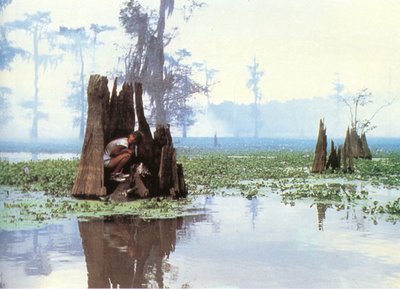
I still have a lot of catching up to do with Andrei Konchalovsky. Out of his 11 or so features to date, the last 4 of which were made in the United States, I’ve seen prior to Shy People only 2. The Soviet Asya’s Happiness (1966), a film made with and about Russian peasants, was suppressed for many years because of its supposedly “gloomy” depiction of rural life but surfaced at the San Francisco Film Festival a couple of months ago. The other was Runaway Train (1985), costarring Jon Voight, Eric Roberts, and Rebecca DeMornay and adapted from a script by Akira Kurosawa. But a couple of things are already becoming clear from this limited if striking evidence. Read more