My latest column for Caimán Cuadernos de Cine, submitted about a week before flying to Europe (Bologna and Paris). — J. R.
En movimiento: Bulle Ogier as Hidden Star
Jonathan Rosenbaum
I have a special reverence for film criticism on film — by which I mean criticism on, by, through, and about film. A few of the gems in this hallowed category are Alphaville (as criticism of silent German Expressonist cinema), audio-visual essays about Ivan the Terrible by Yuri Tsivian and Joan Neuberger, Céline et Julie vont en bateau (as criticism of 1950s Hollywood melodrama), Los Angeles Plays Itself –and now a beautiful 2024 documentary by Eugénie Grandval about a great actress-auteur (one of the four writers-actresses who gave us Céline et Julie) whom I first discovered at a memorable midnight Paris screening of Rivette’s L’amour fou circa 1971: Bulle Ogier, portrait d’une étoile cachée.
She was indeed a hidden star because her gestures were typically synecdochical, tremors suggesting unfathomable depths. (Marguerite Duras once said, “Bulle is not the nouvelle vague, she’s absolute vagueness.”) For me Ogier was an essential part of all of Rivette’s key features. The only major exception is Paris nous apparient, his first, but that’s a film I cherish in part for its vulnerability as an amateur effort, its passionate embrace of bohemian losers — arguably the same properties that keep Rivette’s cinema excluded from the BFI Film Classics as it was established by its founder and canonizer, David Meeker. Read more
Published by the web site Fandor on January 4, 2011. — J.R.

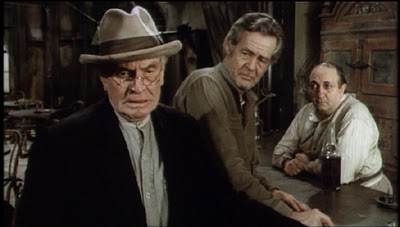
It’s widely and justly believed that the two greatest plays of Eugene O’Neill (1888-1953) were both written near the tail end of his career — The Iceman Cometh, completed in 1939 and first staged in 1946, and Long Day’s Journey into Night, completed in 1941 and produced only posthumously, in 1956. What’s less widely known is that the action of both plays unfolds during the same summer, 1912, when O’Neill was 24, after having attempted to commit suicide the previous spring. As his biographers Arthur and Barbara Gelb note in their 2000 O’Neill: Life with Monte Cristo (New York: Applause), “the plays follow almost literally the chronology of O’Neill’s youthful years, with Iceman (written first) set in ‘summer 1912’ and Long Day’s Journey (which can be regarded as its sequel) set on ‘a day in August, 1912’.”
Both late masterpieces are obsessive distillations of a lifetime of brooding, with the three-hour 1962 film version of Long Day’s Journey into Night directed by Sidney Lumet and the four-hour 1973 film version of The Iceman Cometh directed by John Frankenheimer having served, for many filmgoers, as the versions of reference. Read more
This appeared originally in Senses of Cinema, issue 17, November 2001. The book it appears in has subsequently reappeared in an expanded second edition. — J.R.

The following is an extract from Abbas Kiarostami by Mehrnaz Saeed-Vafa and Jonathan Rosenbaum (University of Illinois Press, 2003) – one of the initial books in a series edited by James Naremore that is devoted to neglected contemporary filmmakers. Abbas Kiarostami contains separate essays by Rosenbaum and Saeed-Vafa followed first by this dialogue, then by an extended interview with Kiarostami conducted by both authors.
***
September 3, 2001, Chicago


JONATHAN ROSENBAUM: You were the one who originally had the idea of proposing that we do this book together. And maybe we should both consider why we thought it was a good idea.
MEHRNAZ SAEED-VAFA: Basically, as far as I remember, we had a lot of interesting dialogues about Iranian cinema and Kiarostami, and I thought it would be a great idea to put our effort into a book. We started our dialogue in 1992, at a time when Kiarostami was still was getting discovered in France, but unknown in the United States. And I respected you highly as a critic and I knew that you were respected among other readers outside the United States as well as inside. Read more