From the Chicago Reader (April 13, 1990). — J.R.

THE COOK, THE THIEF, HIS WIFE & HER LOVER
* (Has redeeming facet)
Directed and written by Peter Greenaway
With Richard Bohringer, Michael Gambon, Helen Mirren, Alan Howard, and Tim Roth.
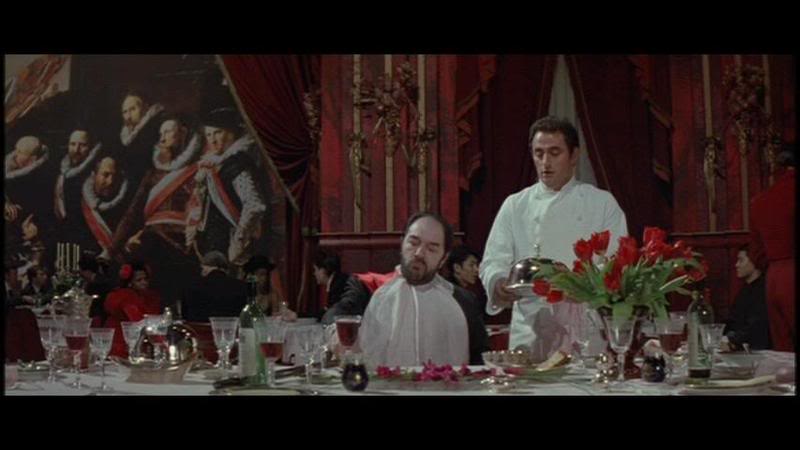
On the face of it, this movie seems to have a good many things going for it. Although he was born in 1942, Peter Greenaway is still probably the closest thing that the English art cinema currently has to an enfant terrible. A former painter and film editor who started making experimental films in the mid-60s, he achieved an international reputation with The Draughtsman’s Contract in 1982; he went on to become a star director and cult figure in Europe with several TV films and three more features that had considerable success in both England and France as well as on the international festival circuit — A Zed & Two Noughts (1986), The Belly of an Architect (1987), and Drowning by Numbers (1988) — although they have had only limited circulation in the U.S. A fair number of my film-buff friends swear by him, and he is commonly regarded as the most “advanced” art-house director currently working in England.
Greenaway’s latest feature makes sterling use of many of his longtime collaborators: Sacha Vierny, one of the best cinematographers alive (working here in ‘Scope), whose credits include Hiroshima, mon amour, Last Year at Marienbad, Muriel, Belle de jour, and Stavisky, as well as films by Raul Ruiz and Marguerite Duras; composer Michael Nyman, a sort of neoclassicist who has worked for everyone from the Royal Ballet to Steve Reich to Sting; and production designers Ben Van Os and Jan Roelfs, former interior designers who have worked in the Dutch film industry since 1983. Read more
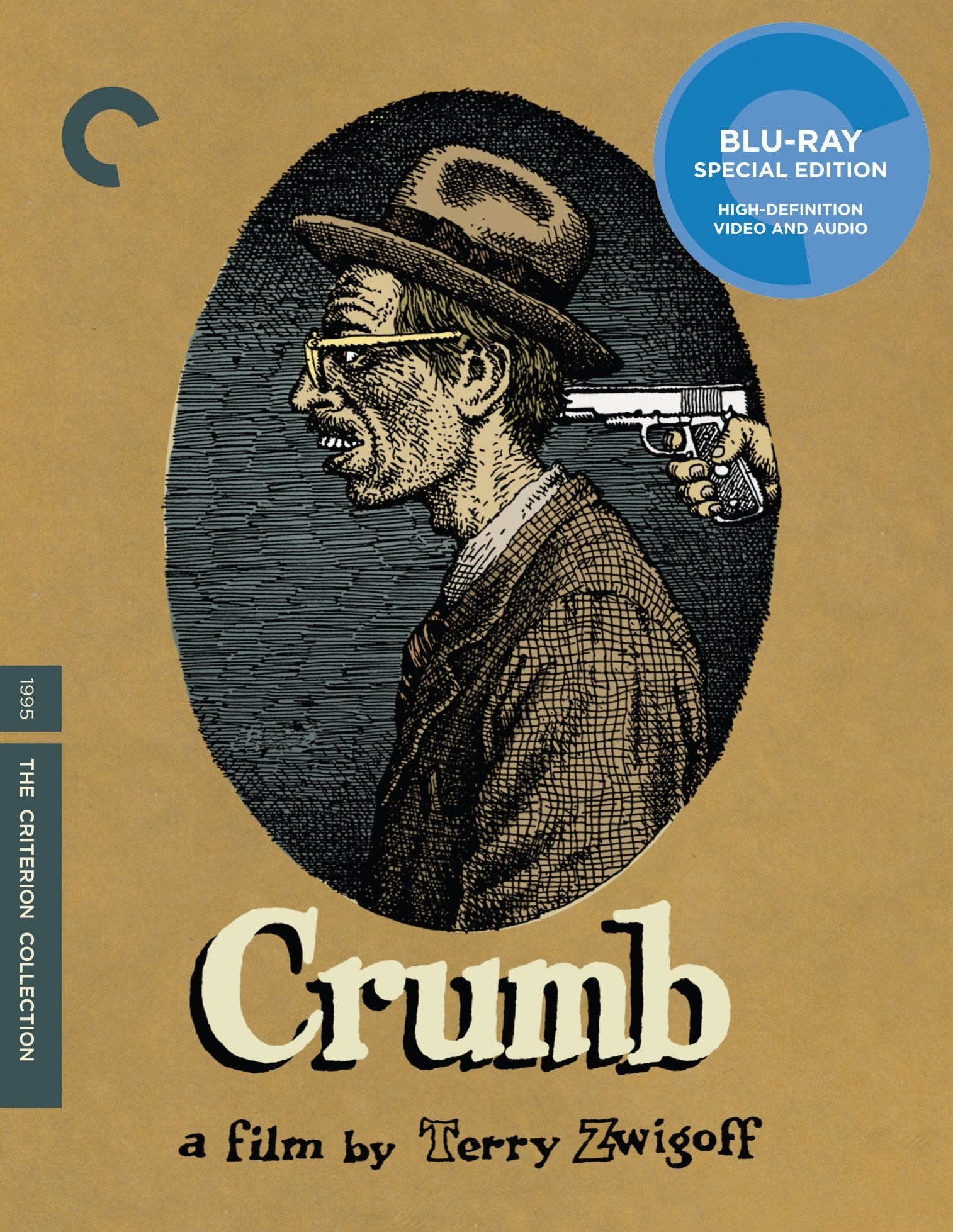
Written in 2010 for Criterion’s DVD and Blu-Ray. This is the second of my essays about Terry Zwigoff’s documentary; for the first one, written 15 years earlier, go here. — J.R.
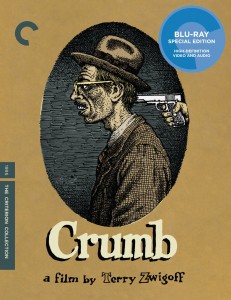
Now that Terry Zwigoff’s Crumb is about fifteen years old, it seems pretty safe to say that it has evolved from being a potential classic to actually becoming one. But what kind? A documentary portrait of a comic-book artist, musician, and nerdy outsider? A personal film essay? A cultural study? An account of family dysfunction and sexual obsession? Or maybe just a meditation on what it means to be an American male artist — specifically, one so traumatized by his adolescence that he has never found a way of fully growing past it.
In fact, Crumb is all these things, with a generous amount of thoughtful art criticism thrown in as well. An old friend of Robert Crumb’s, Terry Zwigoff shot the movie over six years and edited it over three, and the multifaceted density and sometimes disturbing nature of what he has to show and say over two hours seems partly a function of the amount of time he had to mull it over. It’s worth adding that he was in therapy for part of that time, which surely had an impact on the film’s searching thoughtfulness and on Zwigoff’s own investment in the material. Read more
From The Oxford-American, issue #42, Winter 2002. — J.R.
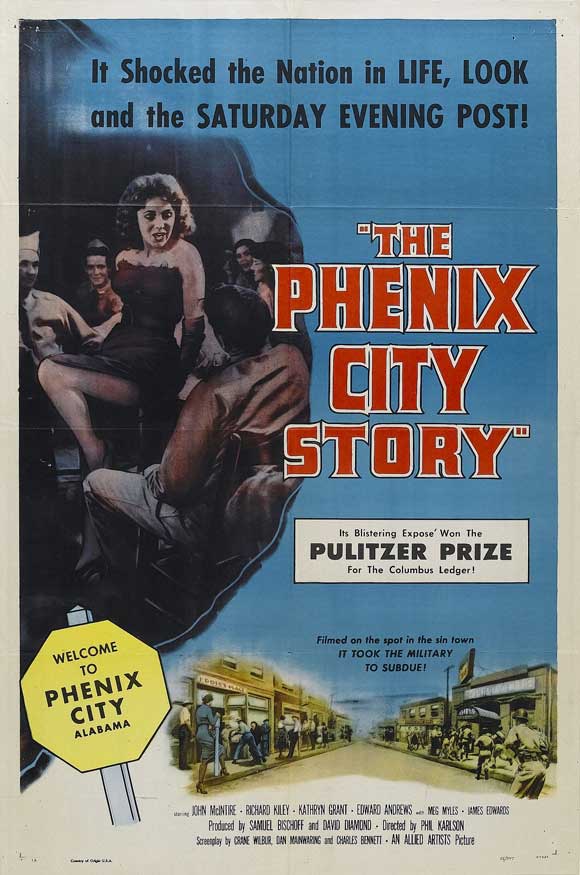
Karlson pushes and punches, but he’s good at it. He can dredge up emotion; he can make the battle of virtuous force against organized evil seem primordial. He has a tawdry streak (there’s an exploitation sequence with a nude prostitute being whipped), and he’s careless (a scene involving a jewelry salesman is a decrepit mess), but in the onrush of the story the viewer is overwhelmed….One would be tempted to echo Thelma Ritter in All About Eve –”Everything but the bloodhounds snappin’ at her rear end” — but some of the suffering has a basis in fact.
— Pauline Kael on Walking Tall (1974)
1. What Qualifies as Real
As an Alabama expatriate who fled north the first chance I could get, I didn’t keep my southern accent for long; it fell away, in a matter of months, like dead skin. The fact was — and is — that Alabama accents sound stupid to Yankees; and since I was both a teenager and trying hard to become a Yankee, they eventually began to sound stupid to me. Especially during the Civil Rights Movement, already in full swing by then, having a southern accent, if you were white, made you sound like a racist to some people, regardless of what you said or did. Read more
From Cineaste (Fall 2006). — J.R.
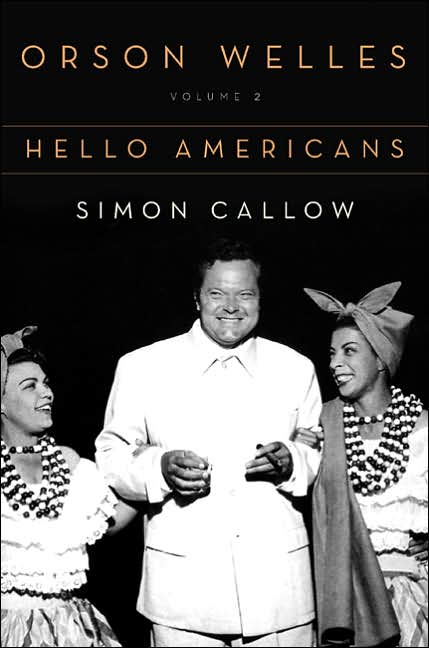
Orson Welles: Volume 2: Hello Americans
by Simon Callow. New York: Viking Adult, 2006. 528 pp., illus. Hardcover: $32.95.
“It seems to me there is a plain, if many-layered, truth to be told,” Simon Callow writes in his Preface to the second volume of his Welles biography — noting his impatience with academics whose sense of the truth is so far from plain that they can only countenance the term between quotation marks. It’s an understandable position for him to take, but he doesn’t always stick to it himself, and it’s hard to see how he could. In his second chapter, he asserts that, although no evidence supports Welles’s claim that Booth Tarkington had been his father’s best friend, it doesn’t matter at all “one way or the other; what is significant is that Welles believed it to be true, and wanted it to be true, and his conception of [Eugene Morgan in The Magnificent Ambersons] is certainly an idealized version of his father.” In other words, Callow is privileging one kind of truth over another — like all of us who write about Welles, including those pesky academics. Like it or not, it comes with the territory. Read more
From the Chicago Reader (May 25, 1990). This is also reprinted in my first collection, Placing Movies: The Practice of Film Criticism. — J.R.
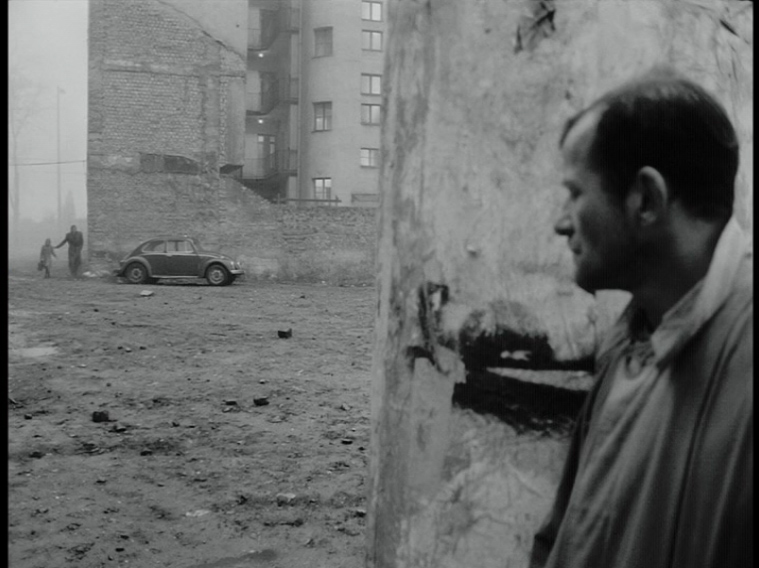
ALMANAC OF FALL
*** (A must-see)
Directed and written by Bela Tarr
With Hedi Temessy, Erika Bodnar, Miklos B. Szekely, Pal Hetenyi, and Janos Derzsi.
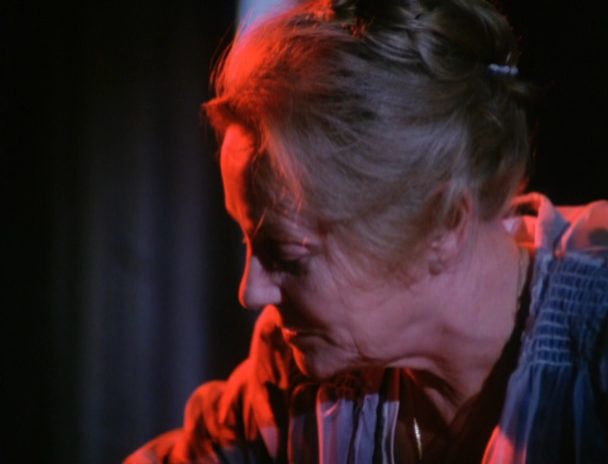
1. Problems
One reason that Eastern European films often don’t get the attention they deserve in the West is that we lack the cultural and historical contexts for them. If Eastern Europe’s recent social and political upheavals took most of the world by surprise, this was because most of us have been denied the opportunity to see the continuity behind them: they seemed to spring out of nowhere. The best Eastern European films tend to catch us off guard in the same way, and for similar reasons.
My own knowledge of Hungarian cinema is spotty at best, despite the fact that, according to David Cook in A History of Narrative Film, the Hungarians “seem to have identified film as an art form before any other nationality in the world, including the French.” (One of the first major film theorists, Bela Balazs, was Hungarian, and a contemporary film studio in Budapest is named after him.) Read more
From the Chicago Reader (December 18, 2000). — J.R.
I don’t get it. Maybe my bias against drug dealers, drug barons, and drug addicts as interesting characters is responsible, but I don’t see this slightly better-than-average drug thriller, with slightly better-than-average direction by Steven Soderbergh, as anything more than a routine rubber-stamping of genre reflexes. (Even the film’s racism — the implication that drug taking by teenage white girls logically leads to their having sex with black males — seems depressingly typical.) Nothing especially new or fresh has been added to the formula by Stephen Gaghan’s screenplay, which shuttles between southern California, Mexico, Ohio, and Washington, D.C., but if you’re happy just to see Don Cheadle, Benicio Del Toro, Michael Douglas, Luis Guzman, Dennis Quaid, Catherine Zeta-Jones, and Albert Finney, among others, move across the screen and deliver lines, here’s your chance to indulge. 147 min. (JR) Read more
From the Chicago Reader (December 18, 2000). — J.R.
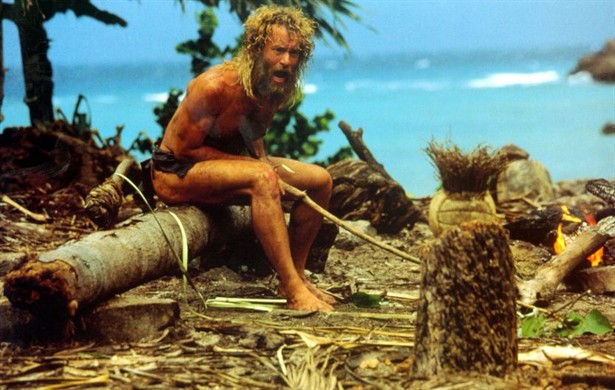
When Robert Zemeckis starts getting serious, it’s time to clear the streets. According to David Denby, Cast Away demonstrates that the director is now ready to tackle Melville, but I’m not sure he’s even ready for Defoe: this is at best an OK variation on the Robinson Crusoe saga sandwiched between sections of an unsatisfying love story. It’s several cuts down from Luis Buñuel’s 1952 Defoe adaptation and seriously hampered by the absence of any Friday (unless one counts a blood-smeared volleyball treated like a fetish and surrogate human), but it’s certainly enhanced by Tom Hanks. Less unctuous than he was as Zemeckis’s Forrest Gump, Hanks plays a FedEx employee who finds himself on a desert island with all the time in the world. The film holds one’s interest, and there’s some nice if underdeveloped ironic poetry when the hero has to depend on diverse FedEx packages to keep himself alive. But this is too full of its own heavy breathing to work as the primordial storytelling it’s aiming for — a so-so adventure story is closer to the mark. Written by William Broyles Jr.; with Helen Hunt and Nick Searcy. 142 min. Read more
A Manhattan investment broker and playboy (Nicolas Cage) wakes up one morning to find himself living in New Jersey as a tire salesman, married to a woman he broke up with years before, and with kids. At first I thought I was watching yet another version of A Christmas Carol; then I wondered if it was a remake of It’s a Wonderful Life; finally I gave up trying to find anything at all in it that was unfamiliar. Brett Ratner directed this 2000 comedy from a script by David Diamond and David Weissman; with Don Cheadle, Tea Leoni, and Jeremy Piven. 126 min. (JR) Read more
Adapted by David Self from a book entitled The Kennedy Tapes: Inside the White House During the Cuban Missile Crisis, this thriller is a lot better than you might expect, especially for a Kevin Costner vehicle. Costner plays Kenny O’Donnell, an aide to President Kennedy (Bruce Greenwood) who shares his boss’s Bostonian accent but is basically decor next to him, his brother Bobby (Steven Culp), Robert McNamara (Dylan Baker), and various Pentagon warmongers such as Curtis LeMay (Kevin Conway). Framing JFK as the man who prevented World War III is surely an idealist fantasy, but it’s hard not to feel nostalgic for a time when, in order to prevent war, Kennedy and Khrushchev had to trust each other more than any Democrat or Republican seemed capable of doing during the 2000 presidential election. Director Roger Donaldson measures out this old-fashioned entertainment with a fair amount of pizzazz. 145 min. (JR) Read more
This fundamentalist SF, based on a best-seller by Tim LaHaye and Jerry Jenkins, is (or was) billing itself as The Christian Entertainment Event of 2000, but seems perfectly timed to coincide with the ascension to office of George W. Bush. It’s a clunky effort Bush could have written and directed. Over 142 million people on the planetincluding all the childrenhave vanished and gone to heaven because they’re true believers. Meanwhile, the Antichrist turns out to be Russian, proving that Joseph McCarthy must have been right all along. The credited director is Vic Sarin and the credited writers are Allan McElroy, Paul Lalonde, and Joe Goodman. Among the cast are Kirk Cameron, Chelsea Noble, Clarence Gilyard, and Brad Johnson, doing what they can with hopeless if weirdly sincere material. 95 min. (JR) Read more
Set in the late 18th century, this dazzling epic by Im Kwon-taek (Fly High Run Far) concerns the love between a prostitute’s daughter and the son of a provincial governor, who marry in secret but are then driven apart. Im is Korea’s most prestigious filmmaker (with about 100 features to his credit), and his stirring 2000 drama is both historically resonant and strikingly modern, remarkable for its deft and spellbinding narrative, its breathtaking color, and above all its traditional sung narration, which he periodically shows being performed with drum accompaniment before a contemporary audience. This is one of those masterpieces that would qualify as a musical if Hollywood propagandists hadn’t claimed the genre as their personal property. A must-see. 120 min. (JR) Read more
Actress and screenwriter Agnes Jaoui makes her directorial debut with this poignant 2000 comedy about the difficulties of getting beyond one’s own social circle. The film’s main triumph is Jean-Pierre Bacri’s wonderfully touching and delicately shaded performance as a married businessman living in a suburb of Rouen who becomes infatuated with his English tutor (Anne Alvaro), a stage actress turning 40 who lives in a world very different from his. Jaoui herself plays a waitress-barmaid who moonlights as a hash dealer and becomes involved with the businessman’s bodyguard. She’s quite sensitive as a director of actors, though the fact that she cites Woody Allen as a model shows how much she thinks as a writer-performer. The script, by her and Bacri, is one in a series of collaborations that includes Cedric Klapisch’s Un air de famille and Alain Resnais’ Same Old Song. In French with subtitles. 112 min. (JR) Read more
A fitfully employed videographer in Shanghai, who never appears on-screen, gets involved with a go-go dancer and then meets a motorcycle courier who’s convinced that the dancer is actually his girlfriend, who’s vanished mysteriously after jumping off a bridge. This moody Chinese independent (2000, 83 min.), the debut feature by Lou Ye, at first seems like a Wong Kar-wai remake of Vertigo, but in fact it’s something much stranger, drawing on not only Hitchcock and Chungking Express but also Hollywood noir and Hans Christian Andersen to create something relatively fresh from the confluencea postmodern fairy tale about romantic obsession. This is well worth checking out. (JR) Read more
Arturo Ripstein’s 2000 absurdist comedy in black and white, sharply scripted by Paz Alicia Garciadiego, begins with a peasant being beaten to death by two of his friends. Initially the reasons for this are quite obscure, but the motivations and back story gradually emerge as his friends, his wife, and his lover bicker over his corpse, both at his house and the morgue. This is the most interesting Ripstein feature I’ve seen, and though it resembles a play in certain respects, it’s energized by an able cast and the filmmaker’s vigorous mise en scene. 98 min. (JR) Read more
Painter Julian Schnabel followed up his debut feature, Basquiat, with another biopic (2000) about a minority artist: Reinaldo Arenas, the gay Cuban writer who learned to read from revolutionaries, published most of his books abroad, and eventually died an exile in New York. The film is less visually inventive than its predecessor and perhaps even more questionable as an accurate portrait: the script, adapted by Schnabel, Lazaro Gomez Carriles, and Cunningham O’Keefe from Arenas’s posthumously published memoirs, answers only a fraction of the questions it raises and allows political correctness to fudge certain aspects of the subject’s personality (his dislike of most other homosexuals, for instance) and the fact that other Latino intellectuals viewed him as a hick. But this is still an impressive piece of filmmaking, with lively and suggestive depictions of pre- and postrevolutionary Cuba (shot in Mexico). Javier Bardem is truly exceptional as Arenas, and other actors make their marks as well, including Sean Penn, Michael Wincott, film directors Hector Babenco and Jerzy Skolimowski, and Johnny Depp in an impressive double cameo. 125 min. (JR) Read more