From the Chicago Reader (December 19, 1997). — J.R.
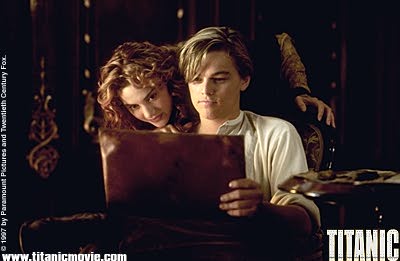
Titanic
Rating *** A must see
Directed and written by James Cameron
With Leonardo DiCaprio, Kate Winslet, Billy Zane, Kathy Bates, Frances Fisher, Gloria Stuart, Bill Paxton, Bernard Hill, and Suzy Amis.

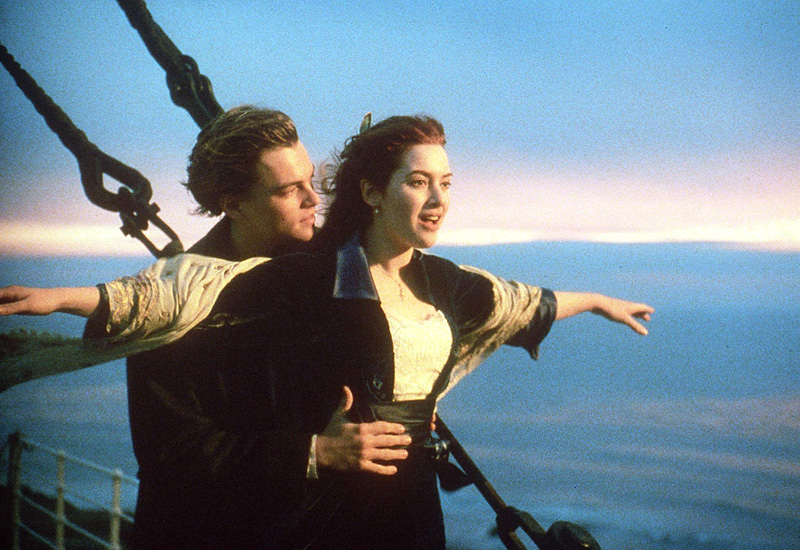
I suppose there’s something faintly ridiculous about a $200-million movie that argues on behalf of true love over wealth and even bandies about a precious diamond as a central narrative device — like Citizen Kane’s Rosebud — to clinch its point. Yet for all the hokeyness, Titanic kept me absorbed all 194 minutes both times I saw it. It’s nervy as well as limited for writer-director-coproducer James Cameron to reduce a historical event of this weight to a single invented love story, however touching, and then to invest that love story with plot details that range from unlikely to downright stupid. But one clear advantage of paring away the subplots that clog up disaster movies is that it allows one to achieve a certain elemental purity.
This movie tells you a great deal about first class on the ship, a little bit about third class, and nothing at all about second class. According to Walter Lord’s 1955 nonfiction book about the sinking of the Titanic, A Night to Remember, which includes a full passenger list, 279 of the 2,223 passengers were in second class, and 112 of them survived. Read more
From the Chicago Reader (September 7, 1990). — J.R.

THE RAGGEDY RAWNEY
*** ( A must-see)
Directed by Bob Hoskins
Written by Hoskins and Nicole De Wilde
With Dexter Fletcher, Hoskins, Zoe Nathenson, Dave Hill, Ian Dury, and Zoe Wanamaker.
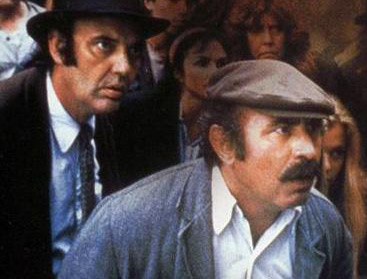
An offbeat and highly original English film that’s been very slow making the rounds — Bob Hoskins’s The Raggedy Rawney (1987) — may be in trouble commercially. It didn’t even show in England until about two years after its completion, and it took an additional year to reach Chicago. Now that it’s here, it has at least five serious handicaps:
(1) At first glance, hardly anyone has any idea what the title means. (“Rawney,” a rather specialized word not found in most dictionaries, roughly means “magical madwoman.”)
(2) As an actor, Hoskins is basically known for his roles in contemporary settings, usually within a noir context — either as a gangster (as in The Long Good Friday and Mona Lisa) or as a detective (as in Who Framed Roger Rabbit). His part in The Raggedy Rawney, as a sort of gypsy leader, plays off neither of these associations, nor is it the lead role.
(3) Inspired by a legend told to Hoskins as a child by his grandmother that reportedly can be traced all the way back to the Hundred Years’ War (1337-1443), the movie is nonetheless given a setting so vaguely defined that the best description I’ve seen yet (published in the synopsis in Monthly Film Bulletin) is: “Sometime during the first half of the 20th century, in a European country at war.” Read more
From the Chicago Reader (May 17, 1991). — J.R.
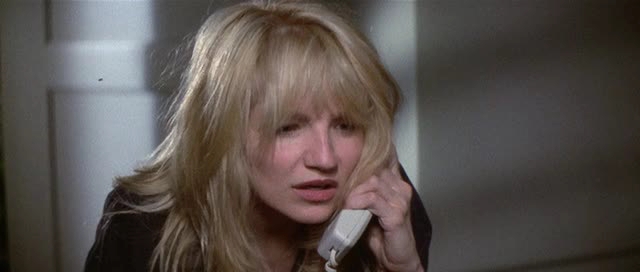
SWITCH
* (Has redeeming facet)
Directed and written by Blake Edwards
With Ellen Barkin, Jimmy Smits, JoBeth Williams, Lorraine Bracco, Tony Roberts, Perry King, Lysette Anthony, and Victoria Mahoney.
In a review of Blake Edwards’s S.O.B. ten years ago, I was skeptical enough about his reputation as a trenchant social satirist that I called him the Perry Como of slapstick. Stylistically I think the comparison still holds — Switch, Edwards’s latest comedy, bears it out with a grim vengeance — but thematically the description may do Edwards’s work less than full justice. However Hollywood-style and boringly upscale the mid-life crises of the self-regarding womanizers in 10, S.O.B., The Man Who Loved Women, and Skin Deep may be, these are still troubled and neurotic movies; not for nothing did Edwards assign partial script credit to his own psychiatrist in The Man Who Loved Women.
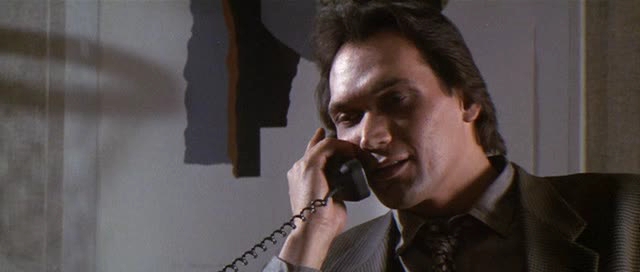
I’m not saying that this element of disturbance makes Edwards a better writer or director, only that it gives him certain characteristics that belie the Perry Como comparison, including a taste for the grotesque and a penchant for self-analysis. Victor/Victoria and That’s Life! show a certain sweetness in dealing with middle-aged characters, and most of Edwards’s movies at least flirt with troubled reflections about sex rather than simply coast along on their Malibu-style furnishings. Read more