Posted on Slate in late 2005. I’m sorry that the links no longer work. — J.R.
The New Global Movie Culture
By Jonathan Rosenbaum
Dec 29, 2005 4:52 PM
Hi, Everybody:
So many films and so little time! Consequently, I hope you’ll forgive me if I skate past most of the titles that we’ve all been citing lately and jump to some of the bigger issues broached by Tony in his first letter, and by David and Scott more recently —specifically, the transformations of film culture that are taking place these days thanks to DVDs, the Internet, globalization, and related pleasures, and conundrums.
In fact, David, I regard you as something of a pioneer in your inauguration of this Movie Club seven years ago. This helped to usher in the idea of critical exchanges in cyberspace that’s been developing so rapidly ever since that I find refreshing new instances of it virtually every day. The irreplaceable Dave Kehr reporting “from the lost continent of cinephilia” on his wonderful new blog and including responses from others is only one of the first examples that spring to mind. Another is the international, auteurist chat group over at Yahoo!, which has been around somewhat longer, where they’ve been raking me over the coals lately — and with a great deal of intelligence and pertinence, I might add — about my skeptical comments regarding Malick’s The New World, which I’ve been making in Movie Club as well as there. Read more
From AFI Education Newsletter (January-February 1982). Because of the length of this, I’ll be running it in two installments. — J.R.
Course File:
EXPERIMENTAL FILM:
FROM UN CHIEN ANDALOU TO CHANTAL AKERMAN (Part 2)


UNIT III: German and Soviet Experimentation in the Twenties
Part of the strategy of studying German and Soviet experimentation over roughly the same period is the striking contrast between these national film movements and their relationship to popular genres as well as their different themes and subjects. On the one hand, one finds the efforts of a Fritz Lang to experiment with the thriller format, and those of F.W. Murnau (and his scriptwriter Carl Mayer) to construct an essentially non-verbal visual language. On the other hand, one finds the relatively less script-bound experiments with montage and certain documentary principles provided by the Soviet filmmakers. An interesting topic to consider speculatively is the Soviet version of Lang’s first Dr. Mabuse film, which was re-edited by Eisenstein for Russian audiences.
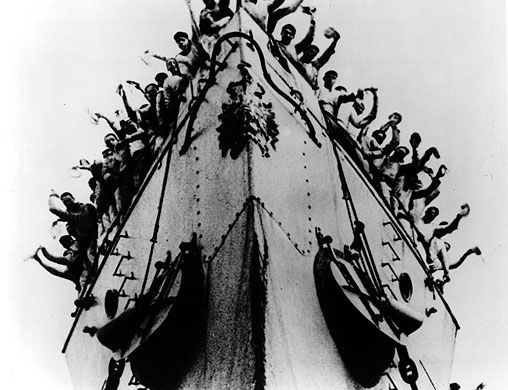


Screenings:
Bronenosets Potemkin (The Battleship Potemkin) (1925, 65 min.) Directed by Sergei Eisenstein — Perhaps the most famous of all experimental films, including some 1300 shots, Eisenstein’s classic is structured in five “acts.” Along with Strike, made the previous year, this is the most accessible of Eisenstein’s silent films, and might be contrasted with October (or significant portions thereof) in terms of the different principles of montage at work. Read more
From AFI Education Newsletter (January-February 1982). Because of the length of this, I’ll be running it in two installments. — J.R.
EXPERIMENTAL FILM:
FROM UN CHIEN ANDALOU TO CHANTAL AKERMAN (Part 1)

UNIT l: lntroduction
One distinct advantage to teaching a course in experimental film as opposed to avant-garde film is that it automatically gives one much more leeway in terms of screenings to be selected as well as overall teaching approaches. While “avant-garde cinema” can be regarded, by and large, as a distinct body of work with its own traditions, history and critical literature, “experimental film” is a rather more subjective and ambiguous category, and one that cuts across certain forms of commercial as well as avant-garde filmmaking. (There are many more references to various commercial forms of filmmaking, including Hollywood, in David Curtis’s Experimental Cinema, than there are in P. Adams Sitney’s Visionary Film: The American Avant-Garde.)
Consequently, any teacher setting out to plan a course in experimental rather than avant-garde cinema automatically has a greater amount of material to select from, and substantially more freedom in defining the scope and limits of his or her subject. By the same token, the demands placed on one’s imagination, creative input and organizational capacities might also be significantly greater. Read more