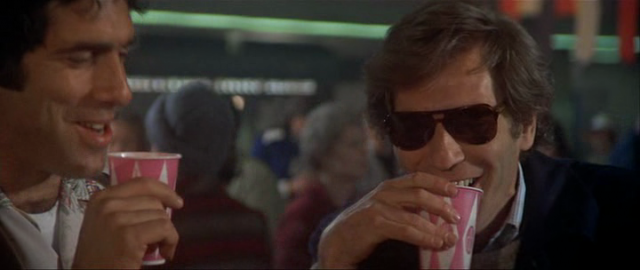
What an onslaught of deaths that week in late March, 2021: Morris Dickstein, Larry McMurtry, Bertrand Tavernier, George Segal….The latter prompted this reposting. From Stop Smiling No. 35 (its gambling issue, guest edited by Annie Nocenti), June 2008. — J.R.
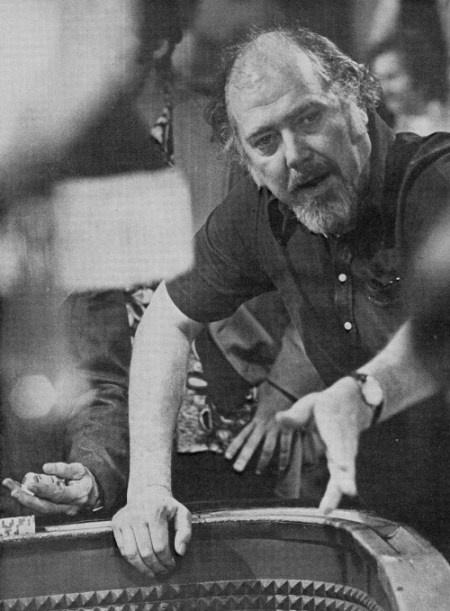
“Trusting to luck means listening to voices,” Jean-Luc Godard reportedly said at some point in the mid-1960s. This has always struck me as being one of his more obscure aphorisms, and one that even seems to border on the mystical. Yet the minute one starts to apply it to Robert Altman’s California Split, released in 1974 —- a free-form comedy about the friendship that develops and then plays itself out between two compulsive gamblers, Charlie (Elliott Gould) and Bill (George Segal), and the first movie ever to use an eight-track mixer — it starts to make some weird kind of sense.
What’s an eight-track mixer? According to the maestro of overlapping dialogue himself, speaking in David Thompson’s Altman on Altman (Faber and Faber, 2006), this is a system known as Lion’s Gate 8-Tracks developed by Jim Webb, and it grew directly out of Altman’s ongoing efforts to make on-screen dialogue sound more real. Sound mixers would frequently complain that some actors wouldn’t speak loudly enough and Altman would counter that this was a recording problem, not a performance problem involving the actors’ deliveries. Read more
From the Chicago Reader (August 31, 2001). Today (September 2, 2014), having recently reseen this movie, I’d probably give it a higher rating. — J.R.

The Curse of the Jade Scorpion
Rating ** Worth seeing
Directed and written by Woody Allen
With Allen, Helen Hunt, Dan Aykroyd, Brian Markinson, Elizabeth Berkley, Charlize Theron, Wallace Shawn, and David Ogden Stiers.

I don’t want to oversell Woody Allen’s 31st feature, which I happen to like. The script is full of holes, most of the one-liners are weak and mechanical, and the plot — a nightclub magician gets two of his hypnotized subjects to steal jewels for him — is so deliberately stupid and contrived that one can probably enjoy it only by pretending it’s a routine, low-budget second feature on an old-fashioned double bill, which is obviously what Allen intended. Yet it’s possible for a picture to be not very good and still be likable — something that doesn’t happen very often for me with Allen’s pictures. (It happened, momentarily, in Everyone Says I Love You — when Allen exposed his vulnerability by singing the first 16 bars of “I’m Thru With Love.”)

The problem with most escapism nowadays is that even if it makes you forget who and where you are, it doesn’t really detach you from norms of the world you’re living in. Read more
I wrote the Preface to this 1973 article in 2009 for its eventual reprinting in Kazan Revisited, edited by Lisa Dombrowski (Middletown, CT: Wesleyan University Press, 2011). Note (early 2013): My favorite Kazan film, Wild River, has been released on Blu-Ray, and it looks better than ever. — J.R.
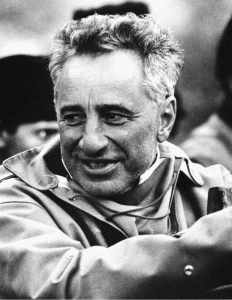
Preface (2009): Rereading this essay 36 years after I wrote it for Richard Roud’s two-volume critical collection, Cinema: A Critical Dictionary – The Major Filmmakers (New York/The Viking Press, 1980), I can’t say that many of my positions or preferences regarding Kazan’s work have changed. But in a few cases I’ve been able to amplify some of my original impressions. For my 2007 essay “Southern Movies, Actual and Fanciful: A Personal Survey” (to be reprinted in my 2010 University of Chicago Press collection, Goodbye Cinema, Hello Cinephila), for instance, I discovered that Kazan hired speech consultant Margaret Lamkin for his stage production of Cat on a Hot Tin Roof, and then again for Baby Doll, to ensure that all the southern accents heard were letter-perfect. And the significance of Kazan having given the names of former friends or colleagues to the House Un-American Activities Committee in 1952 — not in 1954, as my article stated — became a more prominent feature in his career profile when he was given a Lifetime Achievement Award in 1999, almost half a century later, from the Motion Picture Academy of Arts and Sciences. Read more