From the Chicago Reader (January 23, 1998). Today I would probably rank this movie much higher. — J.R.
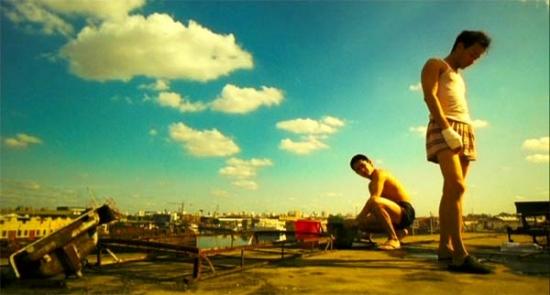
Happy Together
Rating ** Worth seeing
Directed and written by Wong Kar-wai
With Tony Leung, Leslie Cheung, and Chang Chen.
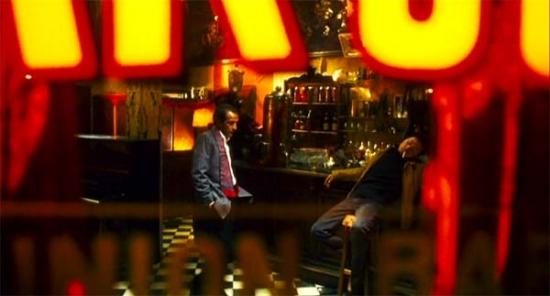
At some point in the mid-90s Wong Kar-wai’s exciting and hyperbolic style lost its moorings. Whether this happened between Days of Being Wild (1990) and Chungking Express (1994), during the two years it took to make Ashes of Time (1994), or between the latter two films and Fallen Angels (1995), Wong’s powerful organic flow, which makes Days of Being Wild his only masterpiece to date, has atrophied into a slag heap of individual set pieces.
Many of these set pieces are thrilling enough in their own right. Fallen Angels has plenty of them, spaced out like showstoppers in a vaudeville revue, though their effectiveness tends to diminish, their frenetic intensity ultimately becoming monotonous. Like the mannerist tics comprising Wong’s style — the use of different characters as narrators; the momentary freeze-frames punctuating Christopher Doyle’s slowed, slurred, or speeded-up cinematography; the shifts between color and black and white; and the bumpy transitions between garish forms of lighting and visual texture — his set pieces always provide a lively surface activity. Read more
 Read more
From the Chicago Reader (October 8 , 1993). — J.R.
Let’s start with the bad news, which also happens to be the good news. With the erosion of state funding virtually everywhere and the concomitant streamlining of many film festivals toward certifiable hits — basically what an audience already knows, or worse, what it thinks it knows — there isn’t a great deal of difference anymore between the lineups of most large international festivals, including Cannes, Berlin, Venice, Toronto, and even Chicago. By and large, the critics at Toronto last month, myself included, who thought it was an unusually good festival were those who hadn’t made it to the previous three big festivals.
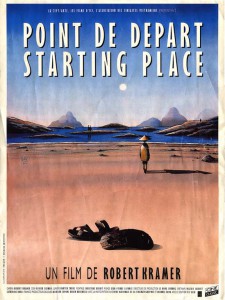
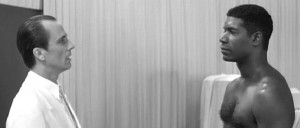
Some films don’t make every list, of course. Luc Moullet, probably the most gifted comic filmmaker working in France, almost never seems to attract international interest, and I was disappointed to discover that his delightful Parpaillon, which I saw in Rotterdam, was passed over by Toronto, Chicago, and New York. The same goes for Robert Kramer’s Starting Place, which I saw in Locarno — a beautifully edited and moving personal documentary about contemporary Vietnam. I’m also sorry that Hou Hsiao-hsien’s The Puppetmaster and an intriguing American independent effort called Suture, both of which I saw in Toronto, are missing from the Chicago roster. Read more
From the Chicago Reader (January 28, 2000). — J.R.

L’ennui
Rating *** A must see
Directed by Cedric Kahn
Written by Kahn and Laurence Ferreira Barbosa
With Charles Berling, Sophie Guillemin, Arielle Dombasle, Robert Kramer, Alice Grey, Maurice Antoni, and Tom Ouedraogo.
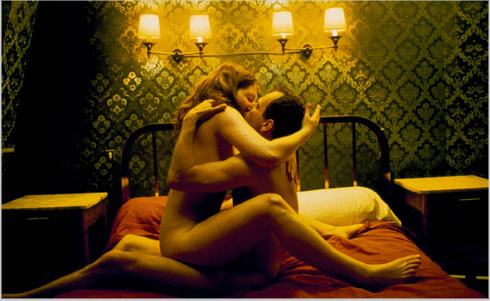
“To think that I’ve wasted years of my life, that I’ve longed to die, that I’ve experienced my greatest love, for a woman who didn’t appeal to me, who wasn’t even my type!” This despairing reflection by Swann about Gilberte appears at the very end of “Swann in Love,” the longest chapter — a little over 200 pages — in Marcel Proust’s Swann’s Way. The chapter serves as a rehearsal for the even more torturous obsessive love of Marcel, the narrator of Remembrance of Things Past, for Albertine — a topic that practically becomes the novel’s principal subject over the thousands of pages to come.
This acknowledgment of the neurotic irrationality that underlies amorous and erotic obsessions is one of Proust’s key passages, and I was reminded of it periodically over the course of Cedric Kahn’s brilliant and hilarious new sex comedy, L’ennui. Yet one of the most striking aspects of the film — adapted from La noia, a 1960 novel by Alberto Moravia that I haven’t read (also the source for a trashy Bette Davis vehicle, The Empty Canvas) — is the way it confounds its Proustian model of jealousy and sexual paranoia with a dash of healthy common sense. Read more
From the November 19, 1999 issue of the Chicago Reader. — J.R.

Sleepy Hollow
*** (A must-see)
Directed by Tim Burton
Written by Andrew Kevin Walker and Kevin Yagher
With Johnny Depp, Christina Ricci, Miranda Richardson, Michael Gambon, Casper Van Dien, Jeffrey Jones, and Christopher Walken.
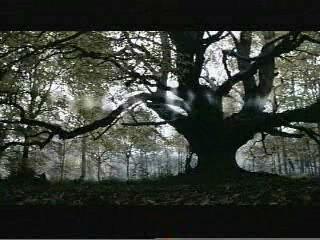
Tim Burton’s new movie is gorgeous — shot by shot it may be the most impressive thing he’s done. So I hope I’m not being too disrespectful if I balk at the idea that his movie is based on Washington Irving’s “The Legend of Sleepy Hollow.”
I was an English major in college and graduate school, yet I can’t remember reading a word of Irving until I read this wonderful 180-year-old story a few days after seeing the movie. He may be one of America’s great writers, but apparently few people still read him, even though his prose is clear and vivid. Take the seventh paragraph of “The Legend of Sleepy Hollow,” for instance:
“I mention this peaceful spot [Sleepy Hollow] with all possible laud for it is in such little retired Dutch valleys, found here and there embosomed in the great state of New York, that population, manners, and customs, remain fixed, while the great torrent of migration and improvement, which is making such incessant changes in other parts of this restless country, sweeps by them unobserved. Read more