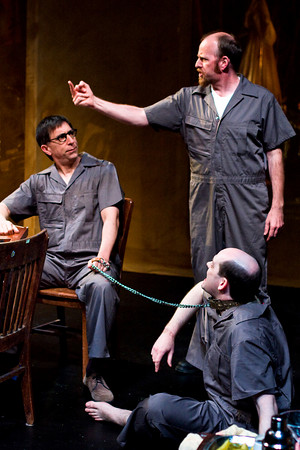
As a fan of the directorless Theater Oobleck dating all the way back to its second show in Chicago (David Isaacson’s riotous Three Who Dared: A Play on the Movies, in June 1988), with particularly fond memories of Jeff Dorchen’s The Slow and Painful Death of Sam Shepard (December 1988) and Ugly’s First World (October 1989) as well as Mickle Maher’s When Will the Rats Come to Chew Through Your Anus? (January 1990), I regret having somehow lost touch with their singular repertory of literary and political shotgun marriages in recent years. A recent visit to Dorchen’s brilliantly excessive Strauss at Midnight at the the Chicago DCA Theater (66 E. Randolph), which runs through July 19, reminded me of how much heat and liberating anger and laughter they can generate.
This play has something to do with Saul Bellow (Isaacson), posthumously still tainted by his former association with Allan Bloom (Troy Martin), and, through Bloom, with Leo Strauss (David Shapiro), condemned to a hell in which he has inhabit the same quarters as Neil Simon’s Odd Couple (Brian Nemtusak and H.B. Ward doing fine, surreal spinoffs of Jack Lemmon and Walter Matthau), not to mention Niccolo Machiavelli (Scott Hermes) and In the Heat of the Night‘s Virgil Tibbs (D’wayne Taylor). Read more
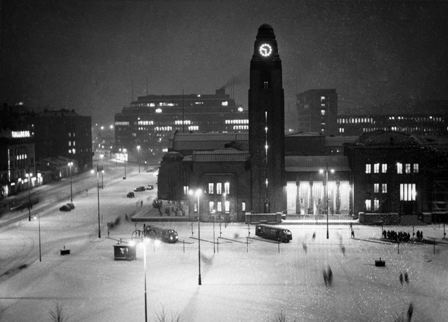
An unexpected gift arrives in the mail: a subtitled preview of Peter von Bagh’s fabulous and rather Markeresque documentary (2008)—a lovely city symphony which is also a history of Helsinki (and incidentally, Finland, Finnish cinema, and Finnish pop music) recounted with film clips and paintings by three voices (two male, one of them von Bagh’s, and one female—each one reciting what seems to be a slightly different style of poetic and essayistic discourse). There are no chapter divisions on this DVD, and the continuity is more often geographical than chronological, although there’s also a lot of leaping about spatially as well as temporally. At separate stages we’re introduced to the best-ever Finnish camera movement and the best Finnish musical, are invited to browse diverse neighborhoods and eras (and to ponder contrasts in populations and divorce rates), and are finally forced to admit that a surprising amount of very striking film footage has emerged from this country and city.
Peter von Bagh—prolific film critic, film historian, and professor, onetime director of the Finnish Film Archive and current artistic director of two unique film festivals, the Midnight Sun Film Festival (held in Sodankylä, above the Arctic Circle, during what amounts to one very long day in the summer, when there’s no night) and Il Cinema Ritrovato (held soon afterwards, in Bologna)—is the man who convinced me to purchase my first multiregional VCR in the early 80s. Read more
This originally appeared in the June 24, 1994 issue of the Chicago Reader, with a slightly different title (“Can Film Be Fascist?”) —J.R.

** THE WONDERFUL HORRIBLE LIFE OF LENI RIEFENSTAHL
(Worth seeing)
Directed and written by Ray Muller.
*** THE EYE OF VICHY
(A must-see)
Directed by Claude Chabrol
Written by Jean-Pierre Azema and Robert O. Paxton.
Last year, about the time that Ray Muller’s mediocre if watchable three-hour documentary about Leni Riefenstahl was getting widespread coverage in New York, a European friend thoughtfully sent me a tape of Looking at “Triumph of the Will”, an excellent 45-minute BBC program designed to introduce Riefenstahl’s famous Nazi propaganda film to a contemporary audience. Interviewing such commentators as Hugh Hudson, Annette Insdorf, Claude Lanzmann, George Steiner, Hans-Jurgen Syberberg, Budd Schulberg, and Brian Winston, the program offered diverse historical, ideological, and aesthetic perspectives without privileging any single point of view. Riefenstahl herself refused to be interviewed, yet her own self-serving interpretation of her career was included, as well as that of one of her American apologists — David Hinton, the author of a book about her, who argues, as Riefenstahl does, that Triumph of the Will should not be regarded as propaganda. Read more