From the Chicago Reader (February 1, 1989). — J.R.
Alejandro Jodorowsky’s 1970 midnight cult hit from Mexico, which made quite a few waves in its time, is an extravagant hodgepodge of hand-me-down surrealism, mysticism, Italian westerns, theater of cruelty, and Buñuel — more enjoyable for its unending string of outrages than for its capacity to make coherent sense. The writer-director plays the lead, wandering through the Mexican desert in search of enlightenment from a series of enigmatic masters, and leaving behind (or experiencing) a great deal of grotesque violence. This was the first genuine midnight-movie hit, and if you’re looking for pure sensation with intimations of pseudoprofundity, this is the place to go. In Spanish with subtitles. Read more
This appeared in the Chicago Reader on November 21, 2003. — J.R.
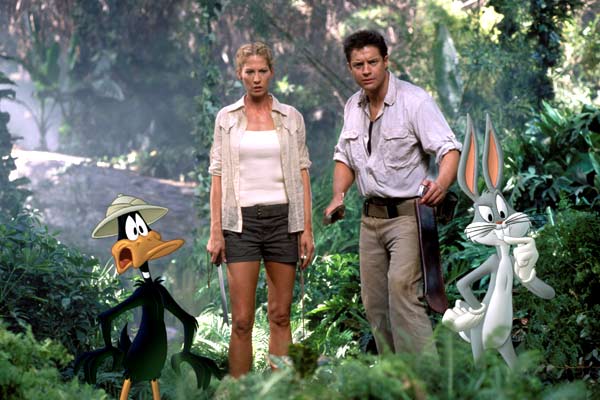
Looney Tunes: Back in Action
*** (A must-see)
Directed by Joe Dante
Written by Larry Doyle
With Brendan Fraser, Jenna Elfman, Steve Martin, Timothy Dalton, Joan Cusack, Heather Locklear, and the voice of Joe Alaskey.

Ever since the word “auteur” became part of the standard English vocabulary in the late 60s and early 70s there’s been some confusion about its meaning. In French auteur simply means “author,” and when François Truffaut started formulating a “politique des auteurs,” or policy of authors, in Cahiers du Cinéma in the mid-50s, he had in mind a critical policy that recognized the stylistic and thematic unity certain directors gave their films. And because politique means “politics” as well as “policy,” he was also implying a ranking of those directors.
In his early writings Andrew Sarris transformed these ideas into an “auteur theory” that focused less on policy and politics. This is where the confusion started, because it wasn’t clear to most people whether this was a theory about how films were made or about how they should be viewed and interpreted. Because the mainstream discourse centered on the powerful Hollywood studios, the theory came to be understood as focusing on how films were made, with the emphasis on film as a business. Read more
A film adaptation of Christopher Hampton’s play, which is based in turn on Choderlos de Laclos’ classic 18th-century epistolary novel Les liaisons dangereuses. Aiming for a mixture of erotic decadence and upscale artiness a la The Draughtsman’s Contract, the film seems a bit studied, but the creepy plot still holds a certain fascination, and Glenn Close, John Malkovich, Michelle Pfeiffer, Swoosie Kurtz, and Keanu Reeves all do their best with it, though Mildred Natwick in a cameo manages to steal the show (1989). (JR) Read more
Lawrence Kasdan’s comedy-drama, based on Anne Tyler’s novel, reunites the two stars of Body Heat, Kasdan’s first feature, William Hurt and Kathleen Turner. The plot concerns a writer of guidebooks for reluctant travelers (Hurt) whose wife (Turner) leaves him; Geena Davis plays the unusual dog trainer he meets. Unlike Body Heat, the interest here is wholly a matter of story and character rather than style, and Hurt’s character is so inert and unemotional that some spectators may find it difficult to stay interested in him. A dog, a ten-year-old boy, and several eccentrics do give things a bit more flavor. The locations include Paris, London, and Baltimore; Amy Wright, David Ogden Stiers, Ed Begley Jr., and Bill Pullman are among the stars (1989). (JR) Read more