I’m reposting this as a sort of adjunct to David Bordwell’s excellent two-part study of Manny Farber (available here and here). My relatively recent review of Farber on Film can be accessed here.
This very personal essay was written in 1993 for my first collection, Placing Movies: The Practice of Film Criticism. I’ve updated a few facts, all placed in square brackets, and corrected some typos, including one that appeared on the first page of the essay in the book, much to my irritation (as well as Manny’s) ….The photograph at the very end of this piece, before the new Afterword, taken by Andy Rector, shows Manny and Patricia with Gabe Klinger. — J.R.

They Drive by Night: The Criticism of Manny Farber
By Jonathan Rosenbaum
“What is the role of evaluation in your critical work?” Manny Farber was once asked in an interview. “It’s practically worthless for a critic,” Farber replied. “The last thing I want to know is whether you like it or not; the problems of writing are after that. I don’t think it has any importance; it’s one of those derelict appendages of criticism. Criticism has nothing to do with hierarchies.” A few years later, in another interview — published in French, so I can’t quote from it verbatim — he expressed his irritation with Pauline Kael writing about RAGING BULL as if she knew what was good or bad in every shot, in every scene. Read more
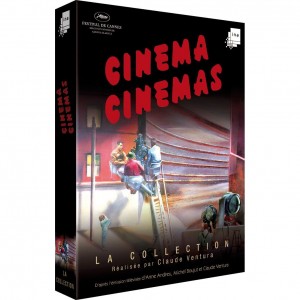
From Moving Image Source [movingimagesource.us], posted March 5, 2009. The last time I checked, the box set Cinéma Cinémas was still available from French Amazon, for 25.56 Euros. — J.R.
How does one distinguish American cinephilia from the original, hardcore French brand? Based on an exchange I had with French critic Raymond Bellour and several other friends a dozen years ago — a round of letters first published in the French film magazine Trafic that later grew into a collection in English that I co-edited with Adrian Martin, Movie Mutations: The Changing Face of World Cinephilia — there’s some disagreement about how serious a role French cinema actually plays in “classic” (i.e., French) cinephilia. According to Raymond, spurred in part by remarks from the late Serge Daney — a mutual friend and the founder of Trafic — modern French cinephilia was from the outset basically American, as suggested by the archetypal question, “How can one be a Hitchcocko-Hawksian?”:
It’s a question of theory, but even more of territory. This is what necessarily divides me from Jonathan, in whom cinephilia was born, like in everyone else, through the nouvelle vague, but who, as an American, takes the nouvelle vague itself as an object of cinephilia — whereas the cinephile, in the historical and French sense, trains his sights on the American cinema as an enchanted and closed world, a referential system sufficient to interpret the rest. Read more
Commissioned by Richard Porton and written for (and published by) On Festivals: 03 (Dekalog), edited by Richard Porton, New York: Columbia University Press, 2009. Because of the length of this, I’m running it in two parts, and this is the second part. — J.R.
Apart from New York and Cannes, I can almost count the other film festivals I attended during the 1970s on one hand: San Sebastian in 1972; London in 1974–76 (after moving to London to work for the British Film Institute, as assistant editor of the Monthly Film Bulletin); Edinburgh in 1975 and 1976 (which I covered both years for Sight and Sound); Filmex in Los Angeles in 1977–78 (after I moved from London to San Diego, to teach film at the University of California); the Toronto Festival of Festivals, thanks to David Overbey, in 1978; and Venice, to attend a three-day conference called The Cinema in the 80s, in 1979.
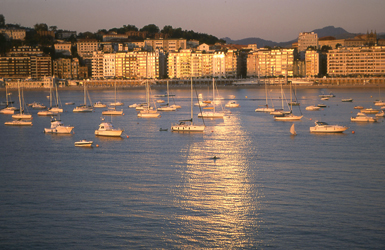
The San Sebastian bash, held back then in July, was by far the glitziest -– an event that incorporated not only a good many midnight banquets at country clubs, but also a trip to Pampelona to attend the bullfight, with Howard Hawks — the festival’s guest of honor, head juror, and the focus of the festival’s retrospective — holding court. Read more
Commissioned by Richard Porton and written for (and published by) On Festivals: 03 (Dekalog), edited by Richard Porton, New York: Columbia University Press, 2009. Because of the length of this, I’m running it in two parts. — J.R.
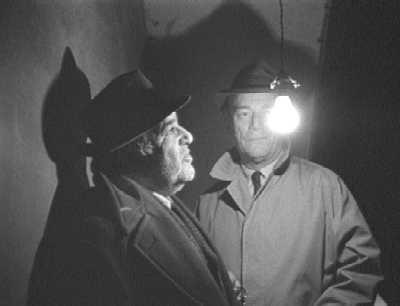
I’m pretty sure the first film festival I ever attended was the third New York Film Festival, at age 22 in fall 1965, to see Alphaville. In 1963, I probably would have attended the first New York Film Festival if I hadn’t transferred from Washington Square College to Bard College, two hours up the Hudson, about half a year earlier. Later that same year, I took over the Friday night film series at Bard, but every once in a while I’d forego one of my own selections in order to take a weekend trip to New York and see something new I was especially curious about; my first looks at Muriel and Dr. Strangelove were during two such excursions. And my curiosity about what Jean-Luc Godard would do with science fiction was enough to persuade me to hop on the train or catch a ride with a classmate. As it turned out, I found the film silly, not really understanding most of its allusions to contemporary Paris or German expressionist cinema. Read more
This essay was written for That Magic Moment: 1968 Und Das Kino Eine Filmschau, a film program and publication organized by the Viennale and Stadtkino in late May and early June, 1998. Like some of the other pieces reproduced on this site as featured texts, this has various passages that have been recycled elsewhere in my work — in this case, both in the Chicago Reader and in my book Movie Wars — but it still seems worth reprinting, chiefly for its personal reflections on film history and, more generally, the 60s. — J.R.
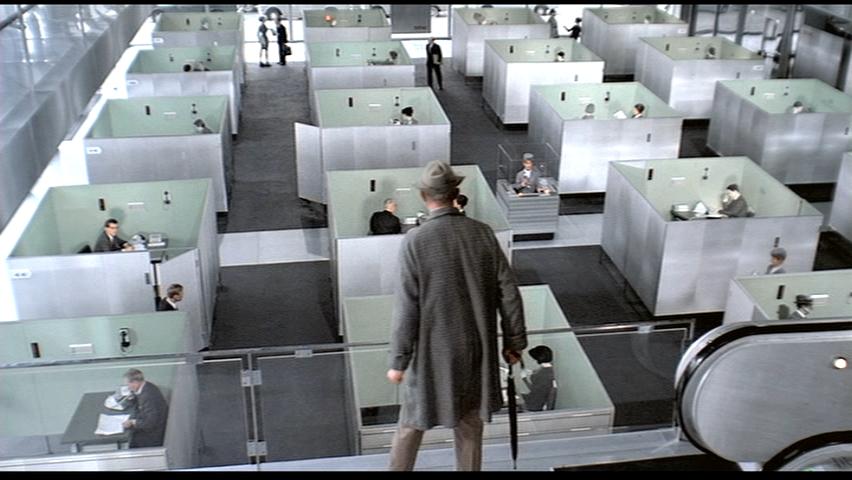
My Filmgoing in 1968: An Exploration
by Jonathan Rosenbaum
In 1968, the year I turned 25, I bought my first appointment book — or at least the first appointment book that I’ve bothered to save, and I’ve saved all 30 of the appointment books that I’ve bought and filled since then. For the most part, I use these appointment books to list appointments of various kinds: meetings with friends, planned trips to other cities and countries, classes I plan to teach or lectures I plan to attend or deliver. But most of the entries concern films I plan to see and when or where they’re playing. Read more
One ironic footnote to the following article, which ran in the March 6, 1992 issue of the Chicago Reader, is that it was itself subjected to a kind of “soft censorship”. Specifically, my editors refused to allow me to allude to having known Chevy Chase personally as a classmate at Bard College during the mid-1960s, which I thought gave some additional weight to some of my reflections about the personal nature of Memoirs of an Invisible Man. (Since I no longer have access to my initial draft, I can’t spell this out here in any detail, except to note that Chase’s jazz piano now figures in the final draft only as a parenthetical detail.) Not only did Chevy and I share a course or two, but we also bonded in various ways through our mutual interest in jazz: in a few student jam sessions, I played piano while Chevy played drums (although he also played some piano even then), and we collaborated at one point with Blythe Danner (another Bard classmate, and a jazz vocalist at the time) on a successful project to bring Bill Evans and his trio to campus to give a concert. —J.R.
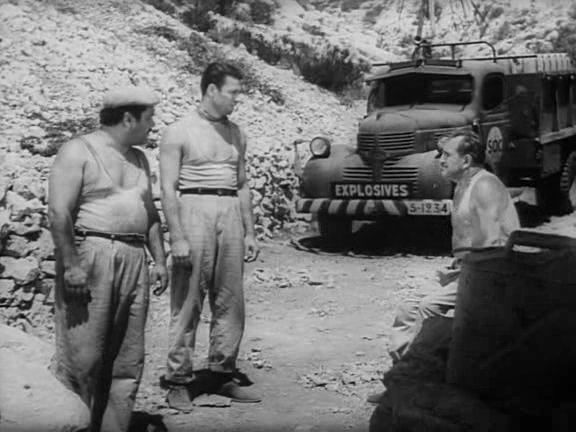
THE WAGES OF FEAR
*** (A must-see)
Directed by Henri-Georges Clouzot
Written by Clouzot and Jerome Geronimi
With Yves Montand, Charles Vanel, Vera Clouzot, Folco Lulli, Peter Van Eyck, and William Tubbs. Read more
The British Film Institute’s Roma Gibson recently contacted me about reprinting a review of Kevin Brownlow’s Winstanley (1976) that I included in my “London Journal” for Film Comment (January-February 1976) with the BFI’s forthcoming DVD release of the film. I responded by requesting that she substitute a couple of lines from my Time Out capsule review of the same period for the last couple of lines in my already somewhat hyperbolic Film Comment review, and she agreed.
I thought it might be instructive for me to reproduce that composite review and then juxtapose it here with “Time Traveler” — my April 23, 1999 Chicago Reader review of Winstanley and Brownlow’s preceding feature, It Happened Here, which explains some of the polemical context that provoked some of the hyperbole in my earlier reviews. —J.R.
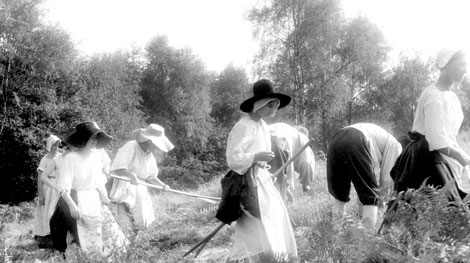
There’s really not much to be said for Winstanley, except that it’s the most mysteriously beautiful English film since the best of Michael Powell (which it resembles in no other respect) and the best pre-twentieth-century historical film I can recall since The Rise of Louis XIV [Rossellini] or Straub-Huillet’s Bach film [Chronicle of Anna Magdalena Bach]. I know that sounds like hyperbole, but I can’t help it. Read more
The following was one of a dozen or more profusely illustrated pieces that I wrote for a London periodical in 1982 called The Movie, specifically for issue no. 117; some of these articles were later recycled into a series of coffee-table books devoted to various decades in film history, but not this one, which I’ve slightly revised for its reappearance here.

Even though this short piece is somewhat dated now, I’m reviving it to celebrate Criterion’s awesome edition of Lonesome on DVD and blu-Ray (in the best print of the film I’ve ever seen, with a superb audio commentary by Richard Koszarski), along with Fejos’s subsequent The Last Performance and Broadway on a separate disc. For me, this is unquestionably one of Criterion’s most impressive releases to date. — J.R.
LONESOME
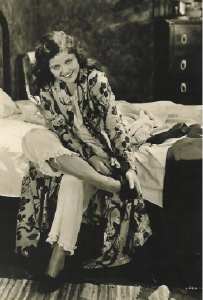
In a large, lonely city, the daily routines of two ordinary people who do not know one another are shown in parallel development. First Mary and then Jim wakes up, dresses and has breakfast (at the same restaurant). They proceed to their separate jobs in the same plant.
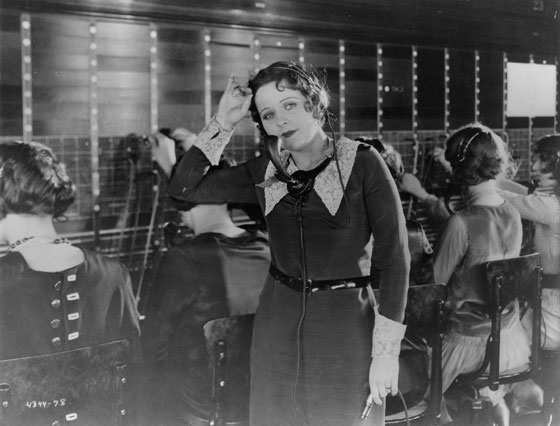
It is July 3, the day before Independence Day, and after the holiday starts at noon both characters turn down invitations to join couples, and go home alone. Read more
Read more
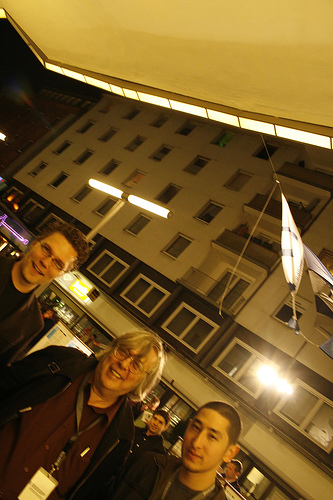
I no longer recall who snapped this deliberately lopsided photo of Oliver Baumgarten (left), Alexis Tioseco (right), and me in spring 2007, when the three of us were the entire FIPRESCI jury at the Oberhausen International Short Film Festival. Our prize that year went to an eye-popping masterpiece, Amit Dutta’s Kramasha (To Be Continued…), from India — which later became one of the five late (2007) entries to my list of all-time favorite films in the Afterword of the second edition of my collection Essential Cinema — and discovering that great film with Alexis was for me the absolute high point of the festival.
As some of you have heard by now, Alexis, who was 28, and his Slovenian partner Nika Bohinc, who was almost 30 and another very talented film critic, were murdered yesterday in their home in Quezon City, the Philippines, apparently by burglars. Nika, whom I also knew, but less well, had only recently moved there from Ljubljana, Slovenia; Gabe Klinger has just posted a very tender and affectionate piece about both of them a few hours ago. And for the moment, at least, one can still access Alexis’ excellent web site, Criticine. (Postscript, 9/3/09: Adrian Martin writes from Melbourne that Nika’s own Ekran blog, also [mostly] in English, which I haven’t encountered until now, “with many fine pieces, is still also accessible”.) Read more

1. Taking a British Airways morning flight from Edinburgh to London this morning, I was delighted to discover that a tourist-class seat entitles me to a full hot British/Scottish breakfast — omelet, sausages, ham, mushrooms, and potatoes, with coffee served in an old-fashioned ceramic cup, at no extra charge. Simply imagining such a thing on any domestic flight in the U.S. nowadays would be indulging in a decadent form of nostalgia.
2. The intelligence, wit, and sharp writing one almost takes for granted in portions of the weekly press here. After bemoaning the phony “knowing” tone of David Thomson pretending to be authoritative about Orson Welles’ life at the time of his death in my last Notes entry, it’s worth quoting from three pieces that I happened to read during my 90-minute flight, all displaying good thoughts as well as good prose. The fact that I happened to just see Fantastic Mr. Fox two nights ago, in the Scottish coastal village St. Andrews, made the latter two pieces, both reviews of the film, especially interesting:
a. From “Your Call is Not Important To Us” by Will Self (New Statesman, 26 October) on mobile phones: “As defined by the psychiatric profession, psychosis is a blanket term for inadequate reality-testing (an ugly coinage, but you know what I mean). Read more
This was written in early 2003 for Trafic no. 46, their summer issue, where it was translated into French by Jean-Luc Mengus, their managing editor. It’s part of a very wide range of “letters” from cities around the world that they’ve been running for many years. It’s very sad to report that Alexis A. Tioseco, whom I’d recommended to the magazine as the perfect person to write their “Letter from Manila,” was in the middle of fulfilling that assignment when he was murdered. — J.R.
Letter from Chicago
Dear Trafic,
Approaching my 60th birthday and the sort of self-definition that stems in part from the various places I’ve lived, I’ve recently noted that I’ve been anchored in the same place for roughly the first quarter of my life (Florence, Alabama) as well as the past quarter (Chicago). Yet it seems equally significant that two-thirds of the remaining half of my life have been spent in New York, Paris, and London, where the world is measured and perceived quite differently from the ways it’s encountered in either Florence or Chicago. This includes the world of cinema, which has figured for me as a distinctly separate entity when viewed from the separate vantage points of these five localities. Read more
This synopsis and review appeared in the December 1975 issue of Monthly Film Bulletin.
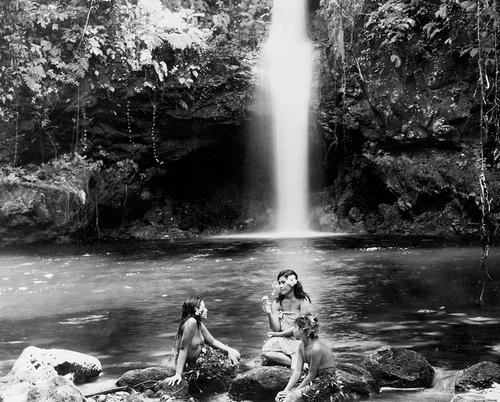
I’ve only just begun to familiarize myself with Moana with sound (see first still below), put together by the Flahertys’ daughter Monica, restored by Bruce Posner and Sami van Ingen (the Flaherty’s great-grandson), and posthumously released on Blu-Ray today by Kino Lorber. But I’ve already sampled enough of it — as well as all of Posner’s “short” (39-minute) history of the project, included along with other extras on the Blu-Ray — to view it as a major achievement, hopefully leading to a major reassessment of what I regard in some ways as Flaherty’s most neglected masterpiece. — J.R.
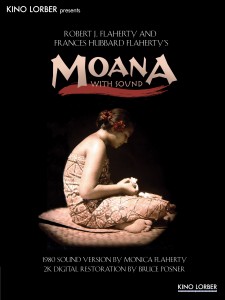
Moana
U.S.A., 1925
Directors: Robert J. Flaherty, Frances Hubbard Flaherty
Savai’i, a Samoan island. Near the village of Safune, Moana pulls taro root from the ground and peels it while his betrothed Fa’angase bundles leaves, his mother Tu’ungaita carries mulberry sticks and his younger brother Pe’a helps them. Setting off for the village, they set a trap for wild boar, the forest’s only dangerous animal, which they subsequently capture. Moana, Fa’angase, and Pe’a go spear-fishing, along with Moana’s older brother Leupenga. Back in the village, Tu’ungaita makes back-cloth for a lavalava, a native dress. Read more
Written for the 120th and final issue of Trafic, Fall 2021, where it appears in Jean-Luc Megus’ French translation. Contributors to this special issue were invited to write about something treasured, bearing in mind the quote from Ezra Pound that’s cited. — J.R.
“I never know how I should end my solos,” John Coltrane reportedly once said to Miles Davis, to which his boss gruffly replied: “Try taking your horn out of your mouth.”
Coltrane’s conceptual orientation versus Davis’s blunt practicality can be felt in the former’s symmetrical, multi-note flurries and rude honks up and down scales, furiously covering almost every available silence with his “sheets of sound”, and the latter’s jagged, elliptical smears and little-boy cries separated by sudden pauses that often register like either interruptions or abrupt afterthoughts, second-guessing himself.
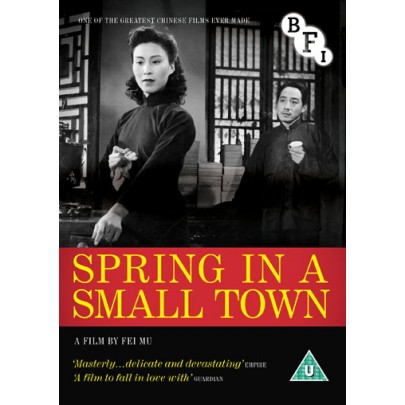
An almost sexual alternation of giving and withholding in a jazz solo becomes a tug of war between conflicting formal as well as sexual impulses — Davis’s version of coitus interruptus versus Coltrane’s giddy flirtations and unresolved foreplay. It persists throughout director Fei Mu’s and screenwriter Li Tianji’s extraordinary Spring in a Small Town (1948), a troubled and troubling piece of cinematic chamber music that seems all the more passionate yet intensely bottled up during the romantic and sexual frustrations of the Coronavirus pandemic. Read more
This appeared in the May 21, 1993 issue of the Chicago Reader. Although the YouTube link given below no longer works, I can happily report that it’s out now on DVD. — J.R.
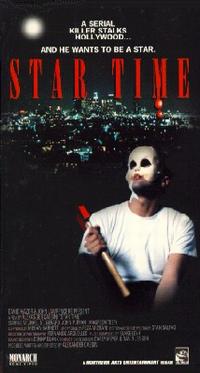
STAR TIME
*** (A must-see)
Directed and written by Alexander Cassini
With Michael St. Gerard, John P. Ryan, Maureen Teefy, and Thomas Newman.
I doubt that any current media buzz term is more ideologically polluted than “family values.” Even its alternative, “suitable for the whole family,” doesn’t contain the same puritanical lies. The egregious false assumptions built into this phrase as it’s now used are breathtaking: that families are all alike when it comes to their values; that these shared values are somehow independent of — and therefore free of — the sex and violence purveyed by Hollywood movies (“sex and violence” invariably viewed as an irreducible entity that also mysteriously includes profanity); and that, because they eschew sex and violence, “family values” are uniformly good and healthy. These assumptions seem predicated on the notion that everything bad that happens in society necessarily occurs outside the home, on the streets. Never mind that statistics show that an inordinate amount of lethal violence occurs during national holidays, in homes, between family members; this is factored out of the discussion along with the inconvenient fact that babies (and therefore families) are generated by sex, not storks. Read more