Last week I congratulated the Chicago International Film Festival for failing to attract more Hollywood studio interest, thereby making it easier for us to see good movies without being pressured by hefty advertising budgets. But this week I feel obliged to point out that the Chicago festival’s organizers probably wouldn’t have minded more Hollywood hoopla. I’ve noticed over the past several years that they tend to hold most of their high-profile events during the opening weekend, reserving many of the less glitzy items for the second week. Perhaps they believe that if they can persuade the public to come to something in the first few days, the remainder of the festival will take care of itself.
As a sworn opponent of this kind of “opening night” snobbery, I can’t help noting that some of the most significant, if less glamorous, movie events occurring in town this week have nothing to do with the festival. Two of Alain Resnais’ lesser-known experiments with musical form are playing at the Film Center; one of them, the 1984 Love Unto Death, has never been shown in Chicago before. Two even more scarce and seminal French experimental films, both from 1968, are playing at Facets Multimedia Center: Jackie Raynal’s Deux fois and Philippe Garrel’s La revelateur–neither of which is likely to come this way again. Read more
Scripted and photographed by Charles Burnett and directed by his former film-school classmate Bill Woodbury, this wonderful neorealist look at a working-class black family in South Central LA (1984) is worthy of being placed alongside Burnett’s Killer of Sheep. Passionately recommended. 80 min. (JR) Read more
Even after one factors in the 1985 stroke that left Michelangelo Antonioni mainly paralyzed, the ambiguous degree to which his wife Erica has been responsible for most of his subsequent work (some of which she cosigns), and the overall decline in the quality of most of his films since the 70s, the shorts in this program, all commissioned and showing in excellent prints or on video, are truly all over the map. They range from his beautiful documentaries of the late 1940s (about people working in the Po River valley, Roman street cleaners, the production of popular photographed comic strips called fumetti, superstitions, and the manufacture of rayon clothes) to his more uneven travel sketches of the 1990s (about Rome, Sicily, and the island of Stromboli). In between are so-so works about rock carvings in the Villa Orsini and a cable car (1950) and bathing in the Ganges (1989), plus a truly awful music video from 1984. 110 min. (JR) Read more
Miscarriages of justice involving black men in the south are nothing new, but there seems to be no precedent for the obtuseness of the legal system revealed in this 2005 documentary by Ricki Stern and Annie Sundberg. In 1984 teenager Darryl Hunt was arrested for the rape and murder of a white woman in Winston-Salem; though convicted with flimsy evidence and later proved innocent by DNA testing, he had to wait 19 years before he was freed and exonerated. The police and judiciary’s unwillingness to acknowledge errors and talent for compounding them evoke the current Bush administration, but the most compelling part of this is Stern and Sundberg’s growing acquaintance with and understanding of Hunt, which ultimately gives their narrative some positive spin. 113 min. (JR) Read more
From the Chicago Reader (December 1, 2006). — J.R.
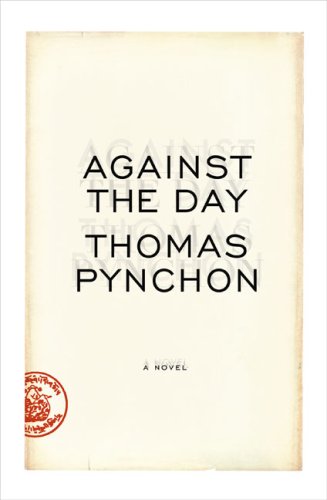
Against the Day | Thomas Pynchon (Penguin Press)
Thomas Pynchon’s 1,085-page Against the Day does a lot of things. Some it does well, some it does badly — and some are impossible to judge this early, though scores of people are trying, in the press and on the Internet. And it may still be beyond the capacity of most of us to judge a year from now. In some respects Pynchon remains as difficult to evaluate as globalization with all its facets and ambiguities.
This passionately anticapitalist book, which most likely took a decade or more to write, follows dozens of characters over more than two decades, starting at the Chicago World’s Fair of 1893 and ending, more or less, in Paris in the early 1920s. Meanwhile it skips across the planet several times, stopping in, among other places, the Balkans, central Asia, Cambridge, Gottingen, London, New York, Paris, Telluride, Venice, and Vienna. Pynchon includes labor history, mathematical equations, ambiguously overlapping stories about alchemy and early photography, and the tale of an anarchist coal miner named Webb Traverse — who specializes in dynamiting railroads and who’s tortured to death by hired guns working for a robber baron — and the lives of his children. Read more
From American Film (October 1979). -– J.R.

The actors playing Chuckie and Mikey, a sinister vaudeville team dressed in matching tuxedos, top hats, and capes, are pretending to walk toward the camera. They move their feet without advancing anywhere. Behind them, a gigantic black-and-white blowup of a garden at Versailles, mounted on a platform, is slowly rolled away to further the partial illusion. Then they turn around and pretend to walk away from the camera, and the Versailles backdrop is slowly wheeled toward them. All this time the characters discuss a woman they have killed in Budapest.
“Think of it, ” Mikey says wistfully in a Russian accent. “I could have married a princess. ”
“All bourgeois dreams end the same way,’’ Chuckie replies in a disdainful tone. ”Marry royalty and escape.”
“OK, cut!” says Mark Rappaport, concluding the fifth and final take.

It’s the first day of shooting on Impostors, a macabre comedy by the Brooklyn-born independent filmmaker. The movie, Rappaport’s fifth feature, is being shot in his loft in the SoHo section of Manhattan, and spirits are running high. A young crew of about twenty persons — fifteen of them on the regular payroll — are clustered on one side of the loft. Read more
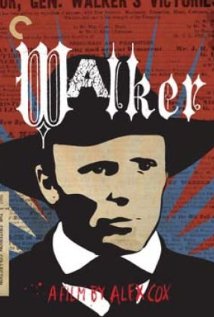
Probably Alex Cox’s most underrated movie. From the Chicago Reader (December 4, 1987). — J.R.
WALKER
*** (A must-see)
Directed by Alex Cox
Written by Rudy Wurlitzer
With Ed Harris, Richard Masur, Rene Auberjonois, Marlee Matlin, Peter Boyle, Blanca Guerra, and Miguel Sandoval.
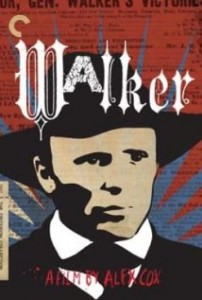
What is it about the American mind that insists on regarding itself as apolitical? It would be easier to understand such an attitude in a country with less political freedom than this one; here it seems willfully self-denying, like ordering a hamburger in a Chinese restaurant. From a Marxist and existential standpoint, being “apolitical” means accepting, hence supporting, the status quo — a political position like any other, acknowledged or not. Yet there is something in the national consciousness that resists such acknowledgment.
Reagan’s appeal has always rested in part on this form of self-deception, which can be traced back to most of his movie roles — the assumption that anyone as bland and as familiar as a favorite uncle can’t be sullied by anything as dirty as politics or ideology. The belated discovery that Reagan’s “apoliticism,” so closely linked with his triumph as Pure Image, chiefly consists of his capacity to do nothing at all, hasn’t eliminated the desire to fill the void with another static, charismatic presence — another movie, in short, to tide us over the many crises to come. Read more
From Sight and Sound (Summer 1985). This is a revised and expanded version of a lecture given at the Rotterdam International Film Festival’s Market in early 1985, the second year I attended the festival. Some of it’s obviously very dated now (hopefully in a way that’s historically instructive) and some of it anticipates a few of the arguments made in my book Movie Wars: How Hollywood and the Media Limit What Films We Can See 15 years later. The late Huub Bals, director and presiding spirit of the Rotterdam festival, asked me to give this talk, and, as I recall, it was well attended; the audience members included, among others, Eszter Balint (the female lead in Stranger Than Paradise), Bernardo Bertolucci, Sara Driver, Jim Jarmusch, and Rudy Wurlitzer. –- J.R.
A feeling of having no choice is becoming more and more widespread in American life, and particularly among successful people, who are supposedly free beings. On a concrete plane, the lack of choice is often a depressing reality. In national election years, you are free to choose between Johnson and Goldwater or Johnson and Romney or Reagan, which is the same as choosing between a Chevrolet and a Ford — there is a marginal difference in styling. Read more
Part of the brilliance of Raul Ruiz rests in his capacity to take on routine documentary assignments for French television and turn them into mind-bending fictions. That’s what happened with this provocative hour-long 1984 film about an actor at the 1983 Avignon Theater Festival; it ingeniously balances reporting on an actual event with Ruizian yarn spinning. Even more impressive is the accompanying 20-minute 1980 short Le jeu de l’oie (Snakes and Ladders) — which was commissioned to promote a map exhibition at Paris’s Pompidou Center — an awesome and hilarious metaphysical fantasy with the tattiest special effects this side of Edward D. Wood Jr., and one of the most purely pleasurable works in the Ruizian canon. Taken separately or together, these gems provide a perfect introduction to the imaginative and labyrinthine universe of a prodigious filmmaker. Ruiz, a graceful and easygoing commentator on his own work, will introduce the films and answer questions at the Saturday screening. (Film Center, Art Institute, Columbus Drive at Jackson, Friday, April 20, 6:00, and Saturday, April 21, 6:15, 443-3737)
Read more
Written for a feature in the August 2018 Sight and Sound about novels set in and around the world of movies. — J.R.
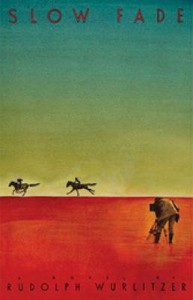
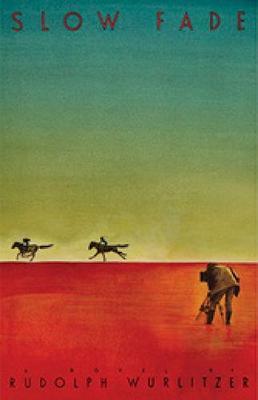
The fourth novel (1984) of Rudy Wurlizer, a remarkable writer better known for his screenplays (including those for Two-Lane Blacktop and Walker, both recently canonized by Criterion), is the only one about movies, but it views salvation as a distinctly precinematic or postcinematic postulate. Following his psychedelic Nog (1969), minimalist Flats (1971), and apocalyptic Quake (1974), Slow Fade is more of a page-turner — as is The Drop Edge of Yonder (2008), a Western that grew out of an unrealized script. It focuses on a wasted septuagenarian macho filmmaker named Travis Hardin contemplating his own demise. Many assume it’s a portrait of Sam Peckinpah, whom Wurlitzer worked with on Pat Garrett and Billy the Kid, though he also suggests John Huston and Nicholas Ray. And the surrounding dead-beat hustlers, all hoping to turn some aspect of his legend into coin, include his alienated son and a roadie whom Hardin hires to write a script recounting what happened to his equally alienated daughter when she ran off to India on a spiritual quest. The script’s progress is intercut with the director’s drift back to his modest origins, combining the Beckett-like/Buddhist theme of identity loss from Wurlitzer’s earlier novels with a road-movie ambience. Read more
Capsule reviews of two of my favorite American films, both commissioned by BBC.com, who previously asked me to name my ten favorite American films. (For some reason, my computer can’t handle their own web site and link, which is why I’m posting this material here.) I responded to their first request with these choices:
1. GREED (Stroheim, 1924)
2. SUNRISE (Murnau, 1927)
3. THE MAGNIFICENT AMBERSONS (Welles, 1942)
4. CITY LIGHTS (Chaplin, 1931)
5. LOVE ME TONIGHT (Mamoulian, 1932)
6. THE BEST YEARS OF OUR LIVES (Wyler, 1946)
7. STARS IN MY CROWN (Tourneur, 1950)
8. LOVE STREAMS (Cassavetes, 1984)
9. A.I. ARTIFICIAL INTELLIGENCE (2001)
10. WHEN IT RAINS (Burnett, 1995)
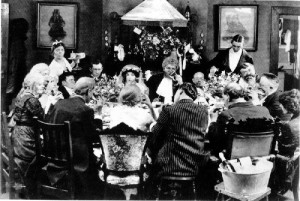
Greed
Other truncated masterpieces (most notably Orson Welles’s The Magnificent Ambersons) tend to be appreciated in spite of their flaws, but Erich von Stroheim’s Greed maintains its strength and intensity and even much of its density in its surviving form. The characters are rich and complex and the mise en scène fully serves both the power of the performances and the richness of the world depicted. The overall fidelity to Frank Norris’s McTeague is matched by a highly personal and inventive dedication to its meanings and resonance, and the overall vision of what money does to disfigure and destroy human personality is unequaled. Read more
From the Chicago Reader (March 9, 1990). — J.R.
The class which has the means of material production at its disposal, has control at the same time over the means of mental production, so that thereby, generally speaking, the ideas of those who lack the means of mental production are subject to it. . . . The individuals composing the ruling class possess among other things consciousness, and therefore think. Insofar, therefore, as they rule as a class and determine the extent and compass of an epoch, it is self-evident that they do this in its whole range, hence among other things rule also as thinkers, as producers of ideas, and regulate the production and distribution of the ideas of their age: thus their ideas are the ruling ideas of the epoch. –Karl Marx and Friedrich Engels, The German Ideology (1845-46)
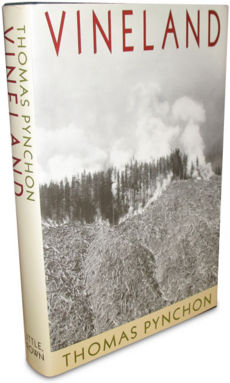
A good many newspapers and magazines have accompanied their reviews of Vineland, Thomas Pynchon’s fourth novel, with the same 37-year-old photograph of the author grinning goofily from his high school yearbook. Given Pynchon’s refusal to be photographed or interviewed, there are touches of both desperation and petty vindictiveness in this compulsion to objectify and visualize, however inadequately, a novelist who chooses to be identified only through his writing. Read more
Commissioned by BFI Publishing and published in the November 2014 Sight and Sound. This version is slightly tweaked. — J.R.
In an amusing, satisfying, and highly persuasive rant in Time Out in 1977, J.G. Ballard took on the cultural phenomenon of Star Wars (1977), including some of its historical and ideological consequences. Noting that “two hours of Star Wars must be one of the most efficient means of weaning your preteen child from any fear of, or sensitivity towards, the death of others”, he also reflected on the overall impact of George Lucas’s blockbuster on science-fiction movies:
“The most popular form of s-f — space fiction –- has been the least successful of all cinematically, until 2001 and Star Wars, for the obvious reason that the special effects available were hopelessly inadequate. Surprisingly, s-f is one of the most literary forms of all fiction, and the best s-f films — Them!, Dr. Cyclops, The Incredible Shrinking Man, Alphaville, Last Year at Marienbad (not a capricious choice, its themes are time, space and identity, s-f’s triple pillars), Dr. Strangelove, Invasion of the Body Snatchers, Barbarella, and Solaris — and the brave failures, such as The Thing, Seconds, and The Man Who Fell to Earth, have all made use of comparatively modest special effects and relied on strongly imaginative ideas, and on ingenuity, wit, and fantasy. Read more
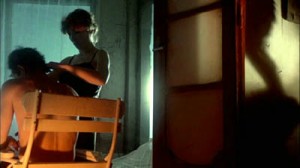
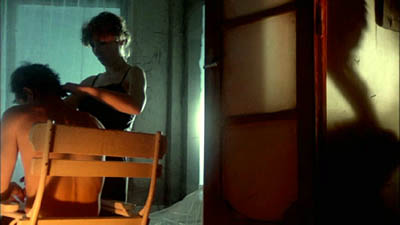
In his first three films Bela Tarr — conceivably the most important Eastern European filmmaker currently working — betrays an impatience with cinematic style, focusing almost exclusively on content, but that tendency was radically overturned with this 1984 feature, whose taste and intelligence are specifically (and exquisitely) cinematic and revealed Tarr as a master stylist. Set entirely in an apartment inhabited by an elderly woman, her son, his former teacher, the old woman’s nurse, and the nurse’s lover, the film consists mainly of intense two-part dialogues and encounters largely concerned with the old woman’s money. The remarkable use of color depends on a lighting scheme that divides most areas (and characters) into blue and orange, and the elaborately choreographed mise en scene is consistently inventive and unpredictable, making use of highly unorthodox angles and very slow camera movements. As in Damnation (1987), the mise en scene often seems to be composed in counterpoint to the action, but the drama itself (whose Strindbergian power and sexual conflicts are realized with an intensity and concentration that suggests John Cassavetes) carries plenty of charge on its own. 119 min. (JR)
 Read more
This is supposed to be set in 1950 in Alabama (where it was filmed), but the true location is some Never-Never Land in John Sayles’s imagination, sparked by research, a sharp ear for dialogue, and diverse fancies about the birth of rock ‘n’ roll. Yet as in the 1943 musical Stormy Weather, the wonderful cast, mainly black, carries it all with ease, even sailing past occasional false moments, such as a tacky flashback toward the end. Danny Glover, as hard-rock reliable as Spencer Tracy in his prime, plays onetime pianist Tyrone Pine Top Purvis, trying to save his title juke joint from economic disaster by pretending that a young drifter with a guitar (Gary Clark Jr.) is blues star Guitar Sam. He juggles and somehow resolves diverse problems with competition, electricity, cash, his wife, his daughter, and the local sheriff (Stacy Keach), spearheading an overall progress toward communal joy that for me yields the most enjoyable Sayles movie since 1984’s The Brother From Another Planet. PG-13, 123 min. (JR) Read more