The Future is Here
Commissioned by BFI Publishing and published in the November 2014 Sight and Sound. This version is slightly tweaked. — J.R.
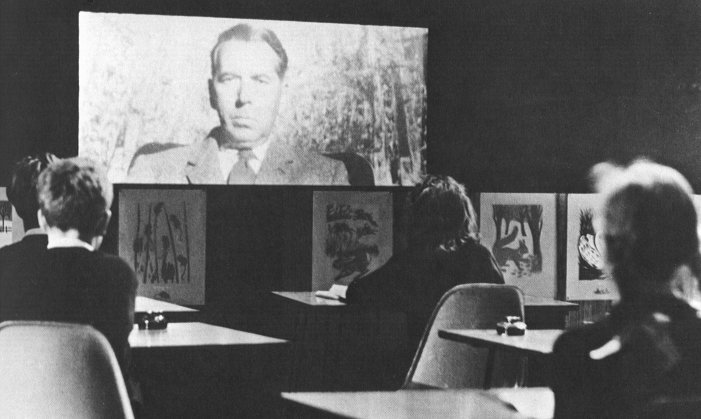
In an amusing, satisfying, and highly persuasive rant in Time Out in 1977, J.G. Ballard took on the cultural phenomenon of Star Wars (1977), including some of its historical and ideological consequences. Noting that “two hours of Star Wars must be one of the most efficient means of weaning your preteen child from any fear of, or sensitivity towards, the death of others”, he also reflected on the overall impact of George Lucas’s blockbuster on science-fiction movies:
“The most popular form of s-f — space fiction –- has been the least successful of all cinematically, until 2001 and Star Wars, for the obvious reason that the special effects available were hopelessly inadequate. Surprisingly, s-f is one of the most literary forms of all fiction, and the best s-f films — Them!, Dr. Cyclops, The Incredible Shrinking Man, Alphaville, Last Year at Marienbad (not a capricious choice, its themes are time, space and identity, s-f’s triple pillars), Dr. Strangelove, Invasion of the Body Snatchers, Barbarella, and Solaris — and the brave failures, such as The Thing, Seconds, and The Man Who Fell to Earth, have all made use of comparatively modest special effects and relied on strongly imaginative ideas, and on ingenuity, wit, and fantasy. Read more