Daily Archives: November 5, 2024

Changing (or Reflecting) the World: Cinema and its Discontents

 Commissioned by the Lima Film Festival in Peru in 2018. — J.R.

rosetta

Whenever someone tells me that it’s impossible for films to change the world, I like to point out that only half a year after Luc and Jean-Pierre Dardenne’s Rosetta won the Paume d’or at the Cannes Film Festival in 1999, a new Belgian law known as “Plan Rosetta,” which prohibited employers from paying teenage workers less than the minimum wage, was passed. And one could further point out that Rosetta “changed the world” in several other ways: it launched the substantial acting career of its eponymous, 18-year-old lead actress, Émilie Dequenne, it greatly enhanced the careers of its writers-directors, and it deeply affected a good many spectators, myself included — viscerally, aesthetically, spiritually, and politically.

The visceral impact came first: From its opening seconds, Rosetta makes it clear that its heroine is angry — before it tells us who she is or what she’s angry about. Alain Marcoen’s virtuoso handheld camera, which stays close to her throughout the film, follows as she slams a door, strides through the industrial workplace where she’s just been laid off, and then assaults her boss when he insists that she leave. After taking the bus back to the trailer park where she lives with her alcoholic       mother, Rosetta stops briefly in the woods and methodically takes off her shoes and puts on a pair of boots hidden behind a large rock in a drainpipe. Read more

Radio interview about THE OTHER SIDE OF THE WIND

The-Other-Side-of-the-Wind

This phone interview (see link below) with Douglas Storm in Bloomington, Indiana aired yesterday. Given all the Buddy Rich extracts, I’m sorry that there wasn’t time to discuss Welles’ own jazz taste (which was oriented more towards Dixieland, at least during the 40s). The clips from the film that are heard, which may be hard to follow in spots, testify to how much the art of Welles as a filmmaker is based on his editing, which obviously can’t be perceived in sound bites. [11/28/18]

Here’s the link of WFHB:

Interchange – That’s So Jake: Reaping Orson Welles

TheOtherSideoftheWind Read more

Global Discoveries on DVD: Auteurist Updates

My Fall 2018 column for Cinema Scope. — J.R.
Spettersad

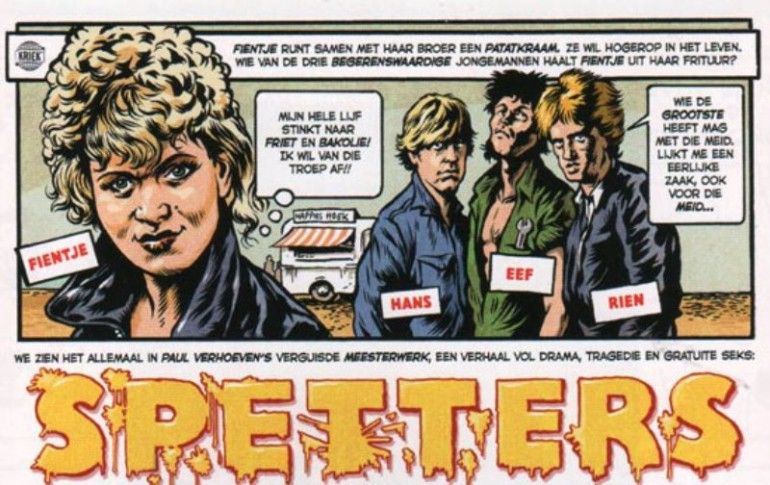
Paul Verhoeven gives exceptionally good audio commentary, especially on the Kino Lorber Blu-ray of Spetters (1980), a powerful feature about teenage motocross racers in a small Dutch town that I’ve just seen for the first time. Speaking in English, Verhoeven tells us a good deal about Dutch culture and life at the time his film was made; his own ideological motivations (such as his desire to depict accurately the behaviour of his young working-class characters) and personal contributions to the script (especially, but not exclusively, those relating to his early involvement with Pentecostal Christianity); his literary influences (in particular, the role played by Céline in conceptualizing the final sequence) and his strategies as a director (including the use of his own dog, who also turns up in The Fourth Man [1983]); his relations with his producer, his locations in and around Rotterdam, his cast and how he directed them; the differences between shooting in Holland and shooting in the US; the filming of stunts; his tricky dealings with Dutch government representatives to avoid censorship (which involved lying and subterfuge); the film’s disastrous initial critical reception, which had a lot to do with Verhoeven subsequently moving to Hollywood; and a great deal more. Read more