
Le gamin au vélo/The Kid with a Bike
I’ve recently been thinking that a considerable portion of what I find the most detestable in contemporary commercial filmmaking can be summed up in a single trend: exploitation movies that go out into the world as “serious” art movies,. Admittedly, two very early examples of this trend in talkies, Lang’s M and Hawks’ Scarface, are two of the greatest movies ever made, though neither of these can be accused of stroking and glorifying the audience’s hypocrisy. But ever since the Godfather pictures, it seems, artiness has been working overtime as a kind of built-in alibi for many of the baser impulses in the audience –- various kinds of cynicism viewing corruption as inescapable, everyday, and deeply profound (e.g., Avatar, The Girlfriend Experience, Contagion), extreme violence as a function of specious and hypocritical morality (or, even worse, “sensitivity,” as in Drive — or, for that matter, The Passion of the Christ), gimmicky temporal structures (e.g., Tarantino, Memento, Babel) or fatuous psychologizing that are somehow supposed to dignify various forms of boorishness or nastiness (ranging from McQueen’s sexist complacencies and brutalities in Shame to von Trier’s dubious and ongoing validation of his own depression as a practical tool for coping with glitzy catastrophes and atrocities of his own making), and even the sort of Oscar-mongering that can cast a liberal activist (Woody Harrelson) as a racist thug (Rampart) to show us how “complex” the modern world is supposed to be. Read more
From the Chicago Reader (September 25, 1992). — J.R.

BOB ROBERTS
*** (A must-see)
Directed and written by Tim Robbins
With Robbins, Giancarlo Esposito, Ray Wise, Gore Vidal, Alan Rickman, Bob Balaban, John Cusack, Susan Sarandon, Peter Gallagher, James Spader, and Fred Ward.
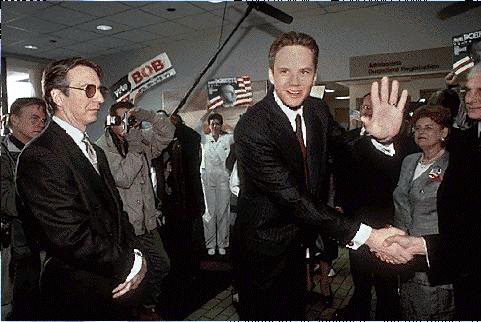
With Unforgiven unexpectedly topping the box office charts and Bush bashing so popular now that even my favorite comic book, USA Today, seems to do it daily, this appears to be the season of demystification. But I wonder how far the public is prepared to take this process. Since it premiered at the Cannes film festival four months ago, I’ve been looking forward to Tim Robbins’s directorial debut, described as an unbridled attack on the Republican glibness and greed of the past dozen years. Clearly the climate is ripe for some good old-fashioned muckraking. But how much of this involves a genuine change in national perception, and how much is it a merely seasonal media construction? As pleased as I am at the media’s apparent recognition of some of Bush’s crimes, it’s hard for me to understand how this squares with the media’s former position that these crimes never took place (as with Iran-contra) or didn’t matter (as with the savings-and-loan scandal) or were heroic deeds showing both restraint and maturity (as with the slaughter in the Persian Gulf). Read more
From Sight and Sound (Summer 1989). — J.R.
The degree to which contemporary cinema has become a desperate recycling operation was pain fully evident in Berlin this year, where even the better films seemed mired in familiar habits. Aki Kaurismaki’s Ariel, a hard-luck story of an unemployed miner pushed into a life of crime, is basically a Warners B-film of the 1930s, cleanly told and decked out with a few 80s ironies, but really nothing new. Martin Donovan’s Apartment Zero, a baroque male-bonding thriller set in Buenos Aires, superbly acted by Colin Firth and Hart Bochner, offers a chilling and complex view of the American abroad, yet its precise genre positionings would be unthinkable without its cues from Hitchcock, Chabrol and Polanski.

For many colleagues, a major disappointment in the competition was Chantal Akerman’s first English-language feature, Food, Family and Philosophy in French (or Histoires d’Amérique in French), a string of monologues and jokes by Jewish immigrants, delivered against Brooklyn exteriors within hailing distance of the Manhattan skyline over what appears to be a single night. Read more