From the Chicago Reader (February 18, 2005). — J.R.


Uncle Nino
** (Worth seeing)
Directed and written by Bob Shallcross
With Joe Mantegna, Pierrino Mascarino, Anne Archer, Trevor Morgan, and Gina Mantegna
Because of Winn-Dixie
** (Worth seeing)
Directed by Wayne Wang
Written by Joan Singleton
With AnnaSophia Robb, Jeff Daniels, Cicely Tyson, Dave Matthews, and Eva Marie Saint
An uninvited guest joins an already stressed household, causing pandemonium and upsetting the neighbors as well. The preoccupied, absentminded father assumes this obstreperous if good-natured invader is visiting only temporarily, but on and on he stays, irritating almost everyone apart from the young daughter. Eventually the interloper wins everyone over and brings them all together.
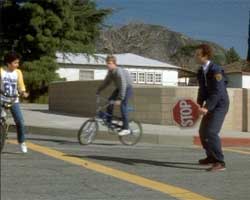
That’s the familiar plot of not one but two current commercial releases, both wholesome family pictures. The visitor in Uncle Nino, which opened last week, is the title hero (Pierrino Mascarino), an elderly Italian peasant with a minimal knowledge of English who flies to the U.S. to visit the family of his nephew Robert (Joe Mantegna) after his brother, Robert’s father, dies. The visitor in Because of Winn-Dixie, which opens this week, is also the title hero, a stray dog in a small town in southern bayou country that’s taken in by the ten-year-old heroine, Opal (AnnaSophia Robb), the daughter of a Baptist preacher (Jeff Daniels). Read more
Film Difficult Becomes Popular
It’s interesting to see how some of the most difficult and challenging examples of art cinema have become increasingly popular over the past decade. Back in the 60s and 70s, Robert Bresson was virtually a laughing-stock figure to mainstream critics, and someone whose films characteristically played to almost empty houses. Yet by the time that he died, a retrospective of his work that circled the globe was so successful in drawing crowds that in many venues — including Chicago’s Film Center — it had a return engagement. Much the same thing has happened with Andrei Tarkovsky — another uncompromising spiritual filmmaker, and one whose films are even tougher to paraphrase or even explain in any ordinary terms.
I’m just back from a trip to the east coast where I was gratified to find, when I turned up to introduce a screening of Jacques Rivette’s 252-minute L’amour fou (1968) in Astoria’s Museum of the Moving Image, that the film was playing to a nearly packed house. (Incidentally, this galvanizing love story about the doomed relationship between a theater director and his wife, played by Jean-Pierre Kalfon and Bulle Ogier, has never looked better to me, though I’ve been a big fan since the early 70s.) Read more
From Film Comment (September-October 2011). — J.R.


Recalling the incident in Turin that reportedly occasioned Friedrich Nietzsche’s final breakdown into madness — his weeping and embracing a cab horse that was being beaten by its driver for refusing to budge — Béla Tarr’s regular screenwriter, novelist László Krasznahorkai, has noted that no one seems to know or ask what happened to the horse. But The Turin Horse is only nominally concerned with this riddle. It’s more concerned with the horse’s driver and his grown daughter, who live in a remote stone hut without electricity, subsisting on an exclusive diet of potatoes and palinka (Hungarian fruit brandy) while a perpetual storm rages outside, then arbitrarily subsides, over a carefully delineated six days. Their abject life remains fixed by a few infernal routines, such as dressing, undressing, drawing water from a well, or looking out the window. (One exterior shot of the daughter doing just that towards the end of the film will haunt me the rest of my life). What passes for plot gradually becomes even more minimal by the driver’s horse first refusing to pull the wagon, then refusing to eat. Read more
From the Chicago Reader (July 12, 1991). — J.R.
POISON
*** (A must-see)
Directed and written by Todd Haynes
With Edith Meeks, Larry Maxwell, Susan Norman, Scott Renderer, James Lyons, John R. Lombardi, Tony Pemberton, and Andrew Harpending.

“The whole world is dying of panicky fright,” reads the title that opens Todd Haynes’s startling and original Poison. It’s a correct and judicious observation, one that helps to “explain” a fascinating and provocative movie, particularly if one sees it alluding directly to the specter of AIDS.
But if one starts to enumerate the symptoms produced by panicky fright in our culture, I’m afraid that the usual set of liberal grievances — greed, intolerance, xenophobia, repression, classism, sexism, racism, homophobia, war fever, and flag waving — doesn’t quite exhaust them. Some of the most cherished and least controversial emblems of postmodernist discourse — irony, stylistic pastiche, and a foreshortened sense of history and politics, all of which are usually employed together — may be symptoms of panicky fright as well. While the list of liberal grievances points to a fear of the world (especially the social world) as it is, postmodernist discourse suggests a fear of discourse (especially art) as it used to be and as it might be once again — a fear of unambiguous self-expression that implies another way of refusing to confront the present directly. Read more

For those of you who might be wondering what has become lately of film critic Donald Phelps — the most gifted and exacting of Manny Farber’s disciples, especially when it comes to low-key acting and pictorial nuance — you should proceed at once to the web site of Comics Journal, where he’s been flourishing in his recent commentaries on movies, prose fiction (ranging from the science fiction of Henry Kuttner and Theodore Sturgeon to the mysteries of Fredric Brown to Calder Willingham’s first novel), and comic strips. I’m especially impressed by parts one and two of his majestic “Like a Mechanical Bird: The Peculiar Stoicism of David Wayne,” posted earlier this month — a detailed and rather astonishing appreciation of one of the most overlooked of Hollywood and TV actors, whose special qualities seemed to flourish in such relatively unsung and/or out-of-reach works as Joseph Losey’s remake of M (1951), a couple of black and white sketch films at Fox in 1952 (O. Henry’s Full House and We’re Not Married, where he costars respectively with Charles Laughton and Marilyn Monroe), Henry King’s Wait Till the Sun Shines, Nellie (1952), which inspires some of Phelps’ best prose, and Down Among the Sheltering Palms (“an amiable bargain-counter South Pacific,” 1953). Read more

The Tree, the Mayor, and the Media Center
What a pity that one of Eric Rohmer’s best features should have fallen between the cracks and never received a U.S. release. But what a piece of luck that the Museum of Contemporary Art should launch its series “Living Spaces: Films on Architecture” with a swell pair of French features: Jean-Luc Godard’s multilingual Contempt (see separate listing), which features a famous villa designed by writer Curzio Malaparte, and Rohmer’s conservative comedy of manners (1993), receiving its Chicago premiere. A provincial mayor (Pascal Greggory) gets a government grant to build a media center, and the film’s gentle mockery of the socialist politician, some of it articulated by his own mistress (Arielle Dombasle), shows how Rohmer must have influenced Whit Stillman (Metropolitan, The Last Days of Disco). Yet Rohmer exceeds even Stillman’s audacity by turning this wry fable into a musical in its closing minutes; nothing he does here is predictable, yet in retrospect it all seems logical and balanced. With Fabrice Luchini; a 35-millimeter print in stereo will be shown. Museum of Contemporary Art, 220 E. Chicago, Sunday, January 16, 4:00, 312-397-4010 Read more
From the Chicago Reader (April 19, 2002). — J.R.

Time Out
**** (Masterpiece)
Directed by Laurent Cantet
Written by Robin Campillo and Cantet
With Aurelien Recoing, Karin Viard, Serge Livrozet, Jean-Pierre Mangeot, Monique Mangeot, Nicolas Kalsch, Marie Cantet, Felix Cantet, and Maxime Sassier.
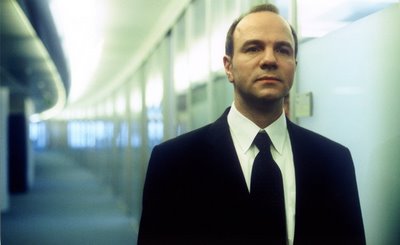
My French-English dictionary defines l’emploi du temps — the term used as the French title of Laurent Cantet’s remarkable feature Time Out — as the “timetable (of work), allotment of time.” Neither translation makes for a catchy film title, so it’s easy to understand why “time out” was selected. It also seems a fairly apt description of the spooky shadow existence of the film’s bland yet mysterious and compelling hero, Vincent Renault (Aurelien Recoing). A financial consultant fired weeks or months previously, he’s afraid to tell his family and friends the news. After a former work associate starts to wonder why he hasn’t told his wife, Muriel (Karin Viard), he invents a new job with the United Nations that obliges him to spend time in Switzerland, then gets his father and some friends from high school to invest in his imaginary activities. All the while he remains on the margins, spending much of his time in a hotel lobby, sleeping in his car in the hotel’s parking lot, eating in convenience stores, and driving aimlessly around the countryside near Grenoble and the French-Swiss border. Read more
From the Chicago Reader (September 8, 1989). — J.R.
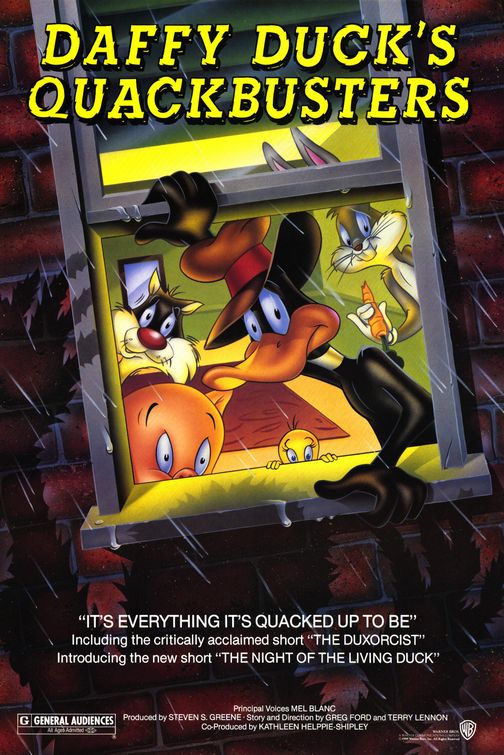
DAFFY DUCK’S QUACKBUSTERS
*** (A must-see)
Directed and written by Greg Ford and Terry Lennon
With Daffy Duck, Bugs Bunny, Porky Pig, Tweety Pie, Sylvester the Cat, J.P. Cubish, and the voice of Mel Blanc.
It seems more a matter of confusion at Warner Brothers than either poetic justice or business acumen that has denied this triumphant new cartoon feature a theatrical opening in Chicago, although it has recently become available here on video. After a limited if successful run in a New York theater last fall and several scattered theatrical play dates elsewhere in the U.S., Daffy Duck’s Quackbusters has entered the vast no-man’s-land of new features that are available for the most part only on tape, never having received the mainstream attention routinely accorded to other, mainly inferior, Hollywood releases.
Recycled Hollywood classics are very much in evidence right now, in a variety of forms, but this postmodernist conflation — consisting of nuggets from nine earlier Warner Brothers cartoons, two more-recent ones, and a generous amount of new material — displays a critical intelligence and a creative energy that were not apparent in such previous compilations as The Bugs Bunny/Road Runner Movie, The Looney, Looney, Looney Bugs Bunny Movie, Bugs Bunny’s 3rd Movie: 1001 Rabbit Tales, and Daffy Duck’s Movie: Fantastic Island. Read more
Commissioned (but never published) by the Guardian, circa 2005. A much-expanded version of this wound up as the final chapter in my book Discovering Orson Welles. — J.R.
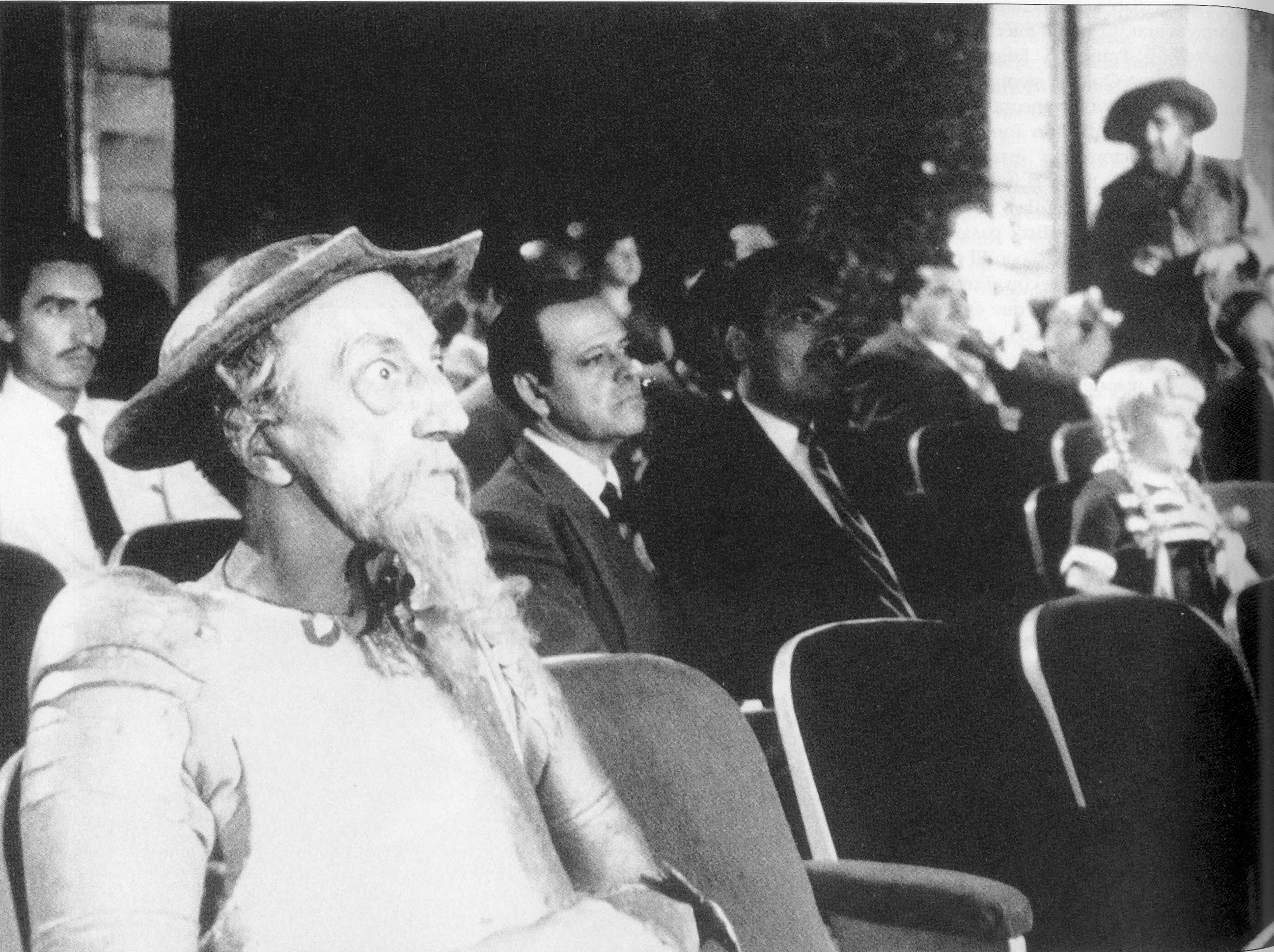
When Will — and How Can — We Finish Orson Welles’s Don Quixote?

When Orson Welles died in 1985, he left many of his films unfinished. Each one was unfinished in a different way and for somewhat different reasons. To the despair of anyone who has ever tried to market his work, no two Welles films are ever alike, even the theoretical ones.
But his Don Quixote, which he owned himself, is distinct from the others, for a number of reasons —- apart from the fact that something calling itself the Don Quixote of Orson Welles was put together in 1992 by Spanish hack director Jesus Franco, who did more to mutilate and distort Welles’ material than anyone had ever done to The Magnificent Ambersons or Mr. Arkadin.
It remained an active project for almost the last three decades of Welles’ life. Starting around the early 70s, Welles jokingly planned to call it When Will You Finish Don Quixote? And the question we used to ask Welles we now have to ask ourselves — namely, how can we find closure? Read more
From the Chicago Reader (April 5, 1991), and reprinted in Goodbye Cinema, Hello Cinephilia. — J.R.
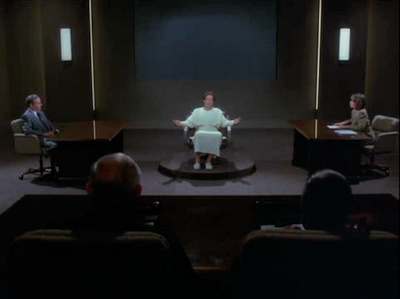
DEFENDING YOUR LIFE
**** (Masterpiece)
Directed and written by Albert Brooks
With Albert Brooks, Meryl Streep, Rip Torn, Lee Grant, and Buck Henry.
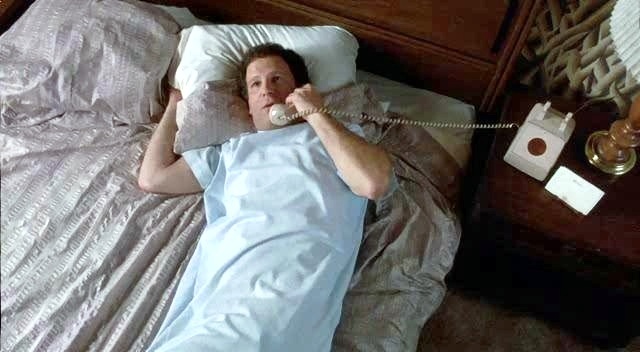
From the very titles of his four comedy features, we know that Albert Brooks is both a serious and an honest filmmaker, because each one is a precise and accurate indication of what the movie is about: Real Life, Modern Romance, Lost in America, and Defending Your Life. But what makes Brooks funny is much harder to get at or agree on.
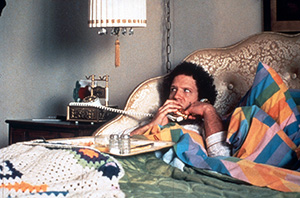
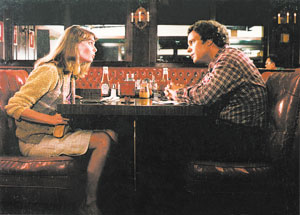
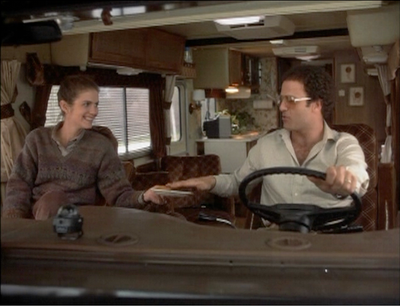
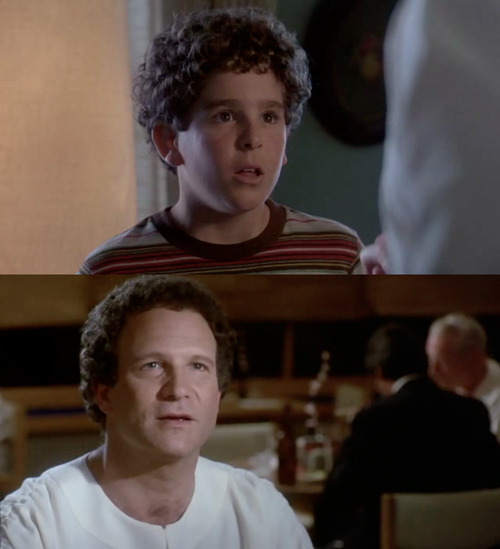
You can’t demonstrate how funny Albert Brooks is by quoting any of his one-liners, the way you can the vastly more popular and respected Woody Allen. And you can’t say that Brooks is funnier than Allen if you’re measuring by the average number of laughs produced. (I find most of Modern Romance too painfully accurate to laugh at, although the comic conception remains flawless; and even though the laughs come more readily in Brooks’s other pictures, the degree of emotional pain being seriously dealt with is well beyond Allen’s range.) Nevertheless, I think Brooks is the best comic writer-director-actor we have in this country at the moment — certainly the most original and thoughtful, and the one who has the most to tell us about who we are. Read more
From the Chicago Reader (February 1, 2002). — J.R.

Joseph L. Mankiewicz’s 1958 adaptation of the Graham Greene novel certainly makes hash of its anti-American, procommunist elements, but this story about a disillusioned British journalist (Michael Redgrave) and an idealistic American (Audie Murphy) battling over the heart, mind, and body of a Saigon woman was sufficiently provocative for Jean-Luc Godard to declare it the best film of the year. The fact that Mankiewicz cast Italian actress Giorgia Moll as the woman suggests how remote he was from Vietnam, yet the scene in which the American asks the Brit to translate his marriage proposal into Vietnamese must have struck Godard: five years later he cast Moll as an interpreter in Contempt. Though The Quiet American may seem a curious cold war artifact today, it embodies Mankiewicz’s talky cinema in all its measured ambiguity. 120 min. (JR)


***
From the Chicago Reader (June 1, 2002). — J.R.

Phillip Noyce’s first-rate adaptation of Graham Greene’s interesting 1955 anti-American novel about Vietnam, scripted by Christopher Hampton and Robert Schenkkan, was held back by Miramax, its U.S. distributor, for over a year because of September 11 — apparently on the assumption that Americans who considered the terrorist attacks unprovoked would find any criticism of their country’s overseas behavior in the 50s unwarranted and unnecessary. Read more