This appeared in the October 1974 issue of Monthly Film Bulletin. This was long before the silent version of Blackmail was rediscovered and restored. — J.R.
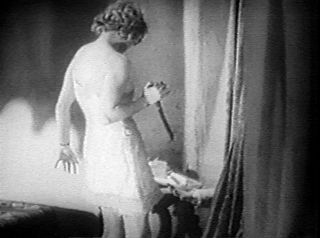
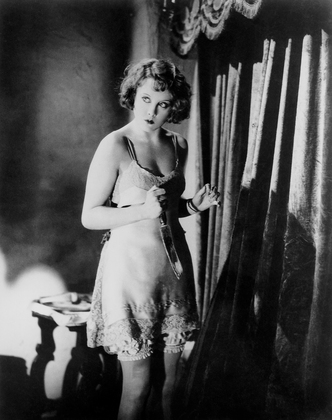
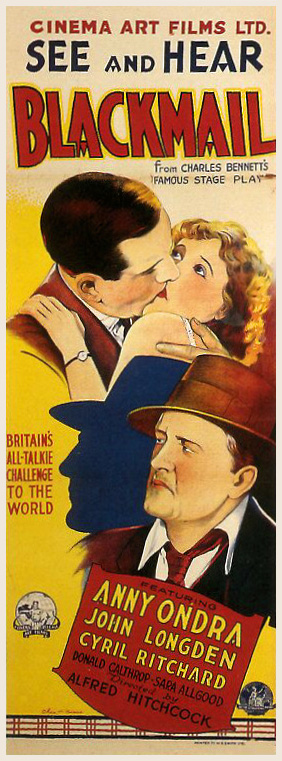
Blackmail
Great Britain, 1929 Director: Alfred Hitchcock
The extraordinary plateau attained by Hitchcock’s first sound film in relation to his overall development is the sum of many accomplishments: above all, a decisive mastery in moving back and forth between objective and subjective narrative modes. If the point-of-view is one of the cornerstones in Hitchcockian syntax, the film quite likely represents the first time in the director career that it is woven so seamlessly into a plot that all notions of stylistic “touches” gives way to a sustained psychological density. Beginning virtually like a documentary, Blackmail provides a quick foretaste of subjective truth in its early glimpses of the anonymous criminal, which subtly veer from the police’s viewpoint to his own – shifting, that is, from one kind of fear and apprehension to another. The complex overtones and ambiguities of the film are informed throughout by this kind of duplicity and intimacy, which oblige us to identify with rapist along with potential victim, murderer along with corpse, and detective along with blackmailer, at the same time as we are asked to regard them all with a certain amused skepticism. Read more
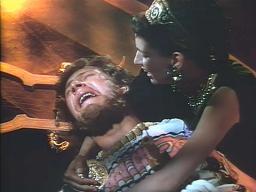
“Is this the end of Nero?” cries Peter Ustinov towards the end of his superbly hammy death scene in Quo Vadis (1951). I can’t recall anyone ever accusing director Mervyn LeRoy, one of Sam Fuller’s favorite directors, of being an auteur, but this clear reference to Edward G. Robinson’s “Is this the end of Little Rico?” in LeRoy’s Little Caesar suggests some kind of sly skullduggery. Even more, I wonder if Ustinov’s eye-rolling Nero occasionally made some of the participants at MGM on this picture think of Louis B. Mayer, just as Leo Genn’s Petronius (see below) might have occasionally suggested Dore Schary.
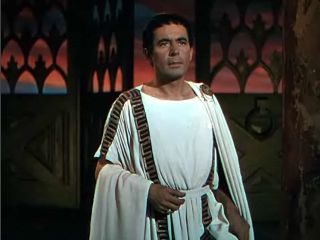
The culmination of this three-hour spectacle, based on an international best seller (1895) by a Polish Nobel prizewinner is, of course, Christians getting thrown to the lions or roasted at stakes as scapegoats for Nero having recently burned down Rome so he could write a tacky musical poem about it — leading Petronius, his main yes-man, after suavely slitting his wrist, to dictate a witty, urbane letter to his studio head in his dying breath, proclaiming that it’s perfectly okay to wipe out the multitudes, but does he have to produce bad art in the bargain? Of course the Roman masses don’t mind at all about filling up the gigantic stadium to be amused and entertained by the slaughter of these Jewish martyrs, which they’re happy to cheer and laugh at, at least until Robert Taylor tells them not to and to cheer the overthrow of Nero instead. Read more