Fiddle-diddle-dee, fiddle-diddle-day,
All the mice are feeling gay,
Fiddle-diddle-dee, fiddle-diddle-day,
Herman’s gone this way.
And which way is that? Surely not the gay way if it’s any way at all. All the characters in these awful 1950s Herman and Katnip cartoons, at least all the mice and the single predatory and macho cat, are male, and sex is the very last thing on their minds. The cat wants to eat the mouse and the mouse wants to torture the cat, but rightly or wrongly, neither eating nor torturing is being presented as a sexual activity. Territorial privilege and imperial dominance are what’s on the limited menu.
Fiddle-fiddle-dee, fiddle-diddle-dough,
He’s the bravest mouse we know,
Fiddle-diddle-dee, fiddle-diddle-die,
Herman’s quite a guy.
Can a mouse be a guy? If not, why not? tFiffle-diddle-dee, fiddle-diddle-day,
It’s just like a holiday,
Fiddle-diddle-dee, fiddle-diddle day,
Herman’s come to stay.

Come to stay where, exactly? In this episode, he and the other mice are actually on a train bound for Florida, “the vacation paradise,” on the “southern route” (Indeed, this particular cartoon is called “Rail-rodents”.)
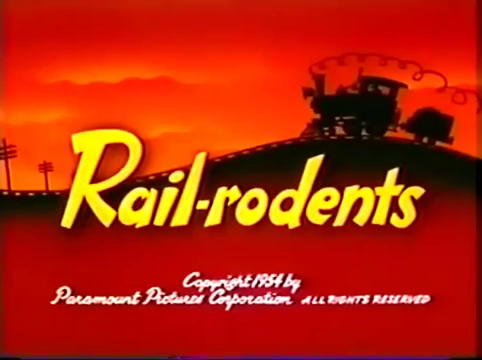
Katnip, now bagless, but stretched out with a pillow on a slat directly below the mice’s RR car, is still in pursuit. So if he’s left the house, so has his prey. Read more

From the May 6, 2002 Chicago Reader. — J.R.
Since I regard Claude Chabrol’s quintessentially French La femme infidele (1968) as one of his greatest films — making it all the more unfortunate for us (and fortunate for the authors of this remake) that it’s been unavailable for years — I was fully prepared to detest the Adrian Lyne version. Yet for roughly the first half of this 124-minute feature, I was pleasantly surprised, especially by the decisive shift in emphasis from husband to wife. Diane Lane, as the unfaithful wife of Richard Gere, gets to show off her magnificent legs at every opportunity — especially but not exclusively on her trips from her suburban home to the Soho loft of a young French hunk (Olivier Martinez) who sells rare books — and Lyne’s fancy cutting, honed on and still often resembling TV commercials, keeps this sensual in a way that the Chabrol movie never was. But then violence, guilt, and the husband’s viewpoint take over, Lane’s legs are sheathed, and the movie doesn’t have a clue about how to proceed. The original was a classically balanced and ultimately very satisfying work held in place by Chabrol’s love-hatred for bourgeois domesticity; the remake doesn’t reflect anyone’s love or hatred for anything, just a lot of anxiety about test marketing, which means it takes a nosedive when it goes shopping for an ending (I counted several, all of them ham-fisted). Read more