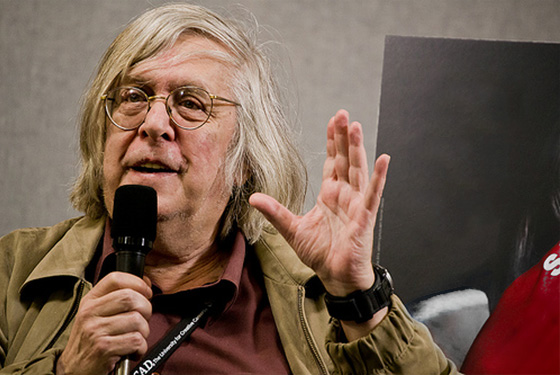
Two aggressive, enjoyable, and highly original videos by Chris Petit, the English novelist and filmmaker (Radio On, Flight to Berlin). Both these portraits of somewhat legendary and cultish media figures were made for BBC TV, a much more enterprising purveyor of edgy television than anything found in this country. But otherwise the videos are quite different. The Falconer (1998, 56 min., codirected by Ian Sinclair) is the more eclectic and difficult of the two, a sort of pseudodocumentary about the countercultural English filmmaker (Daddy) and autodidact Peter Whitehead. Negative Space (1999, 39 min.) is about American film critic, painter, teacher, and carpenter Manny Farber (though American art critic Dave Hickey also appears, along with many film clips and western landscapes that are often glimpsed in Polaroid-framed split screens). Both videos are wild, thoughtful, invigorating, eye-filling, and unusually ambitious. Admission is free. (JR) Read more
Virtually all the works of Belgian filmmaker Chantal Akerman are worth seeing, and her 78-minute video documentary (1999) about Jasper, Texas, is no exception. But this meditation on the American south can’t be described as one of her finer efforts; so the implied link with From the East, one of her greatest films, is unfortunate. Akerman’s painterly instincts are as strong and rewarding as ever, but when she tries to move beyond them the results are often trite. Akerman’s theme was overtaken by a horrifying hate crime that occurred a few days before her arrival, in which a black man was beaten, chained to a truck, and dragged three miles to his death through a predominantly black neighborhood. Akerman interviews various locals about the incident (omitting her questions from the film), but apart from their defensiveness the responses are unilluminating. There’s a lovely shot moving through downtown Jasper at dusk, but on the whole Akerman seems to be floundering, unable to say or reveal anything fresh about the south. When she concludes with the camera moving down the three miles of road, there’s a disquieting clash between the beauty of the shot and the horror of what it signifies, but all she can do is bear mute witness to the crime. Read more
Lea Pool’s sensitive coming-of-age feature (1999, 94 min.), set in and around Montreal in 1963, is apparently autobiographical in inspiration. The 13-year-old heroine (Karine Vanasse), who has her first period while visiting her grandmother in the opening sequence, is the illegitimate daughter of a struggling Jewish writer (Miki Manojlovic) and a Catholic who works as a seamstress to help support the family (Pascale Bussieres); her unlikely role model is the prostitute heroine played by Anna Karina in Godard’s Vivre sa vie, and her sexual stirrings gravitate toward both her older brother and a female classmate, who also attract each other. Nicely acted and inflected, this is a very fresh piece of work. (JR) Read more
Russell Crowe stars as a Roman general asked by the dying emperor, Marcus Aurelius (Richard Harris), to take over as ruler. The emperor’s wrathful son (Joaquin Phoenix) promptly orders the execution of the general and his family; surviving as a gladiator, the general fights his way back to Rome to take revenge and restore justice in the Colosseum. Though the digital effects lack the weight and conviction of their equivalents in old Cecil B. De Mille movies, Ridley Scott’s sword-and-sandal epic has some of the intensity of old Hollywood in terms of storytelling, spectacle, and violenceConnie Nielsen and Oliver Reed make especially strong contributions. But don’t expect anything as good as Spartacus or as enjoyably silly as Quo Vadis? The script, by producer David Franzoni, John Logan, and William Nicholson, is serviceable but not exactly inspired. 154 min. (JR) Read more
A beautiful restoration of the 1924 silent version, one of the loveliest movies for and about children ever made. Though he’s forgotten now, director Herbert Brenon was a formidable figure in the teens and 20s, also known for his work with Annette Kellerman and Theda Bara, his subsequent James Barrie adaptation A Kiss for Cinderella, and his 1926 adaptations of Beau Geste and The Great Gatsby. Peter Pan also benefits from a script by Willis Goldbeck, the superb cinematography of James Wong Howe, and some very charming special effects by Roy Pomeroy, the same man who parted the Red Sea in De Mille’s 1923 The Ten Commandments. The cast includes Betty Bronson in the title role, Ernest Torrence as Captain Hook, and Anna May Wong as Tiger Lily. (My own favorite is the only carryover from the stage production, George Ali as Nana the dog.) David Drazin will provide piano accompaniment and, judging from what he played at the preview, this will be a wonderful enhancement, especially sensitive when it comes to dealing with Tinkerbell. Children under 12 will be admitted free when accompanied by an adult. 105 min. Univ. of Chicago Doc Films, 1212 E. 59th, Thursday, May 4, 7:00, 773-702-8575. Read more
I’ve been late in catching up with Sadie Benning’s magnum opus to date (1998)–a 50-minute black-and-white video shot on both film and Pixelvision in Milwaukee, concentrating on the inner life of an androgynous 11-year-old girl–but it’s certainly everything I hoped it would be. It begins and ends with a montage of rusty urban landscapes that uncharacteristically recalls the work of her father, James Benning, but the really startling thing about this video is that all the characters wear strikingly painted, life-size masks, which gives a kind of surrealist overlay to the feeling of intimacy captured by Benning’s uses of Pixelvision. Her mode is still autobiographical/confessional, but the use of fiction gives her a lot more freedom, accounting for not only the masks but some animation as well. Gender issues are still at the forefront of her concerns, widened here to include the relations between family members and playmates as well as friends and lovers, and the lyricism of Benning’s angle of vision remains as weird and wonderful as ever. 57 min. Film Center, Art Institute, Columbus Drive at Jackson, Thursday, May 4, 7:30, 312-443-3737. –Jonathan Rosenbaum Read more
A bold experiment from Mike Figgis, at once fun and infuriating. The film’s undercut by an overblown satirical plot and grotesquely thin characters that suggest Robert Altman at his worst; you can barely laugh without feeling either glib or stupid. In 93 minutes of real time, four digital cameras simultaneously shoot the trajectories of various characters who have some connection to auditions for a stupid-sounding movie on Hollywood’s Sunset Boulevard and a pitch being made for another movie (which approximates this one); we view the results of all four cameras at once while hearing enough to follow the main strands of the plot, which mainly have to do with who’s sleeping with whom. The action, which features a series of earthquake aftershocks, is synchronized with stopwatches, but the dialogue is improvised. The cast includes, among many others, Figgis regular Saffron Burrows, Holly Hunter (mainly wasted), Richard Edson, Salma Hayek, Kyle MacLachlan, Laurie Metcalf, Mia Maestro, Julian Sands, Stellan Skarsgard, and Jeanne Tripplehorn. (JR) Read more
Joe Gould’s Secret
This charming and evocative period piece about Greenwich Village in the 40s is also a subtle cautionary tale for writers against the danger of losing all your work in talk. The delicate and wryly witty screenplay by Howard A. Rodman, perhaps best known for his work with Steven Soderbergh, tells the true story of shy southern New Yorker editor Joseph Mitchell (Stanley Tucci, who also directed) discovering and profiling the legendary Joe Gould (Ian Holm in a career-defining performance). Gould, a homeless bohemian and raging lunatic–kind of a Mr. Natural before the fact–professes to be writing something called “The Oral History of Our Time,” but it never quite materializes. The fact that Mitchell himself retreated into silence after writing a second Gould profile in the 60s suggests either that Gould’s dissipation had a snowball effect or that Mitchell became Gould’s doppelganger. Either way, this is a movie to savor, not one to scarf. With Patricia Clarkson, Hope Davis, and Susan Sarandon. Fine Arts.
–Jonathan Rosenbaum Read more
An Australian journalist (Rachel Griffiths) who’s pushing 40 wonders what her life would have been like if she’d married her boyfriend, had kids, and settled down to a more conventional existenceand lo and behold, she turns into a woman who’s done precisely that and finds out. In her feature debut, writer-director Pip Karmel, who worked as an editor on Shine, brings a fair amount of sincerity but very little originality to this good-natured comedy, apart from a willingness to include graphic gags about such domestic chores as inserting a diaphragm and teaching toilet training. Some women viewers may respond more favorably than I did; I found this easy to take but ultimately rather aimless.104 min. (JR) Read more
An imprisoned bank robber (Paul Newman) fakes a stroke in order to get transferred to a nursing home, where he’s put in the care of a former beauty queen (Linda Fiorentino) who’s locked into a dull marriage with her childhood sweetheart (Dermot Mulroney). She takes a shine to her new charge and asks him to help make her life more interesting. Without ever containing the spark of such late Newman vehicles as Nobody’s Fool and Twilight, this caper movie starts off as enjoyable guff before turning strictly formulaic and winding up as unenjoyable guff. Marek Kanievska (Another Country, Less Than Zero) directed a screenplay by E. Max Frye, Topper Lilien, and Carroll Cartwright. 88 min. (JR) Read more
In his directorial debut, actor Edward Norton plays a Catholic priest who, along with his best friend, a rabbi (Ben Stiller), falls for a woman (Jenna Elfman) whom apparently neither of them can marry. This isn’t quite a comedy, but the overall mood is light and warm and the charm of the three leads makes it a movie worth seeing. As a director, Norton bites off more than he can chewhe doesn’t seem to know how to handle sight gags, and some material about Stiller’s unseen brother suggests that either Stuart Blumberg’s screenplay is disjointed or a lot of footage got discarded. The handling of New York settings is pretty good, and so are the costars, including Anne Bancroft, Eli Wallach, and Milos Forman in parental and/or avuncular parts. 128 min. (JR) Read more
Jack Smith directed this 1963 experimental film centered on his love of B-movie star Maria Montez. Not really a finished work, judging from the previous versions I’ve seen, but a rollicking piece of Smithiana just the same. (JR) Read more
A beautiful restoration of the 1924 silent version, one of the loveliest movies for and about children ever made. Though he’s forgotten now, director Herbert Brenon was a formidable figure in the teens and 20s, also known for his work with Annette Kellerman and Theda Bara, his subsequent James Barrie adaptation A Kiss for Cinderella, and his 1926 adaptations of Beau Geste and The Great Gatsby. Peter Pan also benefits from a script by Willis Goldbeck, the superb cinematography of James Wong Howe, and some very charming special effects by Roy Pomeroy, who parted the Red Sea in De Mille’s 1923 The Ten Commandments. The cast includes Betty Bronson in the title role, Ernest Torrence as Captain Hook, and Anna May Wong as Tiger Lily. (My own favorite is the only carryover from the stage production, George Ali as Nana the dog.) 105 min. (JR) Read more
Alexei Guerman’s mad, brilliant sequel to My Friend Ivan Lapshin (1982) was begun when the Soviet Union still existed and completed in 1998 with finishing money from France. Set in 1953, during the last days of Stalin’s regime, it has a narrative of sortsthe central character is a brain surgeon and former alcoholic Red Army general who’s sent to the gulag during the anti-Semitic doctors purge and released in a last-ditch effort to save Stalinbut one generally experiences it more as a visionary nightmare. Filmed in high-contrast, deep-focus black and white, in cluttered, claustrophobic interiors and snowy exteriors, often in long takes and with a moving camera, it suggests The Magnificent Ambersons, especially in the way its baroque mise en scene is organized around a subjective camera and various activities in the foreground. But its overall ambience certainly isn’t nostalgic as with the Welles film; it leaves one with a corrosive and unforgettable whiff of the Stalinist era. (JR) 137 min. Read more
James Earl Jones and Lynn Redgrave star as mutually insane neighbors in a California apartment house who become romantically involved (she thinks she’s sexually intimate with Puccini, and he periodically wrestles with a demon of his own named Hank). Charles Burnett (Killer of Sheep, The Glass Shield) directed this whimsical, bittersweet 1999 feature, handling the actors with sensitivity, but the preciousness of Anthony C. Winkler’s screenplay, adapted from his own novel, only underlines how much better off Burnett is writing his own scripts (Nightjohn being an exception). With Margot Kidder. 108 min. (JR) Read more