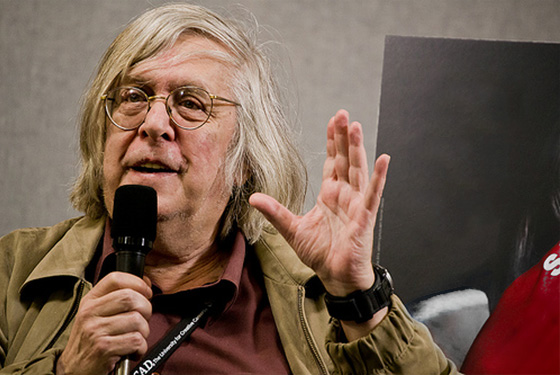
A disappointing hour-long profile (1978) of the maverick producer-director by Christian Blackwood that unhappily never strays far from a strictly promotional skim job. The interviews with various Corman regulars and alumniAllan Arkush, Paul Bartel, David Carradine, Joe Dante, Jonathan Demme, Peter Fonda, Ron Howard, Jonathan Kaplan, and Martin Scorseseas well as Corman himself never dig very deeply. And the decision to restrict the film mainly to Corman’s then-recent films leaves many lacunae; early interesting effortssuch as Rock All Night and The Stranger, Corman’s one serious venture into social problems, specifically racism and the civil rights movementgo completely unmentioned. (JR) Read more
A fascinating 1985 documentary by Christian Blackwood about the shooting of a TV film of Death of a Salesman, focusing on the creative deliberations of director Volker Schlondorff, actor Dustin Hoffman, and playwright Arthur Miller (the latter two served as executive producers). Blackwood mainly addresses some of the technical and aesthetic problems involved in translating a stage work into film, although the personalities and quirks of the participants (including actors John Malkovich, Charles Durning, Stephen Lang, Kate Reid, and Miller’s Crossing’s Jon Polito, as well as cinematographer Michael Ballhaus) also play a substantial role. The presence of Blackwood’s camera and microphone raises the question of how much this documentary is producing or alteringas opposed to merely recordingthe behavior and deliberations that we’re privy to. (JR) Read more
A gifted, asocial teenager with a brain tumor (Zachary Ansley) spends a summer at a camp for children with cancer and gets his attitudes turned around, in a sensitive, touching, and far from depressing drama from Canada, directed by Giles Walker from a screenplay by Joe Wiesenfeld, adapted from Mark Schreiber’s novel of the same title. The characters (all of them campers and staff members) are realized with a great deal of depth and feeling, and the film never caves in to sentimentality or cliche; the thematic focus is how to deal purposefully and honestly with cancer, but what really commands respect here is the varied group of people we’re introduced to. The cast, uniformly effective, also includes Nicholas Shields, Stacie Mistysyn, Andrea Roth, Gordon Woolvett, Alexander Chapman, and Chuck Shamata. (JR) Read more
A battered rodeo bull rider (Scott Glenn) returns to his hometown in Oklahoma and tries to settle down, removing his father (Ben Johnson) from an old folks home, despite the objections of his sister (Tess Harper), and resuming a relationship with his high school girlfriend (Kate Capshaw), now a widow with two kids. Most of this is very familiar stuff, with rodeo sequences serving as the story’s bookends, but some of the performanceswhich also include turns from Gary Busey, Mickey Rooney, Clarence Williams III, and Balthazar Gettykeep it moderately watchable if your expectations aren’t too high. Stuart Rosenberg (Cool Hand Luke, The Pope of Greenwich Village) directed from a script by novelist and songwriter Joel Don Humphreys, with location cinematography by Bernd Heinl. (JR) Read more
At the end of a day when more than 1,000 allied bombing missions had been carried out against Iraq and Kuwait, ABC’s Ted Koppel said, Since that Scud missile hit Tel Aviv earlier today, it has been a quiet night in the Middle East. A comparable deafness and blindness to the fate of nonwhites led the former personal secretary of Nancy Reagan to give airplanes and 2,4-D herbicide to Burma’s brutally repressive, totalitarian military regimesupposedly to wipe out opium fields. In fact, the gifts were also used against students and ethnic rebels of the National Democratic Front; food crops, cattle, people, and water supplies were sprayed in an effort to quell the civil war that has been raging in Burma for decades. The complexity of a situation in which one of the most prominent apparent rebels is an opium warlord commanding about 12,000 troops in his fight for the independence of the Shan state wasn’t lost on Brian Beker, the producer, director, and narrator of this fine hour-long documentary, filmed at great risk in 1989. The film also offers videotape coverage of the 1988 uprising, when around 15,000 civilians were slaughtered by government troops. As an introdution to some of the intricacies of a revolution in the largest country in Southeast Asia, with a population of 40 millionas well as some insight into what the noble intentions of the U.S. Read more
John Goodman is a sleazy Las Vegas piano player who winds up as king of England, in a rather Neanderthal comedy written and directed by David S. Ward, adapted from Emlyn Williams’s novel Headlong, that relies more on easy jokes (including a racist episode involving a spear-chucking African king) than anything resembling inventiveness. A very tired looking Peter O’Toole stars as the new king’s personal secretary, and an equally uncomfortable John Hurt plays a lord who plots his downfall; Camille Coduri plays the commoner and would-be stripper whom the hero falls in love with. I certainly have no objections to low comedy, and Goodman is game enough, but the script and direction are so witless that by the end I was longing for Rodney Dangerfield and Jim Belushi. (JR) Read more
Set in a city 100 miles southwest of Shanghai, this is the autobiographical story of an American kung-fu expert (cowriter and star Mark Salzman) who comes to mainland China in 1982 to teach English. He falls for a young doctor (Vivian Wu), is tutored in Chinese customs and t’ai chi by a widow (Jeanette Lin Tsui), and eventually gets to study wushu (a form of martial arts) with a master (Pan Qingfu playing himself); he also encounters various difficulties as a foreigner coping with an alien society. Based on Salzman’s book of the same title, produced and directed by Shirley Sun (who collaborated with Salzman on the script), and filmed on location in China, this is in part an embarrassing vanity productionat least in appearancein which Salzman, a somewhat awkward actor, gets to show off his wushu, his cello playing, and diverse other skills and charms at length. However, the account of his difficulties adjusting to Chinese life is fascinating for what it reveals about contemporary China (1990). (JR) Read more
Larry Peerce’s coarsened adaptation of Philip Roth’s early satirical novella about a poor New Jersey Jew (Richard Benjamin) falling in love with the daughter (Ali MacGraw) of an upscale suburban Jewish family. With Jack Klugman, Nan Martin, and Michael Meyers (1969). (JR) Read more
For people like myself who still regard Woodstock as the great counterculture rock film, it’s depressing to note that most perceptions of the 60s consist of roughly one part Woodstock and 12 parts Gimme Shelter. It’s no surprise, then, that Oliver Stone’s 1991 biopic about rock guru Jim Morrison should give us about 15 minutes of peace and love (if that much) and two hours of puritanical retribution. According to Stone’s script (coauthored by J. Randal Johnson), Morrison (Val Kilmer) was an incoherent asshole with occasionally inspired poetic flashes, and the film’s double-edged celebrations of sex, bimbos, drugs, booze, and rock ‘n’ rollfull of pretentious hallucinations involving Native Americans and fancy visual effectsare laced with familiar evocations of fire and brimstone. Some of the effects are arresting, and apart from some unfortunate attempts to re-create Ed Sullivan, Andy Warhol, and Nico, the movie does a pretty good job with period ambience. But it’s a long haul waiting for the hero to keel over. With Meg Ryan, Kathleen Quinlan, Kyle MacLachlan, Frank Whaley, Kevin Dillon, Michael Wincott, and Michael Madsen. (JR) Read more
Theo Angelopoulos’s visually striking political thriller focuses on the events that transpire after a trade unionist is assassinated at a rally. A former police informer is arrested for the murder, and he manages to create a governmental crisis by holding a conservative MP as hostage in his prison cell. The film was made under threat of censorship, which, according to Angelopoulos, led him to change the film’s formal structure to emphasize what is unspoken; the attractive use of composition often suggests the work of Antonioni (1972). (JR) Read more
Vitaly Kanevski spent eight years in a Soviet labor camp on unspecified charges, attended film school, and worked as a production assistant on many films. He based this, his first feature, on his own youth in Siberia during World War II. Made on a minuscule budget, it deservedly won the Camera d’Or for best first film at Cannes in 1990. Many critics have compared it to Truffaut’s The 400 Blows, and despite the grimness of the subject, accentuated by the murky black-and-white photography and the harshness of the setting (a Siberian mining town), Kanevski’s feeling for the boy hero (Pavel Nazarov) and his resourceful female pal (Dinara Drukarova) has a related sensitivity and freshness. The efforts of these children to cope with the horrors around them–the nearby POW camp, the black market, the omnipresent mud and cold–often make them more than simple victims (1990). A Chicago premiere. (Film Center, Art Institute, Columbus Drive at Jackson, Saturday, February 2, 4:00, and Sunday and Thursday, February 3 and 7, 7:45, 443-3737) Read more
Holly Hunter’s best performance since Broadcast News: here she plays an Italian American still neurotically tied to her parents (Danny Aiello and Gena Rowlands) who’s looking for romance in her hometown of Boston. It’s a comedy with tragic undertones well scripted by Malia Scotch-Marmo and effectively directed by Lasse Hallstrom (My Life as a Dog); Laura San Giacomo plays her just-married younger sister, and Richard Dreyfuss plays the vulgar, assertive condo salesman from a Lithuanian family background who sweeps Hunter off her feet. Beautifully acted by all the leads (Hunter and San Giacomo have especially good broad Bostonian accents), sensitive and acute about family dynamics, this is a first-class entertainment that goes through some unexpected changes of tone (rather like Terms of Endearment) without ever losing its footing; the focus on family interactions is so concentrated that we never see much of the characters beyond this context, but they’re so well defined and developed that it hardly matters. With Roxanne Hart and Danton Stone. (900 N. Michigan) Read more
My favorite of Charles Burnett’s three features (the other two are Killer of Sheep and To Sleep With Anger) focuses on the family pressure exerted on a young man in Watts (Everett Silas) who works at his parents’ dry cleaners–pressure to abandon his disreputable ghetto friends and adjust to a more middle-class existence. This struggle is pushed to the limit when he has to choose between attending his older brother’s wedding to a woman from an affluent family and attending the funeral of his best friend, a former juvenile delinquent. Burnett’s acute handling of actors (most of whom are nonprofessionals) never falters, and his gifts as a storyteller make this a movie that steadily grows in impact and resonance as one watches. If a better film has been made about black ghetto life, I haven’t seen it (1983). (Facets Multimedia Center, 1517 W. Fullerton, Friday and Saturday, January 11 and 12, 6:30 and 9:00; Sunday, January 13, 5:00 and 7:30; and Monday through Thursday, January 14 through 17, 6:30 and 9:00; 281-4114) Read more
The first feature (1978) of the highly talented and singular black filmmaker Charles Burnett, all of whose films (including My Brother’s Wedding and To Sleep With Anger) are based in Watts; this one deals episodically with the life of a slaughterhouse worker (Henry Sanders). Shot on weekends over a year on a minuscule budget (less than $20,000), this remarkable work was recently selected for preservation by the National Film Registry as one of the key works of the American cinema–an ironic and belated form of recognition for a film that still has had virtually no distribution and has seldom been seen. It shouldn’t be missed. (Facets Multimedia Center, 1517 W. Fullerton, Friday and Saturday, January 4 and 5, 7:00 and 9:00; Sunday, January 6, 5:30 and 7:30; and Monday through Thursday, January 7 through 10, 7:00 and 9:00; 281-4114) Read more
It’s possible that a good half of the greatest African movies ever made are the work of novelist-turned filmmaker Ousmane Sembene (Black Girl, Xala, Ceddo). Camp Thiaroye, his first feature in 11 years, cowritten and codirected by Thierno Faty Sow, recounts an incident that actually occurred in 1944. Returning from four years of European combat in the French army, Senegalese troops are sent to a transit camp, where they have to contend with substandard food and other indignities. An intellectual sergeant major (Ibrahima Sane) gets thrown out of a local bordello when he goes there for a drink; mistaken for an American soldier, he is arrested and beaten by American MPs, which provokes his men into kidnapping an American GI. Then when the Senegalese troops discover that they’re about to be cheated out of half of their back pay, they launch a revolt. Leisurely paced, with some talky stretches devoted to debates among the soldiers, this lengthy feature is neither a simple tract nor a loose, undisciplined fresco, but a novelistic (and often witty) treatment of a complex subject in which all the characters get their due. Sane is especially fine, but the other characters–including a mute and traumatized Senegalese survivor of Buchenwald and a sympathetic if naive white officer–are delineated with comparable depth. Read more