From the title this sounds like a leftover from the heyday of American International Pictures, but it was released in 1989. Featuring tight jeans, black leather, female bonding, old-time religion, explosions, and a mad-scientist mortician with a dwarf assistant; you can figure out the rest. Dan Hoskins directed; with Jamie Rose, Catherine Carlen, Lycia Naff, Vicki Frederick, and an early appearance by Billy Bob Thornton. (JR) Read more
Silly but nicea marijuana farce featuring Cheech Marin and Thomas Chong as spaced-out dealers working out of an ice-cream van, Stacy Keach as the cop on their trail, and Evelyn Guerrero as the romantic/sexual interest. Chong directed (1981). (JR) Read more
Perhaps the biggest revelation here is how advanced the British are in the specialized area of claymation, particularly when it comes to using this technique to delineate character. (A substantial amount of this work comes from TV commercials, though perhaps the best in the lot, saved for last, is Nick Park’s 1989 Oscar nominee Creature Comforts, a short in which zoo animals describe their living conditions.) Unfortunately, the length of the program presents some problems; 110 minutes of compressed bombardment ultimately becomes a kind of punishment, regardless of how good the work is. But taken in reasonable doses, this is mainly delightful. Among the more prominent animators are David Stone, Peter Lord, Candy Guard, Joanna Quinn, David Anderson, and Richard Ollive, who contributes a lovely re-creation of a turn-of-the-century comic strip that recalls Winsor McCay. (JR) Read more
A threadbare comedy from Universala sequel to Bedtime for Bonzo without Ronald Reagan but with the same chimp and the same director (Frederick de Cordova). With Maureen O’Sullivan, Charles Drake, and Edmund Gwenn (1952). (JR) Read more
Kurt Russell and William Baldwin star as fire-fighting brothers in Chicago carrying on the tradition of their late father, in an action picture written by former firefighter Gregory Widen and directed by Ron Howard. While Russell is at his best, creating a character of some density and mystery, Baldwin mainly registers like a cavity on the screen; his character seems both underwritten and uninhabited. Howard, as usual, seems bent on mixing genres to make several movies at oncemonster movie, crime movie, coming-of-age movie, and action-adventure movie (among others)yielding an overall narrative that’s not boring but not especially suspenseful or focused either. Visually speaking, the film does pretty well with fire-as-spectacle, less well with everything else (Howard tends to trot out fuzzy-toned Spielbergian backlighting on any pretext). With Scott Glenn, Jennifer Jason Leigh (basically wasted), Rebecca De Mornay, and Donald Sutherland and Robert De Niro, both working minor wonders with their limited parts. (JR) Read more
This time Woody Allen’s irresolute, neurotic, and masochistic stand-in protagonist is Alice Tate (Mia Farrow), a very upscale housewife and lapsed Catholic with an unappreciative husband (William Hurt). She goes to a Chinese herbalist for a bad back and gets more than she bargained forincluding hypnosis and a magic potion that makes her invisiblewhich finally pushes her into having a tentative affair with a musician (Joe Mantegna). The thematic sources this time appear to be Fellini’s Juliet of the Spirits and Topper, although when the heroine briefly sprints off to India to join Mother Teresa, Allen borrows a clip from Louis Malle’s Calcutta. Weak and predictable, this comedy differs from earlier Allen forays only in that its ethnocentric limitations are more glaring than usual: the Chinese sage, played by one of Charlie Chan’s number one sons (Keye Luke), is encouraged to speak a kind of pidgin English that would have been offensive even in the 30s, and needless to say, we hear a lot of Limehouse Blues on the sound track. As usual, there are many good actors present in small rolesincluding Blythe Danner, Bob Balaban, and Gwen Verdonand they’re invariably wasted (1990). (JR) Read more
Chicago filmmaker Tom Palazzolo’s sequel to his semiautobiographical Caligari’s Cure, featuring Chicago performance artists Carmella Rago, Jim Grigsby, Lynn Book, Michael K. Meyers, Ellen Fisher, Jack Helbig, Kapra Fleming, and Liam Hayes. I haven’t seen its predecessor, but this free-form fan-tasy/absurdist vaudevillewhich leads its affectless young hero through some striking surrealist and expressionist sets as well as some Chicago locationsis much more enjoyable to look at than to think about or to follow as a consecutive (or even nonconsecutive) narrative. References to such movie landmarks as Les vampires, Un chien andalou, and The Blue Angel are scattered through this picaresque free-for-all (along with confetti, a painted lunch pail, and a bird cage, among other significant images), but the loosely satirical SF framework promises more than it delivers, and Palazzolo’s deft cutting and sense of visual extravagance rarely matches his dialogue or his direction of actors. On the same program, Hey Girls, a ten-minute short by Palazzolo and Heather McAdams described as a live-action comic strip. (JR) Read more
This first feature by Senegalese director Djibril Diop Mambety is one of the greatest of all African films and almost certainly the most experimental. Beautifully shot and strikingly conceived, it follows the comic misadventures of a young motorcyclist and former herdsman (Magaye Niang) who gets involved in petty crimes in Dakar during an attempt to escape to Paris with the woman he loves (Mareme Niang). The title translates as “hyena’s voyage,” and among the things that make this film so interesting stylistically are the fantasy sequences involving the couple’s projected images of themselves in Paris and elsewhere (1973). Cosponsored by Blacklight. (Univ. of Chicago, 1212 E. 59th St., Sunday, April 28, 5:00, 702-8575) Read more
Even this minor film from Max Ophuls has so much energy it makes the major work of figures like Spielberg and De Palma shrink to virtual nothingness. Ophuls was effectively imported to the Netherlands to make this 1936 feature to help beef up the lackluster Dutch film industry. Based on an original Ophuls story (and coscripted by Walter Schlee, Alex de Haan, and Christine van Meeteren) and featuring songs and commentary from a neo-Brechtian clown who stands outside the plot, the film describes the misadventures of a bank courier (Herman Bouber) who is robbed of bank funds and fired, only to be appointed as head of a finance company by crooked businessmen who believes that he has the stolen money. Rather light and on the cutesy side as narrative, this comedy is worth seeing mainly for the inventive mise en scene (with the great Eugen Schufftan as cinematographer); it’s full of unexpected camera angles and Ophuls’s usual delight in camera movement (watch for an especially giddy dream sequence). With Rini Otte and Cor Ruys. (Film Center, Art Institute, Columbus Drive at Jackson, Thursday, May 2, 6:00, 443-3737) Read more
From the Chicago Reader (April 12, 1991). — J.R.
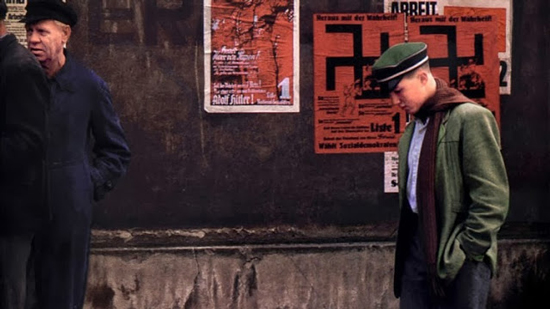
It’s a pity that Jerry Schatzberg’s most recent picture — and one of his very best — has had to wait two years for its Chicago premiere. Adapted by Harold Pinter from a novel by Fred Uhlman, and shot in ‘Scope by Bruno De Keyzer, this French-English-West German production is a story about a Jewish lawyer in New York (Jason Robards) who’s returning to Stuttgart, Germany, after a 55-year absence to discover what happened during the early 30s to his best friend (Samuel West) — an ambassador’s son who didn’t share the racism of his aristocratic family. Most of the story is told in flashback (Christien Anholt plays the hero as a youth), and much of what’s impressive about its unfolding is the meticulous re-creation of Germany during the rise of Nazism (the superb production design is by the great Alexandre Trauner, who appears in a cameo in a warehouse office), as well as a sensitive (and perhaps timely) depiction of how the gradual changes in national thinking were reflected in everyday life. It’s a story that’s been told before, but seldom with such feeling for detail and nuance; one has to adjust to the curious mix between English dialogue and street signs in German, but the performances — including those by Francoise Fabian, Maureen Kerwin, Barbara Jefford, and Bert Parnaby in small parts — are impeccable (1989). Read more
A genuine oddity from 1963 Czechoslovakia, long banned because of its satirical and antiauthoritarian tendencies, this fantasy in ‘Scope and color by Vojtech Jasny describes what happens when a magic show featuring a cat with a pair of eyeglasses turns up in a fairy-tale town. When the eyeglasses are removed, people are obliged to show their “true colors”–folks in love turn red, liars purple, thieves gray, betrayers yellow and the local schoolchildren see through the duplicity of the adults for the first time. To complicate matters, the magic show and cat are described in advance by a salty local layabout (Jan Werich) who serves as a sort of narrative equivalent to the stage manager in Our Town and who entertains schoolchildren with his tales while serving as their art-class model; when the magic show and cat arrive in the town, the magician is played by the same actor. Whimsical, likable, and inventive, if never wholly successful, this colorful cross between the Pied Piper and Bye Bye Birdie qualifies as one of the best early examples of the Czech New Wave; significantly, Ivan Passer worked on it as an assistant. Also known as That Cat… and One Day a Cat; with Vlastimil Brodsky and Jirina Bohdalova. Read more
A womanizing male chauvinist (Perry King) is killed by three of his former conquests, reincarnated in the body of a woman (Ellen Barkin), and told he can enter heaven if he can find one female who likes him. Writer-director Blake Edwards in a burned-out mode seems so taken with this rickety concept that he hasn’t bothered to flesh it out with characters or much of a plot; it’s merely a soapbox from which he can deliver a few would-be feminist gibes. Ellen Barkin copes resourcefully with the limited material, but the rest of the cast — Jimmy Smits, JoBeth Williams, and Lorraine Bracco — is left high and dry (1991). (JR) Read more
Chuck Workman’s entertaining 1990 documentary about Andy Warhol disappoints only if you’re looking for something more than a good, breezy account of the life and times of Warhol, as well as the scene and mystique — don’t expect much information about or insight into the specifics of his art, his filmmaking, or his intelligence. Among the many people interviewed are Bob Colacello, Henry Geldzahler, Dennis Hopper, Sally Kirkland, Fran Leibowitz, Roy Lichtenstein, Gerard Malanga, Taylor Mead, Sylvia Miles, Bobby Short, Ultra Violet, Viva, and Holly Woodlawn, as well as several members of Warhol’s family. (JR)
Read more
Also known by the French title Paris vu par . . . , this is probably the best of the French New Wave sketch films (1964). Six directors are assigned separate sections of Paris, and each sketch is shot in 16-millimeter. The most powerful episodes are those by Jean Rouch (one of his few purely fictional works, shot documentary style in only one or two takes and costarring the future director of Reversal of Fortune, Barbet Schroeder) and Claude Chabrol (a convulsive bourgeois family melodrama featuring Chabrol himself and his then-wife Stephane Audran). Eric Rohmer contributes a mordant and well-crafted story set around l’Etoile, and the interesting if uneven Jean-Daniel Pollet, whose other films are woefully unavailable in the U.S., is represented by a bittersweet comic short starring the Harry Langdon-like Claude Melki. Jean Douchet (best known as a Cahiers du Cinema critic) offers a fairly undistinguished depiction of a Left Bank seduction, and Jean-Luc Godard presents a more detailed version of a story told in his feature A Woman Is a Woman, shot by Albert Maysles and starring Joanna Shimkus. Like most sketch films, this is patchy, but the Rouch, Chabrol, and Rohmer segments shouldn’t be missed. (JR) Read more
Not the Kevin Costner feature or the Alain Delon Mafia thriller, but a much better movieJoseph L. Mankiewicz’s hard-hitting, action-packed 1950 melodrama about a young black doctor (Sidney Poitier in his film debut) and a white gangster (Richard Widmark) who provokes a race riot after Poitier fails to save his brother’s life. Made long before such a theme was fashionable in Hollywood, this benefits from Mankiewicz’s flair for snappy dialogue and strong performances by the leads and secondary cast, which includes Linda Darnell, Stephen McNally, Ruby Dee, and Ossie Davis. 106 min. (JR) Read more